
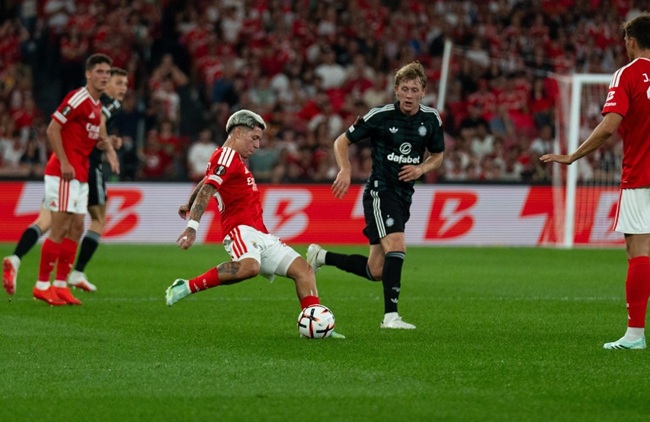
Gianluca Prestianni has been called the next Messi since he was 16. At 20 he is finally playing like somebody. The question is whether that somebody needs to be Messi at all.
On 14 November 2025, in Luanda, Argentina beat Angola 2-0 in a friendly. Lionel Messi set up the first goal for Lautaro Martínez and scored the second himself, in what was his 196th game for his country. Late in the match a 19-year-old winger from Benfica came on for Nico González and won his first cap. He is 1.66m tall, quick, happiest with the ball at his feet and running at a full-back, and for two years people had been calling him the next Messi. That evening the two names were on the same team sheet. Only one of them made the headlines, which is roughly how the comparison has always gone.
Prestianni was born in Ciudadela, on the western edge of Buenos Aires, on 31 January 2006, to a family of Italian descent. He joined Vélez Sarsfield’s academy at four. According to Benfica, he became the youngest player ever to appear for Vélez’s first team, at 16 years, three months and 22 days. By late 2023 English-language websites were running headlines about Real Madrid and Barcelona “missing out on the next Lionel Messi”. The club that did not miss out was Benfica, which agreed a fee of €9 million plus up to €2 million in add-ons for 85% of his economic rights, leaving Vélez a 15% share of any future sale. Because of FIFA’s rules on minors, the deal could only be completed once he turned 18, and Benfica announced it on his birthday.
The move was not only about football. In an interview with the Argentine channel DSports a few months later, he said that after threats he and his family could not stay in Argentina. In the same interview he was asked whether he saw himself as the heir to Ángel Di María, Benfica’s other Argentine winger. He said it was nice to be compared with a world champion but that it was probably just because they played in the same position, and that he did not even reach Di María’s heels. It is not the answer of someone who believes his own press.
Two slow years
For a while, the press looked premature. Prestianni made his Benfica debut as a substitute in a 1-1 draw at Rio Ave in May 2024. The following season brought 14 appearances and a single goal, in a Taça de Portugal semi-final against lower-league Tirsense, plus four games at the Club World Cup in the United States. In 2025-26 he played much more, 41 times in all competitions, but scored only three goals. In the autumn of 2025 he reached the final of the Under-20 World Cup in Chile with Argentina and lost it. A month later came that debut in Luanda.
Then came 17 February 2026. During a Champions League knockout play-off against Real Madrid at the Estádio da Luz, Vinícius Júnior accused Prestianni of calling him a monkey. The game was stopped for around ten minutes under UEFA’s anti-racism protocol. Prestianni denied making a racist remark. He was banned provisionally for the second leg in Madrid, and on 24 April UEFA handed him a six-match suspension, three of those matches suspended for two years, for discriminatory conduct that it judged to be homophobic. Prestianni had told UEFA that what he said was an anti-gay slur rather than a racial one. FIFA later extended the ban worldwide, and in May he was left out of Argentina’s World Cup squad, a decision parts of the press connected to the case. Any honest conversation about Prestianni’s future has to include that night. Most of the talk about the next Messi tends to leave it out.
The leap
What has happened since August is the reason this conversation is back. By Benfica’s own count, Prestianni has 12 goals and six assists in 20 official matches this season, against three goals in the whole of the previous one. In early November he had six goals and four assists in ten league games. He scored in a 7-0 win at Casa Pia, at Marítimo, at Moreirense and against Gil Vicente, and he scored and set up a goal in the 2-1 win at Santa Clara in late October. In the Europa League he made two goals against Celtic and scored away at Omonia Nicosia.
The players’ union named him the best player in the league for September. Then the league’s head coaches voted him forward of the month for September and October, ahead of André Clóvis of Académico de Viseu and his own team-mate Vangelis Pavlidis. In between, on 3 October at the Monumental in Buenos Aires, he scored his first goal for Argentina in a 7-0 win over Burkina Faso. Lionel Scaloni, it seems, has not stopped picking him.
The market has noticed. In November, TyC Sports reported that Paris Saint-Germain are interested, with Bayern Munich, Arsenal, Newcastle and Aston Villa also said to be watching. His release clause is reported to be €100 million. His contract runs to 2029, Benfica are said to want to extend it, and A Bola reported on 10 November that the club has no intention of selling key players in January.
So, the next Messi?
The short answer is no, and that is not a criticism of Prestianni. It is a statement about Messi.
At 18, Messi won the Under-20 World Cup with Argentina and took both the Golden Ball and the Golden Boot. Prestianni, at 19, lost the final of the same tournament without scoring. At 19, Messi scored a hat-trick against Real Madrid and then, about five weeks later, ran half the length of the pitch against Getafe to score a goal that looked like a copy of Diego Maradona’s against England. At 20 he finished third in the Ballon d’Or. Prestianni, at 20, has just won his first monthly award in Portugal. They are not even the same kind of player. Messi is left-footed and drifted inside from the right to become the centre of everything. Prestianni is right-footed and has mostly played wide on the right, where his job was to beat a man and deliver. Interestingly, his “explosion” this season has coincided with a switch of flanks. Presitanni has played mostly on the left, enabling him to cut inside and shoot for goal with his right foot, which he has done numerous times to spectacular effect.
There is also a simpler problem with the label. Football has been searching for the next Messi for nearly twenty years. Bojan Krkić, Alen Halilović and Takefusa Kubo all carried the tag at Barcelona at one time or another. Some became good players and one or two very good ones. None became Messi. And when Messi himself was a teenager, nobody called him the next Messi. They called him the next Maradona, as they had called a whole generation before him.
The Lisbon route
Benfica knows this pattern better than most clubs. Pablo Aimar, the player Messi has named as his childhood idol, and Javier Saviola, both once presented to the world as heirs to Maradona, ended up at the Estádio da Luz in the late 2000s, in the second half of their careers. Ángel Di María arrived from Rosario Central at 19 in 2007, left for Real Madrid in 2010, and went on to score in a World Cup final before coming back to Lisbon. Enzo Fernández spent six months at Benfica and was sold to Chelsea for €121 million.
That is the more useful comparison for Prestianni. Not the impossible one, but the Di María route: arrive young, take a couple of seasons to settle, become the best attacking player in Portugal, then go somewhere bigger with a real chance of being important there. On current evidence he is on that path.
What a model can and cannot say
At NerdyTips, a site that has published AI football predictions since 2021, questions like this come up in a different shape. Its model, NT Apex, is decent at the closed question. Before this season it had been right about 62 of 87 Benfica league games since January 2024, a little over seven in ten. A match has three possible results, a few days of team news and a lot of history behind it.
A career has none of those properties. It has injuries nobody can forecast, coaches who leave, transfers that come a year too early, and nights in February that change how the world sees a player. Forecasters start with base rates, and for the phrase “the next Messi” the base rate is clear enough: in two decades of looking, the number of players who became the next Messi is zero.
None of that makes Prestianni’s season less impressive. If anything, it makes it more interesting. Messi at 20 was already Messi. Prestianni at 20 is something more ordinary and in some ways more worth watching: a good young player getting better in public, in a league that has turned several Argentines into stars before him. Argentina spent twenty years looking for the next Maradona and ended up with someone else entirely. It might be kinder, and more accurate, to let Prestianni simply be the first Prestianni.
