
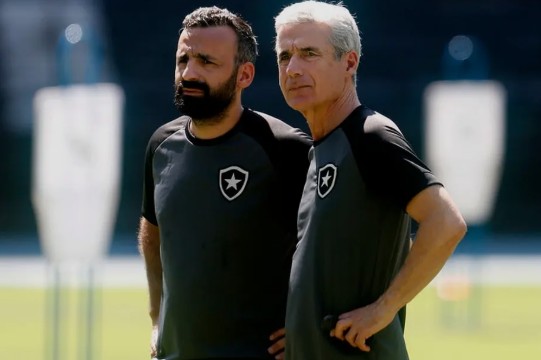
From Ukraine to Qatar, from the United Arab Emirates to Saudi Arabia to Brazil, Vítor Severino has coached in just about every corner in the world over the past seven years, but it was in Portugal where he first came to grips with management.
Born on 16 August, 1983, Vítor Severino grew up in the seaside parish of Ferrel before turning 18 and heading north for Coimbra University, where he graduated with a degree in sports science. Instead of returning home, he started teaching at the academy and coaching high school students and players in Académica de Coimbra’s youth ranks, with the generous support of his parents helping him to pursue his coaching dreams with an unpaid, part-time role. Similarly to others like Michael-John Tate, Severino was able to get his foot in the door with youth football coaching with Académica before eventually getting his big break and making the move to Porto, where he mentored future stars like Diogo Costa, Diogo Dalot, and Rúben Neves across his two years as an assistant coach for Porto’s U-15 and U-17 side. He then departed the Dragão in 2016 and followed outgoing Porto B manager Luís Castro to Rio Ave.
The rest, as they say, is history: Severino has spent the past decade as Castro’s assistant, guiding Rio Ave, Chaves and Vitória to top-six finishes before departing his homeland in 2019 and making the move to Shakhtar Donetsk, where they won the Ukrainian Premier League title in 2019/20. Spells at Qatari side Al-Duhail and Brazilian powerhouse Botafogo would follow before they linked up with Cristiano Ronaldo at Saudi giants Al-Nassr, lasting just over a year before being given the axe. And after a fleeting spell at Emirati outfit Al Wasl, they decided to return to Brazil at the end of 2025 and set up shop in Porto Alegre with Grêmio. PortuGOAL spoke to Severino.
You watched Portugal miss out on quite a few major tournaments as a youngster…fast-forward to today, and they’re one of the most powerful teams in the world. How do you think that growing up amid Portugal’s golden generation helped your own development?
Portugal has a very strong football culture that is born immediately into the children’s homes. I remember growing up at home with my parents, and we talked about football all the time. My father watched football and talked about football, and the only games in the street and at school were football.
It was an era when the Portuguese national team didn’t even participate in World Cups and Euros, and it was normal for my group of friends and me, who grew up with that culture of football and collecting stickers, sticker albums, calendars, and all that football-related stuff, it was normal for us to support another national team. We usually supported Brazil due to the language, proximity, the great players, and the culture itself. I remember watching the 1990 FIFA World Cup in Italy and the 1994 FIFA World Cup in the United States and anxiously waiting for the Brazilian team to play, because we really wanted to support a team, and Portugal usually wasn’t there.
After that, Portugal really experienced significant growth in terms of developing young coaching talent and began to have a very strong presence in major tournaments. Today, it’s a powerhouse in world football, a talent factory, and I myself feel proud to have participated, obviously as a small part, but I worked in youth development for many years in Académica and Porto with great players that I see playing for our national team today, like Diogo Dalot, Diogo Costa, Rúben Neves, as well as others who didn’t make it to the national team but who are professionals and play at an elite level.
For me, that’s a source of pride, and I look back on it with great satisfaction because, as a child who started playing football in the street, in a very small environment, I myself wanted to be a football player, but there weren’t as many options as there are today. Playing football itself was a selective process, because there was little space, there were few clubs that offered space to play, but fortunately, children now have space to express themselves and play, and we also know that the processes of player development are asymmetrical. Nowadays, there is room to develop this talent and also to channel it, sometimes, into other sports.
In other words, things are more structured. I’m happy. I was that kid who loved football and played football in the street every day, but I also understood that I wouldn’t be a football player at the level I wanted to be. I was lucky. And it was a coincidence to grow up in an era of great Portuguese coaches, with José Mourinho at the forefront. Mourinho made my generation of coaches believe in ourselves, he motivated us and dismantled the idea that in order to become a top coach, you had to have been an elite football player, and Portugal became even more of a great school, not only for players, but also for coaches.
It’s safe to say that you’ve been joined at the hip with Luís Castro…how exactly did that relationship come about?
As I was rising through the Académica ranks, I met Castro, who was the coach of the Porto B team as well as the general coordinator of the entire academy. There was a colloquium, and the vice president of Académica called me and said: “Look, there’s a UEFA seminar in Madrid. Six Portuguese clubs were invited, including us, and I’d love for you to represent us during those three days in Madrid.” The Federation sent a delegation of Porto, Benfica, Sporting, Braga, Paços de Ferreira, Vitória de Setúbal, and Académica representatives. I don’t know why, but these clubs were chosen based on certain criteria.
We spent three days there in Spain, doing talks, watching training sessions, visiting the Academy of Real Madrid, talking to the coordinators of some clubs, and that’s where I met Castro, who represented the Porto bloc. We exchanged some ideas, shared some reflections on football and training, and then, a few months later, he needed a person and called me, and I accepted. He then called me again when he was going to Porto, even though we weren’t in the same department for two years. He was on the B team, and I was coaching the Under-19s with Antônio Folha, where we were national champions for two years running, another memorable moment for me.
Then Luís said, “Look, I’m leaving Porto, I don’t know if you’re interested or not, but I’m going to Rio Ave. I’m going to restart my career in the Primeira Liga. I want to take someone with me to be my main assistant, and I’d like it to be you. When I heard the invitation, I already knew the answer. I said this is what I want. I’d completed my journey here, now was going to be the assistant of a senior team in the first division. That’s where I really wanted to get to without forcing it.
I was happy at the Porto youth ranks but I had a dream of coaching in the Champions League and facing the best players and the best coaches, reaching the elite level and being able to play in the biggest competitions in the world, and for that, I had to leave. So I accepted and went with him to Rio Ave, and we’ve been together ever since for the past decade, going from three clubs in Portugal, then Ukraine, Qatar, Brazil, Saudi Arabia, the United Arab Emirates, and now, Brazil again.
You’ve spent the past decade as an assistant coach, but have you ever considered going solo and trying out an experience as a head coach?
I’ve already had real and concrete approaches, including from Brazil and Portugal, but I never thought it was the right timing for various reasons. I want to be a head coach, I have this desire, but I’m not in a hurry, I don’t look at things that way where I have to be at this age, or I have to be this by now, or I’ll do another year or two, and then I’ll go. I don't look at it that way. I like to be happy. I like to feel fulfilled, and I feel good in my role. I have space to work, I know my place in the hierarchy, and I know that one day I’ll have my opportunity to be a head coach. I don't know if I’ll be successful or not, nobody knows that, but I know I’ll have that opportunity. I want to be one, but I don't know when that will be. As long as I feel happy and fulfilled, I can work as an assistant.
If I stop being Luís Castro’s assistant, obviously I’d wager that the next step for me will be to become a head coach, because I’ve been an assistant for many years. I have a very strong relationship with Luís. The last time I got an offer from a club, Luís and I had just left Al-Nassr midway through the season, something that had never happened before, and I spoke to Luís, who always makes me feel comfortable, and who said: “Vitor, it’s your decision. I don’t want you to leave, but whenever you want to, I’ll give you my full support.” I told Luís it wasn’t the time to leave because I wanted to accompany him on his next project, and move on to another challenge. That’s why I don’t make plans. I have this motivation, I know I’ll have this opportunity and I’m looking at it very, very naturally. I don't spend much time thinking about it, honestly.
