
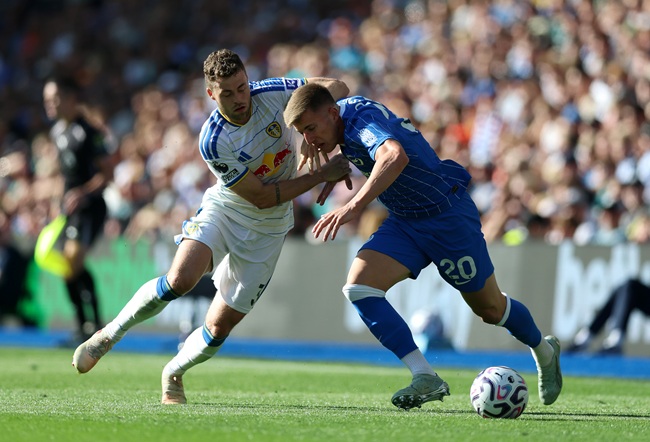
Costinha is living a dream. The former Rio Ave Portuguese right-back joined Brighton from Olympiacos in a deal worth around €12 million in the summer.
PortuGOAL’s partner website Flashscore spoke to the 26-year-old ahead of Brighton’s clash with Premier League rivals Crystal Palace. Costinha expressed how playing in the world’s most high-profile league has been “an indescribable feeling,” and lifts the lid on the fascinating level of detail the south-coast club go into with regard to information gathering before signing a player.
Read selected highlights of the interview below.
How has your Premier League experience been so far? Tell us a little about this adventure at Brighton.
“The experience has been incredible because it is a stage that most players want and dream of reaching. There are great games every week and, above all, it’s been an incredible experience: the daily routine, the way they look at football and every detail, and how they do everything possible to help us improve.
“Brighton, in particular, focuses on players’ potential, and we have a lot of young players in the squad. It has been very different from Rio Ave or Olympiacos, but it has been an interesting experience. Playing in the Premier League is incredible.”
“After the first game against Aston Villa, I came on in the 66th minute, we won, and it was an incredible feeling. Then I got home that day – or perhaps the following day – and started thinking: ‘Wow, I’ve just made my Premier League debut.’
“It was a dream I had had since childhood, one that seemed a long way off, almost impossible to reach. Even today, there are days when I lie in bed before going to sleep and think: ‘Is this really happening? Am I really in the Premier League?’
“As for my debut, it was a normal day, but after the game something clicked, and it became special. It was an indescribable feeling.”
Can you give us some examples of this new reality in England?
“The pace is different, with transitions and full-pitch pressing. Brighton are also known for liking to press and for reacting well when they lose the ball.
“Just a few days ago, our coach showed us that we are the Premier League team covering the most distance during matches. It demands a great deal from us physically. It has been a very, very challenging test for me.”
How has your adaptation to the city been?
“It’s been easier than I expected. I have a beach, but no sand, just stones (laughs). This has been one of the warmest years in England in recent times, especially in Brighton.
“I spent the last few years in Athens and had an incredible life there, but when you weigh everything up – football and quality of life – it is much better here.
“The club gives me complete support, not only me but also my girlfriend, so that we can be as relaxed as possible. They help us with everything. They want us to feel comfortable and for football to be our only concern. It has been a good adaptation.”
What is your daily routine like between training, matches and rest?
“I leave home at around eight o’clock and live five minutes from the training ground. I have breakfast at the club, then receive treatment and do some pre-activation work. Training normally lasts an hour and a half, an hour and 45 minutes, and sometimes two hours.
“We often do additional work too; 10 or 15 minutes after training, most of us stay behind to do extra work: the centre-backs have a specific session, and the full-backs do the same.
“There is a different, specialist staff working with players in every position. Depending on the day, we may go to the gym and work more on our legs or upper body. I almost always have lunch at the club.”
“After that, when I leave the training ground, I have a nap. I stay at home or go for a walk with my girlfriend and our dog. Brighton city centre is 15 or 20 minutes from my house.
“We make the most of it by going for a walk and having dinner. I go to bed at 10 or 10:30. On days off, as we are about an hour and 15 minutes away, we go to London.”
You mentioned the importance of data at Brighton and throughout the group of clubs owned by Tony Bloom. Can you explain the background to your signing?
“It made an immediate impression. From the first conversations and the first few days of training, I noticed that with the staff and the other players.
“They had a complete report containing my data: how much high-intensity running I can produce in matches, how many kilometres I cover on average, and what my mentality is like. They had several other right-backs in mind too.
“A year and a half before finalising my signing, they started asking various players who had been my opponents or team-mates when I was 18 at Rio Ave, where I did not play and only trained with the first team.
“They asked what I was like in training and away from training, and how they had got to know me. Later, they asked some of my former coaches. I think they even spoke to Luís Freire’s staff.
“Then they widened the search and contacted my closest friends. They spoke, for example, to Aderlan Santos. We are very close, and he helped me a lot. We are friends, and he knows me very well.
“They spoke to Marcelo, who now plays for Leiria. He was never my teammate; I only played against him. Marcelo then came to speak to me and told me about it.
“You can see how far they go to minimise the margin for error when signing a player. I am 26, but here I already feel like an old-timer; I am one of the oldest players in the squad.
“The club goes into detail about everything: training, matches, signings and nutrition. Players have to be at the highest level in every respect to make it here and succeed. I was no exception.”
Looking to the Portuguese national team, what did you make of the Cristiano Ronaldo situation and the new era under Jorge Jesus?
“A great deal has already been said about it – too much, in fact. I do not think it is healthy to remain stuck on the issue because the situation will be resolved in the best possible way, I hope.
“All of us – players, officials, the national team manager, fans and the media – have to row in the same direction, supporting and helping Portugal win as much as possible.
“But speaking about football, it was clear to everyone from the last four games that we were very competitive. In footballing terms, it was very positive. It’s not easy for the coach or the players in such a short space of time, but we’re on the right track.
“There’s a good connection between the players and we have already seen some tactical ideas, although I think we need to give it more time. Jorge Jesus has good ideas about the game. I also have some former teammates who have spoken to me about him and say he was the best coach they ever had tactically.
“So, I think the national team will improve. That is another reason why I am trying to reach the national team: I would like to experience working with him.”
Tell us about Rio Ave, being released by Braga and your family support structure
“Rio Ave is a beautiful story and I was very happy in Vila do Conde. Looking back, there were times when I complained. Now, with a cooler head, it was the perfect path. Rio Ave gave me a helping hand when I needed it most and helped me become the person I am today.
“I joined the club in a difficult situation. At 17, I was released by Braga and told my parents that football was over for me. That was not what I wanted, and my parents had made a huge sacrifice since I started playing.
“They had done everything to ensure I lacked nothing and could dedicate myself to football. Then, when I was released by Braga – and I think I deserved to be released after the season I had – I felt lost. From one day to the next it all ended. It was quite a shock for me. I told my parents that football was over, that I was going to quit because I wasn’t feeling good. I had been released and was also struggling at school.
“I felt that I was letting my parents down. ‘What am I going to do now?’ My parents worked in agriculture. Much as I liked it, I did not want to work in that world either. When the chance to play for Rio Ave came up, it changed something in my mind. I felt it was my last chance and I had to seize it by any means necessary.”
“As for my parents, I would just like to say ‘Thank you’. The first trip we took as a family was when I was 21, when we went to Troia. We left our village, our comfort zone. The whole family came with us, and we even took my dog. They were incredible and very rewarding moments. Later, I managed to take them to Greece, and they have already visited me here in Brighton.
“My girlfriend is also a very important person. We started dating when I was released by Braga, and she is from Braga. She has been with me throughout this journey.”
Brighton have been a launchpad for several players in recent seasons. Which teammates have surprised you most?
“That is a very difficult question, but the one who has surprised me most is Pascal Gross, although he is not a surprise to anyone; he has already been named Player of the Month.
“He’s 35, but his dedication and passion in training and matches are above average. Every day after training, he stays on the pitch for another 15 minutes to work on finishing and practise free-kicks and penalties.
“At his age, he covers around 13 kilometres every three days. I think: ‘How is that possible?’ He presses like a madman.”
Our thanks to Flashscore for giving permission to share to interview. To read the full Flashscore interview with Costinha by Leonel Gomes, click on this link.
