
Imagine you are a Sporting fan in a small town close to Lyon. His club is over 1000 kilometres away from him. Has never sat in the home end on a game day. However, he is familiar with all the names in the squad, and is already making calls in three group chats.
The fan is not uncommon. He is the new “normal”! Football fandom in the old days was constructed on the streets, in the stadium and in the smoky cafés. It is now on screens, schedules and shared stories for millions of Portuguese families in this country.
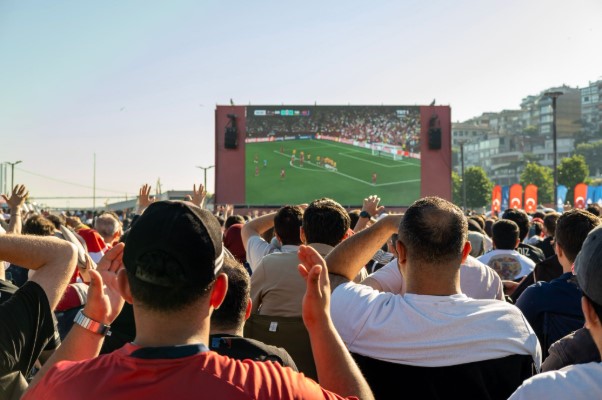
Nearly two million fans without a home ground
The United Nations estimates that there were 1.8 million Portuguese nationals residing abroad in 2024, according to data made public by the Emigration Observatory of Portugal. That’s 1,799,179 people, to be exact. France has the most at approximately 577,000; followed by Switzerland with approximately 204,000; and the United Kingdom with 156,000 along with Brazil with nearly 147,000.
Of course, not all of them watch football. There are plenty, however, and they take their habit along borders. Their children and grandchildren – sometimes feeling Portuguese on matchday despite holding a French or Swiss passport – and the actual fanbase is much, much bigger than any census number can capture.
From the corner café to random video chat
The previous model was straightforward. You met other emigrants, found a room with a TV and shouted at the referee together. Benfica made that a tradition. President Rui Costa states that the club has 298 Benfica Houses on five continents, and that they generate approximately a quarter of the club's income from the stadium.
These locations continue to have significance. A club house provides a migrant with a room that is like home. That can be more than three points for a new person to a country.
You don’t need to be in any specific physical location. A random video conversations app - like CallMeChat, for instance—connects you with people from all over the world. So, even a fan who isn’t anywhere near the Benfica stadium can find someone to talk to after a match. You might connect with another Portuguese speaker, or perhaps run into a curious stranger who only knows the name "Ronaldo." In either case, the conversation can revolve around a positive discussion about football.
The living room is the new stadium
When streaming came along, the map shifted once more. Today, a fan in Geneva can see the same match as a fan in Porto and at the same second he can see this on a phone. No need to go to a café, as it were. No search for a crappy signal.
The catch is, however, It's a lot easier to watch alone and a lot lonelier. The mass of people that used to occupy one room has dispersed in a hundred flats.
Group chats, clips and the second screen
It's not just the match. Goal seconds for the fans and they share clips. They post reactions, memes and furious voice notes. Not only does fandom turn into a conversation that never ends, but even when it's not game time.Fandom has turned into a conversation that doesn't ever end, even in the middle of a week when no one is playing.
Time zones complicate things. A kickoff post-dinner in Lisbon comes in the early evening, in São Paulo, meaning that there is no one neat window for talking. It is like a relay race.
Fans now follow players, not only clubs
In this place the diaspora does something strange. In Portugal, people play everywhere, so allegiance is not in line with the table. A Manchester family might support Bruno Fernandes's team more than any in the country. The other follows Cristiano Ronaldo to Saudi Arabia.
It's a silent revolution. A fan can be a Benfica fan, cheer for a Portuguese midfielder at a Premier League club and still be able to sing for the national team when it's time for a tournament. Three loyalties, one heart. There is no one who thinks there is any contradiction.
The kids who grew up somewhere else
This makes it messier and more interesting with 2nd generation fans. A person who has heard Portuguese as a native language and French as a second language. His local club is located just around the corner. His grandfather's club is on screen. Which one wins?
Often, both. Tons of youngsters divide their weekend between the neighborhood ballpark and their household team. Football is the vehicle to language, language of the village, language of the old stories. That bridge could be seen in the streets in Portugal when it won Euro 2016 in France.
Why a stream is not enough
Streaming solves access. Does not help to save the business. A feeling is a match, and a match requires another person. That's why scattered fans are constantly devising their own little rituals, such as a video call at halftime or a quick call to a cousin after a penalty shootout.
Most of them want the same few things:
- Someone to react with in real time
- Someone who gets the references, not just the rules
- A place to cool off after a bad defeat
What clubs and media can learn
It's time clubs listen up. Benfica's Houses are a testament to the power of physical space. The next step is hybrid: matchday streams with live chat, bilingual content, events timed for fans in Zurich or Toronto, rather than just Lisbon.
This is something known to the media that covers Portuguese football in English. Their readers aren’t only locals. They're cousins, grandchildren and curious neighbours, who discovered the game through family.
A fandom that carries its home with it
Football, once a place, was Portuguese. Now it belongs to a people, where they find themselves dwelling. Here the word stadium is still used for the heart, but the body is now found in Europe, South America, and beyond.
No, that doesn't take the game down any. It makes it louder, odder and a lot more human. People who don't have a place of their own are creating one, from a group chat to a stream and sometimes a stranger's face on a screen.
