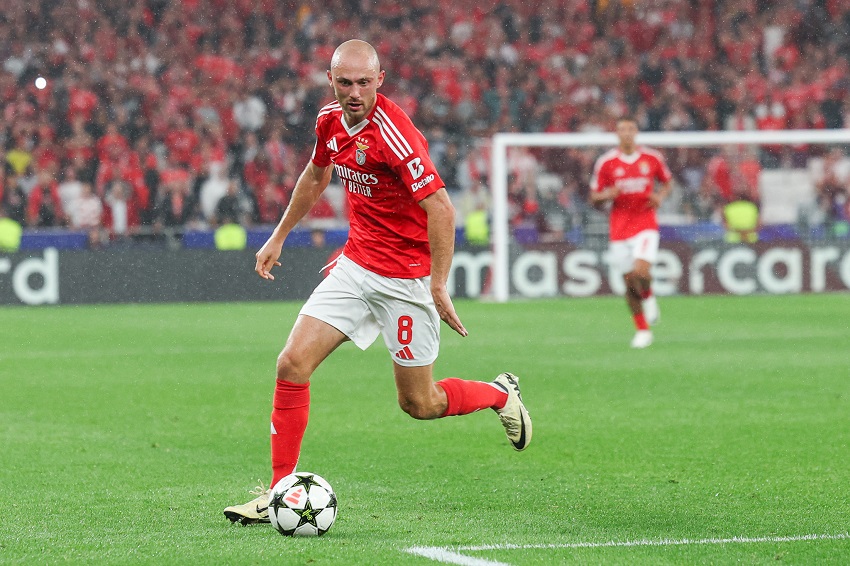
Bruno Lage chose to stick with the same 11 he started with in the first leg against OGC Nice on Tuesday, and in all honesty, why not? Aside from a few hiccups in the opening 30 minutes in France, things couldn’t have gone much better for SL Benfica in the first leg. In a hostile atmosphere at the Allianz Riviera, the Lisbon club managed to take command of the tie with goals from the newly signed striker Franjo Ivanović and Florentino, earning a two-goal cushion to take back to Lisbon. On Tuesday, Benfica picked up right where they left off at the Estádio da Luz.
This was a dominant display from the home side from start to finish. Benfica knew that they only needed a draw (or even a one-goal defeat would suffice) to progress to the playoff round of the Champions League competition, but that didn’t stop Lage’s men from taking the initiative. Vangelis Pavlidis, Franjo Ivanovic, Fredrik Aursnes and Andreas Schjelderup all looked dangerous, and two early goals seemed to calm the home supporters’ nerves. Ultimately, Benfica cruised to a comfortable 2-0 victory, completing a 4-0 aggregate win.
Porto started the new Primeira Liga campaign with a comfortable 3-0 victory over Vitória de Guimarães at Estádio do Dragão.
Francesco Farioli’s side took the lead in the 12th minute following a swift counter attack, Pepê starting and finishing the move which involved Samu and Borja Sainz.
Guimarães rode their luck which ran out in the 32nd minute when a well worked corner routine resulted in Samu heading Alberto Costa’s cross past Charles.
The visitors enjoyed a brief spell of pressure before half-time but that was as good as it got for Luís Pinto and his new side.
Samu wanted more and got it in the 79th minute when Stephen Eustaquio’s strike was spilled by Charles, the Spanish striker pouncing and converting from close range.
Porto 3-0 Vitória de Guimarães
Tiago Silva went desperately close inside the opening 60 seconds before Porto began to apply pressure. It paid off in the 12th minute when the Dragons took the lead.
Pepê started the counter attack with Samu Aghehowa racing clear, the striker sending it back to the Brazilian via Borja Sainz, Pepê taking a touch and dinking it over Charles.
Tiago Silva was booked for a dangerous tackle on Alan Varela as Vitória started to crumble under the weight of a packed Estádio do Dragão. Victor Froholdt pounced on a shocking pass from Nuno Santos, drove into the box and dragged his shot wide.
Samu then slammed the ball into the net but Pepê was offside in the buildup. The Spanish striker had another chance when he robbed Toni Borevković on the edge of the box but couldn't beat Charles from a tight angle.
Porto’s second goal came in the 32nd minute following a corner won by Samu. Pepê played it short to Alberto Costa who crossed into the danger area, Samu getting in front of João Mendes and heading past Charles.
Nuno Santos volleyed wide but the attention immediately returned to the other end of the pitch, Samu and Pepe firing over the bar Samu testing Charles once again.
Guimarães enjoyed a brief spell of pressure before the break when Tomás Händel and Mendes saw their shots blocked, Oumar Camara unable to beat Diogo Costa and Gustavo Silva denied on the goal line by Jan Bednarek.
Porto regrouped at half-time and got back on the front foot following the restart, the momentum halted when Martim Fernandes fell awkwardly and was stretchered off the pitch to be replaced by Zaidu Sanusi.
Bednarek was the next Porto player to pick up an injury which saw Dominik Prpic come off the bench, Farioli using the opportunity to bring on Stephen Eustaquio and William Gomes for Gabri Veiga and Sainz.
Samu tested Charles once again but didn’t have to wait long for another opportunity which came in the 79th minute. Eustaquio’s long range strike swerved and was spilled by Charles, the ball falling straight to Samu who converted from close range.
Froholdt fired wide and Eustaquio saw his goal ruled out due to De Jong being offside, Porto cruising to the finish line for a well deserved victory.
Francesco Farioli era begins
Porto’s victory was significant in more ways than one. André Villas-Boas couldn’t have asked for much more after sacking Martín Anselmi, bringing in Francesco Farioli and making a number of important signings.
Farioli isn’t trying to be a tactical genius, the Italian simply selecting a 4-3-3 formation, putting his players in their best positions and providing them with a platform where they can shine.
Jan Bednarek and Alberto Costa made their competitive debuts in defence with Dominik Prpić replacing Bednarek in the second half. Alan Varela’s ability to provide defensive cover allows the recently signed Gabri Veiga and Victor Froholdt some freedom to operate in midfield.
Pepê might be able to find some consistency under Farioli, Borja Sainz on the opposite wing another new signing to make his Dragons debut.
Samu was unable to sustain his early season form in the previous campaign due to the demises of Vítor Bruno and Martín Anselmi. He was close to unplayable against Guimarães, the Spanish striker taking six shots which included five on target and two goals.
Luuk de Jong replaced Samu late on, the Dutch striker a direct replacement which means Farioli doesn’t have to change the tactics to accommodate the veteran.
The only downside for the Dragons was the unfortunate injury to Martim Fernandes, hopefully the 19-year-old won't have to spend a significant amount of time out of the game.
Rodrigo Mora didn't make it off the bench but the Italian manager stressed that the 18-year-old will have chances during the season: "He will be important for Porto, without a doubt. He's talented. The coach has to make decisions. There's no doubt about what he represents for the club and for me. It's great to have this level of talent. It's a huge responsibility for me to help him develop. And then it's also up to him to continue working like this and developing, moving forward. I'll have to use all the players; the season is long, and he'll find his place. His contribution this season will be great."
Estádio do Dragão was a lonely place at times last season with many spectators abandoning their team. They should be back in force to support Farioli and his side who have every chance of going toe to toe with Sporting Clube de Portugal and Benfica.
Before the match there was a tribute for Jorge Costa, the legendary Porto player who tragically died on Tuesday at just 53 years of age. A club legend and universally respected by all, his passing is another reminder that existence on this planet is short.
Braga began their Primeira Liga campaign with a 3-0 win against Tondela at the Quarry.
Tondela went close on three occasions and had a goal ruled out for offside before Vítor Carvalho headed home Leonardo Lelo’s corner in the 24th minute.
The Warriors extended their lead 13 minutes later when Lelo delivered a perfect cross to Pau Víctor who scored in his first start for Carlos Vicens’ side.
Ricardo Horta came off the bench in the second half, the Braga captain winning a penalty that he converted in the 83rd minute.
Braga 3-0 Tondela
Tondela had a great chance to shock the home crowd in the 6th minute following a loose pass from Vítor Carvalho. Miro picked it up and got past Paulo Oliveira before seeing his shot saved by Lukas Hornicek.
Braga lost possession in their own half again in the 14th minute, Miro threading the ball through to Yarlen who went a whisker wide of the post. The chances kept coming for the visitors, Maranhão heading home with the goal ruled out due to Yarlen bring ruled offside in the build up.
Ivo Vieira’s side should have taken the lead in the 23rd minute, Yarlen’s cross picking out Maranhão who couldn't connect from close range.
The Warriors weathered the storm and scored against the run of play less than 60 seconds later. It was a simple goal due to Tondela’s defence falling asleep, Carvalho left free to head Leonardo Lelo’s corner into the net.
Braga doubled their advantage before the break when Gorby released Lelo, the wing-back delivering a perfect cross to Pau Víctor who slotted past Bernardo in his first start since sealing a €12m move from Barcelona.
Tondela were unlucky at the start of the second half when Carvalho headbutted Cícero in the box, Cláudio Pereira awarding a penalty that was overturned by the VAR.
Amine El Ouazzani tested Bernardo from a tight angle before Braga sealed the deal in the 83rd minute. Ricardo Horta had replaced Victor earlier on and was dragged down by Brayan Medina, the captain stepping up and making no mistake from the penalty spot.
Vicens rings the changes
Carlos Vicens made eight changes to the side that started in the 2-1 win at CFR Cluj in the Europa League qualifiers on Thursday. Lukas Hornicek, Paulo Oliveira and Jean-Baptiste Gorby were the players to keep their spot.
Vítor Carvalho had been used as a wing-back in Braga’s two matches against Levski Sofia, he was back in the side on the right edge of a back three and had a tough time throughout despite his opening goal.
It’s amazing what happens when players are deployed in their proper positions. Leonardo Lelo got his first start since being signed from Casa Pia, the left back making it count with two assists and a solid all round performance.
Amine El Ouazzani started up front next to Pau Víctor as Vicens started two strikers for the first time this season. Competition for places is strong with the new manager searching fot his best combinations.
The 3-0 scoreline looks comfortable but Braga were fortunate not to fall behind after gifting Tondela a number of early chances. The promoted club will have to start finding the net because keeping clean sheets could prove problematic this season.
The Warriors return to the Europa League qualifiers on Thursday, Vicens sure to make more changes as his side attempt to reach the Europa League play-offs.
“I think it was the best game since I’ve been at Sporting,” said coach Rui Borges after the Portuguese champions began their quest for a third consecutive league title in impressive fashion in Rio Maior tonight.
A goal in each half by Francisco Trincão and Morten Hjulmand secured the three points for the Lions, and only the woodwork and a fine exhibition by Casa Pia goalkeeper Patrick Sequeira prevented further goals for the visitors.
In the inaugural match of the 2025/26 Liga Portugal, Casa Pia were gunning to build on last season’s superb showing. Coach João Pereira expressed his ambition pre-match by saying the aim was to try and beat their Lisbon rivals for the first time in almost 100 years (since 1930)!
As for Sporting, new Colombian striker Luis Suárez was handed his full debut in a 4-2-3-1 formation as Borges continues to seek alternatives to Ruben Amorim’s three-at-the-back system.
Attack, attack, attack
A focused Sporting were dynamic from the off, pinning Casa Pia into their defensive half of the field for practically the entirety of the first half.
Captain Morten Hjulmand hit the post in the 9th minute with Sequeira saving bravely from Suárez on the follow-up. Pedro Gonçalves was next to go close, his first-time curler bringing a flying save out of the Costa Rican goalkeeper. Maxi Araújo then sent a header crashing against the bar as the hosts struggled to survive the visitors’ avalanche of attacking football.
The lively Suárez was seeing plenty of the ball and combining well with Pote and Trincão in the centre of the pitch. Only a fine sliding tackle by José Fonte denied the striker, and shortly afterwards Sequeira saved instinctively from the debutant after Trincão had charged down the goalkeeper’s clearance.
Trincão strikes
Just when it seemed Casa Pia would somehow survive until the interval Sporting found the breakthrough with a well-executed goal demonstrating their enterprising offensive play. Diomande found Trincão who carried the ball forward before releasing Pote, who weighted his return pass perfectly for Trincão to sweep into the net on the run from the top of the box.
The first half ended with Sporting having accumulated 18 shots (6 on target) compared to zero for the home team.
A series of injuries, multiple substitutions and a more aggressive Casa Pia made the second half a different affair. Maxi Araújo was forced off in the 53rd minute, paving the way for Ricardo Mangas to make his debut, and soon afterwards Ousmane Diomande also hobbled off the pitch, replaced by Zeno Debast.
For Casa Pia André Geraldes and Renato Nhaga came on for João Goulart and Rafael Brito. The hosts had stemmed the attacking tide since the break, but continued to be inoffensive.
Captain on the mark
Just after the hour mark Sporting doubled their lead. This time Trincão turned provider, his cleverly worked free kick with Pote prodded into the net by Hjulmand.
Another injury saw Kelian Nsona replaced by Korede Osundina, and as both coaches used up their allotted substitutions the game drifted into a somewhat anarchic end. Giorgi Kochorashvili for Sporting and Max Svensson for Casa Pia came close to late goals with headers, but no further goals were added.
One week after losing the Super Cup to Benfica in a lukewarm match in the Algarve, Sporting fans will be feeling much happier given the convincing nature of the victory, while João Pereira has work to do to elevate his team to last season’s high standards.
Casa Pia AC: Patrick Sequeira, Fahem Benaissa (Miguel Sousa, 82’), José Fonte, João Goulart (André Geraldes, 57’), Gaizka Larrazabal (Max Svensson, 82’), Duplexe Tchamba, Rafael Brito (Renato Hnaga, 57’), Yassin Oukili, Kelian Nsona (Korede Osundina, 71’), Jérémy Livolant, Cassiano
What’s behind the rise in Nordic footballers making their mark in Portuguese football? Zach Lowy investigates, with the help of Portuguese football journalist João Pedro Cordeiro.
Once upon a time, in a galaxy far, far away, Liga Portugal used to be considered the doorstep of Europe for footballers on the other side of the Atlantic. Portuguese teams would sign promising South American youngsters, develop them and get them accustomed to European football, before selling them for a premium. Óscar Cardozo, Radamel Falcao, James Rodríguez, Ángel Di María, Deco, Hulk, Mário Jardel, David Luiz, Ederson, Jackson Martínez, Pepe, Enzo Fernández…the list goes on and on.
However, ever since FIFA banned third-party ownership in 2015, Portuguese clubs have found themselves resigned to losing out on the best South American talents to Spanish or English teams. Instead, they’ve had to look at different, under-invested markets like Scandinavia to reinforce their teams with up-and-coming young prospects.
From Sporting captain Morten Hjulmand, Benfica’s jack-of-all-trades Fredrik Aursnes, and Viktor Gyökeres, who, after winning back-to-back Bola da Prata awards at Sporting, has made the move to Arsenal, we’re seeing more and more Scandinavians make their mark in Portugal. But just what exactly has changed? I spoke to Portuguese journalist and Nordic football expert João Pedro Cordeiro.
“If I had to guess, the problem was never exactly the scouting. Having spoken to people who are in the know; the players have been scouted for some years. It was more a decision-making “problem” than a scouting problem. But as the Scandinavian players started to make a bigger splash in the big leagues like Portugal, Belgium, and the Netherlands, Portuguese club directors became more convinced they could be a good target. Portuguese football was always very close to agent companies that operated mainly in South America, but the context changed, and those players who used to come to Portugal started going to other markets like Major League Soccer.
“I just think we came a bit too little too late because clubs like Midtjylland, Malmö, København, Nordsjælland, and Brøndby are already selling their top players for over €20 million, and it’s not easy to get them.”
Priced out of the South American market
Suddenly, Portuguese clubs have woken up to the fact that Scandinavian leagues – be that Denmark, Norway, or Sweden – are churning out readymade, young talent who have the physical skills and technical finesse to make an instant impact in the Primeira Liga. Whilst there are still a few South American footballers who make their way to Portugal to launch their careers in Europe, for the most part, the local teams have been priced out of signing them. Whereas 10-15 years ago, a player like Estêvão or Franco Mastantuono would have opted to go to Lisbon or Porto to jumpstart their development, they’re now making their start in London and Madrid.
Fredrik Aursnes has been a big hit for Benfica since arriving in Lisbon three years ago, here in action with Alexander Bah in the background (Photo: Arlindo Homem)
Portuguese teams, for their part, have responded by dipping into a cheaper market, one filled with raw prospects who can easily appreciate in value and earn them a lucrative profit. Last summer, we saw Casa Pia pay €50,000 for Espanyol’s Spanish-Swedish striker Max Svensson, whilst Porto paid €4.50m for Hammarby’s Deniz Gül, who, despite being born and raised in Sweden, represents the Turkish national team. Sporting, meanwhile, paid €19 million for Nordsjælland’s Danish striker Conrad Harder, who may very well end up being the heir to Gyökeres’ throne.
This summer, it has been more of the same. Benfica have completed the permanent signing of Swedish left back Samuel Dahl from Roma for €9 million (joining the aforementioned Aursnes as well as Alexander Bah and Andreas Schjelderup at the Estádio da Luz), whilst Braga have added Ivorian striker Mário Dorgeles from Nordsjælland for €11 million while also signing Celtic’s Swedish centre-back Gustaf Lagerbielke for €2.57 million. Porto, meanwhile, have responded to their disastrous Club World Cup display by splurging a total of €88.6 million on nine new recruits, none more expensive than teenage Danish midfielder Victor Froholdt, who has arrived from København for €20 million.
“It all starts with the fact that Nordic clubs became much better at producing players than before; the facilities got better, pretty much all clubs have indoor fields and astroturf fields that enable them to train all year, as opposed to what was happening until the nineties,” added Cordeiro. “They’re starting to reap what they sow – the type of player and profiles that started being produced in the Nordic countries changed, and they’re now way more technical than before and more suited to play a part in modern football. They’re not the tall, physical guys with technical limitations anymore; if anything, they’re now physical monsters with good to great technical ability.”
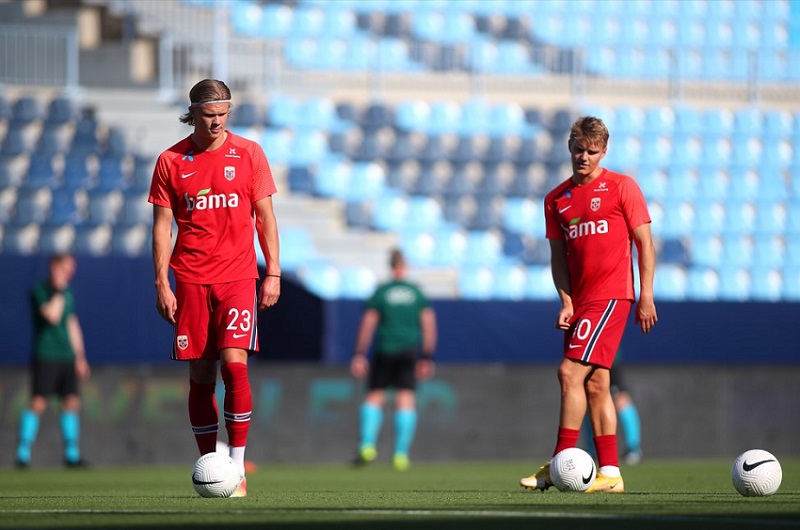
“It’s hard to pinpoint a singular moment where Portuguese teams started to take Scandinavian football seriously – it was more a global trend that eventually caught up. The charisma of Zlatan Ibrahimović, Erling Haaland and Martin Ødegaard becoming global stars… I feel that changed a bit how the football world started looking at Sweden and Norway football-wise, as well as the great Danish campaign at Euro 2020 as well.
Global stars like Erling Haaland and Martin Ødegaard have helped changed the perception of Scandinavian footballers (Photo by Fran Santiago/Getty Images)
“I can’t point to one single event that changed everything, but there was also a cultural shift in Nordic football in the last decade as clubs became much more aware that producing players can be very profitable and started giving much more playing time to kids. The number of academy players and U21 players being used in Sweden, Denmark, Norway, is at an all-time high, and they have one of the youngest average ages in world football, according to CIES.”
Primeira Liga launchpad
Portuguese clubs are well aware of their place in the global food chain. They know that they can’t compete with English, Spanish, German, Italian, French or even Turkish or Brazilian clubs when it comes to offering mouth-watering wages and astronomical bonuses. However, they can offer players a steady launching pad to get their feet in the door, acclimatise to European football, before making the move to greener pastures. And for their part, teams like Paris Saint-Germain, Chelsea, and Real Madrid are more than happy to wait and see regarding players who have not yet hit the heights, allowing these prospects to go from raw gems to refined talents, before paying a hefty premium for them just as they’re about to enter their prime.
Could the next Alexander Isak or Viktor Gyökeres or Erling Haaland be found in Portugal? Don’t bet against it.



 Porto started the new Primeira Liga campaign with a comfortable 3-0 victory over Vitória de Guimarães at Estádio do Dragão.
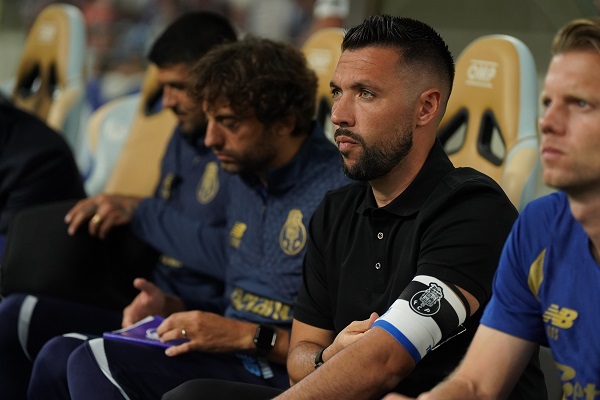 Nuno Santos volleyed wide but the attention immediately returned to the other end of the pitch, Samu and Pepe firing over the bar Samu testing Charles once again.
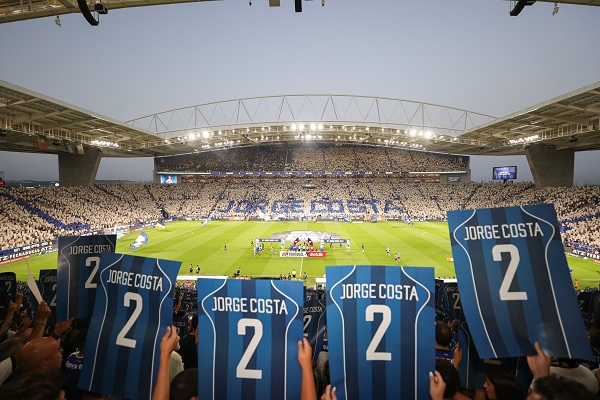 Pepê might be able to find some consistency under Farioli, Borja Sainz on the opposite wing another new signing to make his Dragons debut.
 Braga began their Primeira Liga campaign with a 3-0 win against Tondela at the Quarry.


 What’s behind the rise in Nordic footballers making their mark in Portuguese football? Zach Lowy investigates, with the help of Portuguese football journalist João Pedro Cordeiro.