
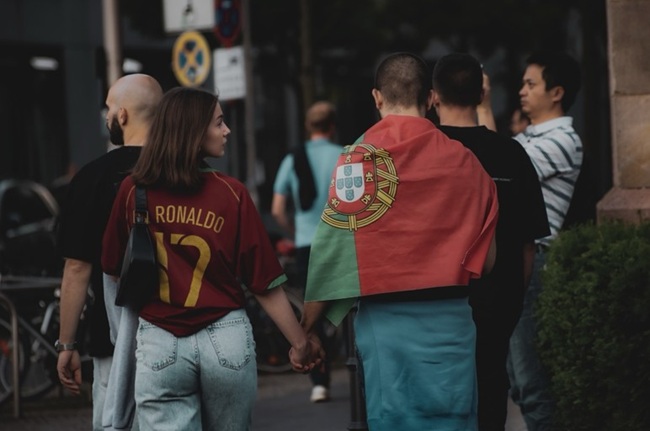
New research measuring replica kit prices against local wages reveals a gap of more than 90 times in the real cost of supporting your country at this World Cup, and Portugal's position in that table tells a story worth knowing.
When Portugal pulled on the Puma home shirt for the first time at this World Cup, few of the 68,777 inside NRG Stadium in Houston paused to consider what that shirt cost the fan wearing it. In most cases, probably not much. Portugal draw strong support from a diaspora spread across western Europe and North America, where the Puma replica retails at around £85 and represents, for most supporters, roughly the equivalent of a meal out for two. That figure comes from new research that mapped the official retail price of every home kit across all 48 qualified nations against the average monthly wage in the country it represents. The findings are striking.
Portugal's shirt sits in the middle of the affordability table, but only because of where Portugal's average wage sits relative to the rest of the tournament. For a fan in Switzerland, who are also kitted by Puma, the same replica costs 1.4% of a month's average earnings. For a supporter in DR Congo, the Umbro replica works out at around 130% of a full month's average formal-sector wage, a figure that likely understates the real cost given the scale of informal employment across the country. DR Congo were the side that held Portugal to a 1-1 draw in Houston on Matchday One.
Puma's Roster and What It Means for the Group K Picture
Puma supplies 11 nations at this tournament, including Portugal, Morocco, Senegal, Ghana and Switzerland, with replicas ranging from around £77 upwards. Portugal's shirt sits at the higher end of that range. The price has moved upwards since Qatar 2022, when Puma's replica line averaged around 25% lower across its roster. That increase has not been evenly felt. For fans in Switzerland or Austria, also Puma nations, the price rise is a minor inconvenience absorbed into everyday spending. For fans in Ghana, Senegal or Ivory Coast, it represents a considerably larger share of disposable income. Portugal's group opponents tell a similar story of uneven burden. Colombia's Adidas replica retails at around £85 and lands at a very different point on the affordability scale, reflecting a wage gap that sits at roughly 3:1 in Portugal's favour.
Uzbekistan represent the most interesting case in Group K. As the first Central Asian nation to qualify for a World Cup, their squad carried genuine historic weight into the tournament before Portugal's 5-0 victory on 23 June effectively ended their progress. Their kit is supplied by local brand 7Saber, making their World Cup debut alongside the national team, and carries a lower shelf price than Portugal's. But in working days of labour, the cost to an average Uzbek supporter is substantially higher than for their Portuguese counterpart. The gap across the full index between the most and least affordable shirt in the tournament runs to more than 90 times the equivalent days of work.
That disparity has not dampened the betting appetite around the tournament. An analyst at Freebets.com, a long-established independent authority on football World Cup betting sites and licensed bookmaker reviews, noted: "The volume of interest in Portugal's outright price shifted sharply after Houston. Ronaldo's record at six World Cups, combined with the depth behind him in Fernandes and the PSG quartet, means this squad looks more balanced than it did after Matchday One."
"We have a very good, spectacular generation. We have a mix of young players with a lot of experience and other older players who also have a lot of quality. We have a great group and obviously we have to be responsible." — Pedro Neto, speaking ahead of Portugal's World Cup preparations, June 2026
Colombia, the Knockout Rounds, and Why the Shirt Index Matters Beyond the Numbers
Portugal sit second in Group K on four points heading into their final group match against Colombia in Miami on Saturday 28 June, behind Colombia on six after two wins. Daniel Munoz's 76th-minute goal gave Colombia a 1-0 win over DR Congo on 23 June to go alongside their 3-1 opening victory over Uzbekistan, with Luis Diaz and James Rodriguez providing the attacking threat throughout. Portugal must win in Miami to overtake them; a draw would leave Colombia top on goal difference, with Portugal's superior goal difference of plus five against Colombia's plus three the only safeguard if the two sides finish level on points.
The Big Three, Nike, Adidas and Puma, supply 77% of the 48 nations at this tournament. Their pricing is set globally and applied with minimal adjustment for local markets. A kit that costs a Swiss fan 0.3 days of work costs a Congolese fan nearly 29. The same tournament, the same global brands, very different financial realities depending on where you live.
Martinez's Template and What Saturday Requires
Roberto Martinez has a template from the Uzbekistan win. Ruben Dias back in central defence gave the full-backs licence to push higher, Nuno Mendes covered 98 touches, and Bruno Fernandes ran off the shoulder of Uzbekistan's defensive block to create the space Ronaldo needed for both goals. Portugoal's pre-match analysis of the Uzbekistan fixture had flagged Colombia as the hardest test in Group K well before the tournament began, a reading that looks more accurate now than it did before Matchday One.
Whether that structure holds against a Colombia side that has scored four goals and conceded one across their two group games is the tactical question for Miami. For fans in both countries pulling on their shirts for the occasion, the hours of labour behind those 90 minutes vary considerably more than the football itself.
"Obviously, speaking personally, records are always nice, but my goal is always to help the national team achieve its objectives." — Cristiano Ronaldo, post-match press conference, Houston, 23 June 2026
The shirt index is a pre-tournament data set. It cannot account for the secondary market, discounted replicas or the informal trade around tournament host cities. But its core finding stands: the price of backing your country is not just measured in pounds or dollars. It is measured in how many days you have to work to afford it. For a supporter in Kinshasa, that measure looks very different to one in Lisbon.
