
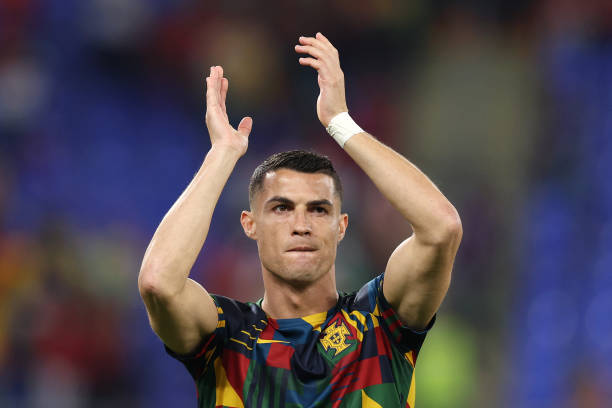
The gods are unkind to man.
Mortals are invariably their playthings, summoned into existence to satisfy some celestial curiosity on any given Saturday. They are given dreams large enough to consume them, gifts enough to make them extraordinary, and just enough time to discover that nothing extraordinary lasts forever.
And every so often, the gods make a terrible mistake.
They create a man so magnificent that, for a little while, he begins to look like one of them.
Then they send him to Madeira.
A small island, adrift in the Atlantic, where the ocean stretches towards a horizon that promises everything and guarantees nothing. There, in the westernmost reaches of Europe, a boy is born who will one day make an entire nation believe that the impossible is merely a matter of persistence.
His name is Cristiano Ronaldo dos Santos Aveiro.
And Portugal will spend the next four decades discovering just how impossible it is to make another one.
Portugal, a nation whose independence took shape under Afonso Henriques in the twelfth century, whose sailors once ventured into oceans that swallowed the certainties of lesser men, whose ships traced passages towards Africa, Asia and the Americas when much of the world remained beyond their maps.
This is a country that understands the romance of departure. A country that understands the ache of distance. A country whose history is inseparable from the men who left its shores in pursuit of something greater than themselves.
Its buildings still remember the sea. In the carved ropes, shells and maritime ornaments of Manueline architecture, the ambitions of an exploring nation remain suspended in stone.
Portugal has always known how to send its sons into the unknown.
But what happens when one of those sons becomes impossible to replace?
Because Ronaldo did not merely leave Madeira. He left it for Lisbon, then Manchester, Madrid, Turin, and eventually the farthest reaches of football’s imagination. He carried a flag that belonged to a country of roughly ten million people into stadiums watched by hundreds of millions more.
He made Portugal impossible to ignore.
There were goals, of course. Goals enough to fill the record books, to settle arguments, to silence stadiums, to turn impossible nights into national inheritance. There were headers that seemed to defy gravity, free kicks that bent the laws of physics , and penalties struck with the cold conviction of a man who had already decided how the story would end.
There were tears in Paris. There was the European Championship in 2016, when his own body betrayed him before his country could, when the captain who had carried Portugal’s dreams was forced to watch from the touchline as his teammates finished what he had started.
And when the final whistle came, Portugal were champions of Europe.
The boy from Madeira had become the captain of a European champion. The child who once left home in pursuit of a footballing dream had returned to give his country something it had never possessed.
A place among Europe’s kings.

But trophies, for all their brilliance, tell only part of the story.
The more extraordinary achievement was that Ronaldo made Portugal believe it belonged in every conversation. He did not abolish the country’s limitations. He did not make its population larger, its footballing history longer, or its resources limitless.
He simply made the world look.
Again, and again, and again.
And now comes the question nobody wants to answer.
Who comes next?
Portugal will produce footballers. Of that, there can be little doubt. There will be another gifted winger, another elegant midfielder, another striker with a nose for goal. There may be another captain who lifts a trophy beneath a shower of confetti. There may even be another player who breaks his records.
Football will continue. The shirts will be worn. The national anthem will rise. The stadiums will fill.
But another Ronaldo?
No.
Not because Portugal will run out of talent. Not because the future has nothing to offer. But because greatness is not a factory product, assembled from familiar parts and reproduced whenever demand requires it.
Ronaldo was a collision of things that rarely coexist: the talent to astonish, the vanity to demand more, the discipline to pursue it, the audacity to believe he deserved it, and the longevity to keep demanding it long after the world began preparing his replacement.
He was the boy who wanted to be the best, the man who could not bear to be second, and the veteran who refused to let time write his obituary without a fight.
You can teach a child to shoot. You can teach him to leap, to move, to finish, to study the game.
You cannot promise him that peculiar hunger. That unreasonable insistence that yesterday’s miracle must become tomorrow’s minimum requirement.
You cannot manufacture the years, the moments, the injuries endured, the failures survived, the nights when the entire world expected him to deliver and he delivered anyway.
You cannot recreate a lifetime by copying its highlights.
And this is where Portugal’s inheritance becomes its burden.
For every child who pulls on the number seven, there will be a shadow waiting. Every promising goal will invite a comparison. Every missed chance will awaken the memory of the man who might have scored it. Every new star will be asked, sooner or later, whether he can become the next Cristiano Ronaldo.
What an impossible thing to ask of a young man.
What an impossible thing to ask of a country.
Perhaps Portugal’s greatest challenge after Ronaldo will not be finding somebody who can score his goals. It will be learning to appreciate the players who cannot be him.
Because the tragedy of a once-in-a-generation footballer is that he changes the imagination of a generation. He expands the boundaries of what people consider possible, then leaves them disappointed when the next generation turns out to be merely human.
And perhaps that is the final cruelty of the gods.
They allow us to witness the extraordinary, then leave us to live with the ordinary.

One day, Ronaldo will no longer walk out in the red shirt. One day, the number seven will belong to another man, and the stadium announcer will call another name. The cameras will search the touchline for a familiar figure and find only the space where he used to stand.
Portugal will sing.
Portugal will play.
Portugal will, eventually, win again.
But somewhere in the stands, an old man will remember a boy from Madeira who made the whole world watch a small country.
And he will wonder whether the young people around him understand what they are watching now, or what they have lost.
Because some footballers leave behind goals.
Some leave behind trophies.
A very rare few leave behind a standard that becomes a burden to everyone who follows them.
And then, once in a lifetime, a footballer leaves behind something more difficult to name.
An absence that arrives before he has even gone.
Cristiano Ronaldo will not be the last great Portuguese footballer. History would be foolish to make such a promise.
But Portugal may wait a hundred years for another man who combines his gifts, his defiance, his longevity, his appetite, and his ability to make an entire nation feel that, for all its smallness, it can stand above the world.
It may wait a thousand Saturdays.
It may search every island, every academy, every street where a child dreams beneath the Atlantic sky.
And still, it may never find him.
The gods, after all, are not obliged to repeat themselves.
They gave Portugal Cristiano Ronaldo.
They did not promise it another.
The Ronaldo in each of us
Perhaps the most interesting thing about Cristiano Ronaldo is that, despite the extraordinary distance between his life and ours, there is something in his story that feels strangely familiar. Most of us will never play in a World Cup, stand before eighty thousand people or have our achievements measured against the greatest athletes in history. Yet we understand the desire to be recognised, the quiet frustration of knowing we are capable of more, and the peculiar pain of watching our potential remain larger than our circumstances. There is a Ronaldo in each of us, not necessarily in the talent we possess, but in the uncomfortable relationship between who we are and who we believe we might become.
Ronaldo’s life offers an unusually vivid lesson in the psychology of ambition. He has spent much of his career behaving as though achievements were never quite sufficient, as though every record should become an invitation to pursue another. There is something admirable, and perhaps even unsettling, about this refusal to settle. We are often encouraged to be grateful for what we have, which is sensible enough, but gratitude can sometimes become an elegant disguise for fear: the fear of attempting something greater and discovering that we might fail. Ronaldo reminds us that contentment with our present circumstances need not require surrendering our ambitions for the future.
But his story also reveals a less comfortable truth about excellence: it is rarely glamorous while it is being constructed. We see the goals, the trophies, the immaculate celebrations and the carefully maintained image, but achievement is built in the less memorable spaces between them: repetition, discipline, disappointment and the willingness to return to work when nobody is watching. The lesson is not that we should all become obsessive, or that our worth must be measured by productivity. It is that the lives we admire are often supported by habits we would rather avoid, and that the distance between aspiration and achievement is usually crossed through ordinary acts performed with extraordinary consistency.

Obrigado Cristiano
There will come a time when the voices that once thundered his name have fallen silent. When the stadiums that trembled beneath his footsteps have turned to dust. When those who witnessed his wonders are themselves but whispers in the corridors of history.
And still, they will speak of him.
They will speak of a boy born where the Atlantic kisses the shores of Madeira. A boy who looked upon a world immeasurably larger than himself and, with nothing but football and an almost frightening belief, decided that the world was not large enough for his dreams.
They will tell of the mountains he climbed, of the kingdoms he conquered, of the nights when the heavens seemed to bend to his will.
And they will tell of Portugal.
A nation that had known the agony of almost. That had stood at the gates of greatness and watched them close. That had wept beneath the weight of unfulfilled dreams.
Until he came.
Not a king with a crown. Not a saviour descended from the heavens.
Just a boy.
A boy who would grow into a man. A man who would grow into a legend. And a legend who would become the living, breathing embodiment of a nation’s impossible dream.
But even legends must bow before the passage of time.
And now, the hour has come.
For the first time in what feels like forever, tomorrow must arrive without Cristiano Ronaldo.
And yet...
How can a man truly leave a nation when he has become a part of its soul?
How can a story end when its greatest chapter is still being written in the hearts of those who never even saw it begin?
Perhaps it cannot.
Perhaps some men are not remembered because they conquered the world.
Perhaps they are remembered because they convinced the world that it could be conquered.
The goals were his gift to football. The belief was his gift to Portugal.
And long after the final whistle, long after the last roar of “Siuuu” has faded into the night, somewhere in the streets of Madeira, Lisbon or Porto, a little boy will pull on a red shirt, look towards the heavens, and dare to dream.
And perhaps that is the greatest thing Cristiano Ronaldo leaves behind.
Not the goals. Not the records. Not even the glory.
But the beautiful, immortal conviction that a boy from a small island could make the whole world remember his name.
Obrigado, Cristiano.
By Tobi Peter (X: @keepIT_tactical)
