
This wasn’t the European Cup of old nor the Champions League we came to know. During a few seasons, UEFA toyed with a hybrid model that adjusted every single campaign to become slightly different from the previous one. It resembled the European Cup, as this was still a tournament exclusive to holders and league champions, but at the same time it was played with a group stage that the Champions League would be famed for.
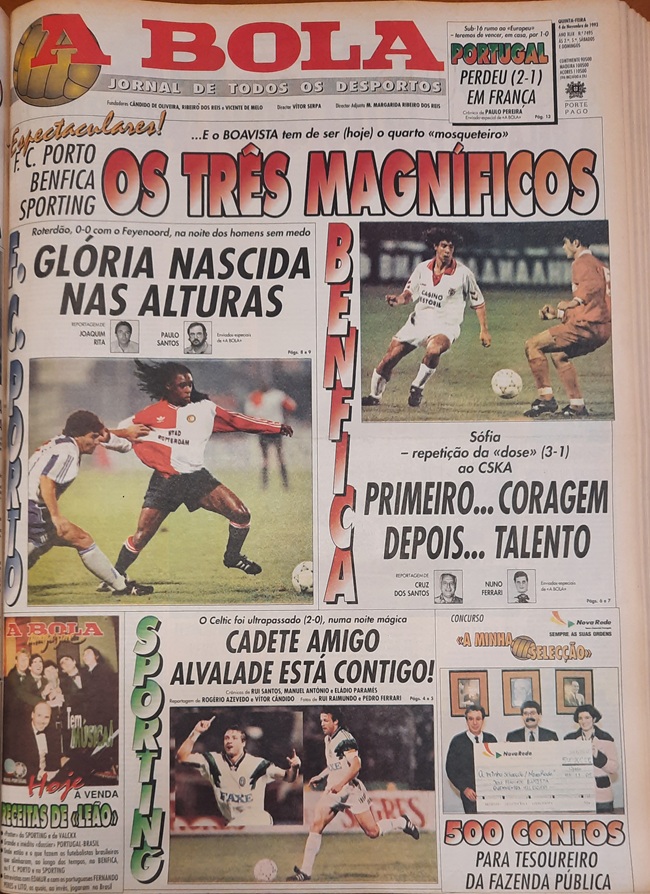
To get there, preliminary rounds without seeding had to be negotiated, which provided some of the most iconic matches of the 1990s. One of them was FC Porto’s trip to Rotterdam in the cold autumn of 1993.
***
The European Cup transitions into the Champions League
It was as confusing as it gets. Teams who played the knockouts were playing the European Cup but once you got to the group stage you were playing the Champions League. The old and the new mixed up together. Both FC Porto and Feyenoord were previous European champions, the Dutch back in 1970, when they became the first side from the Netherlands to claim the trophy, ahead of their bitter rivals Ajax, and FC Porto later, in 1987.
The Dragons had already taken part in the first official Champions League edition the previous year. That had been a group stage in the 1991/92 tournament, won by Barcelona against Sampdoria. Despite the mini-league format which involved two groups from which the finalists would be decided, UEFA decided to brand it simply as the European Cup. The following year, though, they moved to a new model where all league champions would have to face each other in two knock-out preliminary rounds that were still labelled part of the European Cup, before moving to a two-group model that would select the finalists. These knockout games were not seeded, which is the reason behind both the European Cup winners FC Barcelona and the returning English champions, Leeds United, not reaching the group stage.
FC Porto had to beat Union Luxembourg and then Sion to get there. On the first day of the new competition, they faced the Dutch champions, PSV, and drew at home, while AC Milan and IFK Gothenburg played a memorable match in San Siro, with Marco van Basten scoring four goals. In the other group Olympique Marseille, CSKA Moscow, Glasgow Rangers and Club Brugge played each other and in the end the French ended up claiming the trophy by beating AC Milan in the final. After the Valenciennes affair, Marseille were excluded from the following season’s competition, and AS Monaco, who had finished third in Ligue 1, claimed the spot after PSG refused.

Former champions toil in Malta and Iceland
For the 1993/94 edition, UEFA decided to include a semifinal, but contrary to what was customary – and would be so again – it was to be played in a single match at the home ground of the group winners. There was a first preliminary round between twenty teams of the weaker football nations and then a formal first round where Porto suffered more than expected to beat Floriana from Malta. A poor 2-0 home win was followed by an equally dreadful 0-0 away draw, but the ticket to the last preliminary round was booked, where they would face Feyenoord.
The Dutch champions, who had claimed their first league win since 1984, ending a PSV-dominated era, were hardly impressive themselves. They had to come back from a defeat in Iceland to win the return leg at De Kuip. With Portugal and the Netherlands so close in the UEFA ranking, like today, this was expected to be a titanic affair, one of the most intense in the round alongside Manchester United versus Galatasaray.
Tomislav Ivic back in the dugout
Porto had started the campaign poorly. Carlos Alberto Silva, who had won them back-to-back leagues but whose tactical style was not to the fanbase’s liking, returned to Brazil at the end of the season. Pinto da Costa did what he had already done when Quinito left, in 1987. He called back a former manager. Then Artur Jorge, now Tomislav Ivic. The Croatian had been at the helm in the club’s most memorable season, the one that followed the European Cup in Vienna. In a single campaign, the Dragons lifted the Portuguese League & Cup double, the Super Cup, the European Super Cup, and the Intercontinental Cup, only missing a second European Cup after Real Madrid came back in the final minutes of the quarter-final second leg. Despite all of that, Ivic was booed by supporters. He was deemed a hyper-defensive coach who liked to play on the counter, using the passing ability of the likes of Gomes, Magalhães and Sousa to take advantage the speed of the young Rui Barros.
In 1993, Ivic did not have those sorts of players available anymore and he felt out of touch since day one. Porto started the campaign with a 3-3 home draw against Benfica and were always on the wrong foot in the league, dropping important points home and away, conceding more than often and, worst, not scoring enough goals. The attacking duet of Emil Kostadinov and Domingos Paciência seemed to have lost its old chemistry. Even the likes of Jaime Magalhães, Ion Timofte, António Folha, or Jorge Couto weren’t providing the same number of key assists the crowd were used to. In defence, the arrival after a period out on loan of Jorge Costa to partner Fernando Couto, Zé Carlos and Aloísio was essentially the only good news from the transfer market that also brought the surprise signing of former Salgueiros striker Vinha.
Star-studded Feyenoord shatter PSV dominance
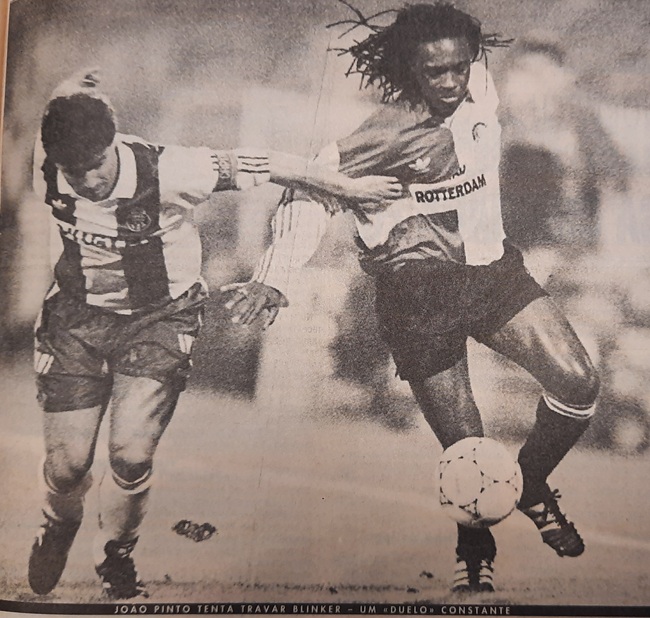
Feyenoord were still coached by Willie van Hanegem, the former international who had led them back to domestic silverware, but they too began the season on the wrong foot after Louis van Gaal’s Ajax trashed them 4-0 in the Dutch Super Cup. However, by October Feyenoord were top of the league, with nine wins and a draw against Ajax. This was a side that included the likes of Ed de Goey, Rob Witschge, Gaston Taument, John Metgod, Peter Bosz, Ulrich van Gobbel and the promising Swedish striker Henrik Larsson, but in the first leg, in Porto, they succumbed to a very late Domingos goal, after playing most of the second half with only ten men, once Bosz picked up his second yellow card of the night.
It was a good result for Porto, particularly because it meant they hadn’t conceded in the era when the away goals rule was in place, but it showed once again how much they suffered in attack to score. Ivic was well aware of it, so he prepared a different plan for the return leg to be played in the cauldron of Rotterdam, the De Kuip, one of the loudest stadiums in the world.
Pinto da Costa sees through “bomb threat” hoax
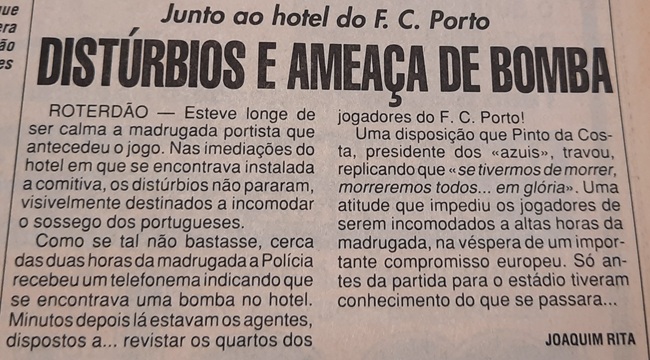
The night before the match, president Pinto da Costa was sitting in the hotel lobby where Porto were staying when a member of staff came to warn them that the reception had received a bomb threat and they should wake up the players and evacuate. Smelling a con by some radical Feyenoord ultras, Pinto da Costa quietly told the hotel management that no-one was moving. “If we have to die, we all die… in glory,” he said, making sure the players were not disturbed. Nothing happened.
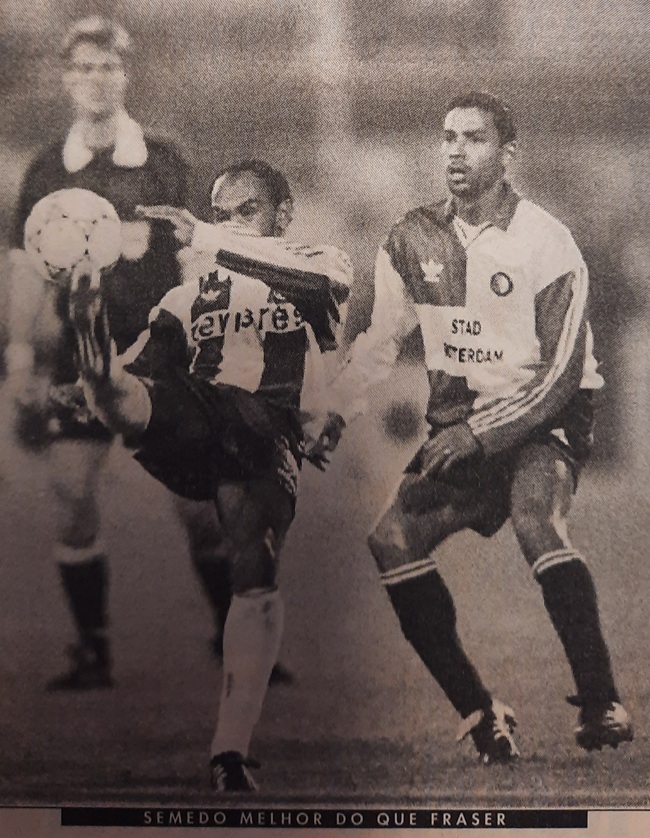
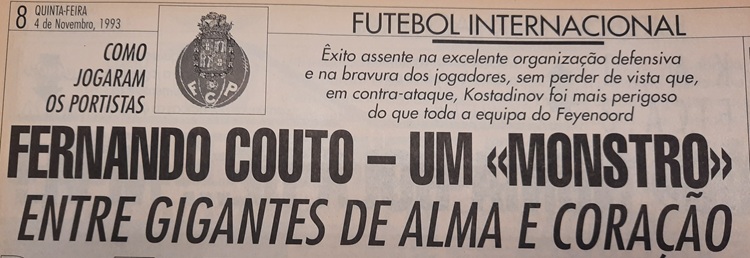
When the lineup for the match was announced, everyone was on their feet. Ivic had decided to defend with every single man available in the back line. Porto would play four centre-backs, two defensive wingbacks, and a single forward, Kostadinov. In front of Vitor Baía, the manager called upon Fernando Couto, Jorge Costa, Aloísio and Zé Carlos, with Rui Jorge and João Pinto by their side. Secretário, who then still played essentially as a winger, and Magalhães would help out the attack, while defensive midfielder Semedo was the only link between attack and defence. It was the most conservative side Porto had ever used in their history of European nights, and a testament to Ivic’s plan of focusing exclusively on not conceding to make the most of Domingos’s late effort at the Estádio das Antas.
The “brick wall” does its job
Feyenoord, on the contrary, were a much more balanced team with van Hanegem opting for de Goey, Refos, del Wolf, Fraser and van Gobell in defence while Witschge, Maas, Blinker, Scholten, Taument and van Loen would play in attack. Larsson, injured, and Bosz, suspended, were out of the match and had to watch from the stands how, from minute one, their teammates went into all-out attack mode but found themselves heading into a thick, brick wall.
Feyenoord had the ball, controlled the tempo and tried to create chances, but with the number of defenders called up by Ivic, there was simply no room to play. Whenever they tried to send crosses into the box, one of the centre-backs eventually cleared the ball back. Jorge Costa played alongside Semedo to close down the central corridor as Couto exerted command in the box and Baía saved the few shots that got past the defensive line. Offensively, Porto didn’t exist. Even when they could find the opportunity to run into space, they were usually so far away from de Goey’s goal that they were never able to pose a real threat. Instead of scoring the goal that would have made Feyenoord need to net three, Ivic seemed content to wait and see.
Frustration get the better of van Loen
At half time, he moved the first piece of the board, taking off winger Jaime Magalhães for the young midfielder Rui Filipe, a clear message that there was no plan B available. Feyenoord kept on going desperately but, as time passed, they became even more frustrated. Van Hanegem decided to replace Scholten with Nigerian striker Mike Obiku and then left-back Henrk Fraser for the attacking midfielder Dean Gorré, to no avail. As the game was going to their final moments, an assault from John van Loen, their star striker, cost him a red card, and the game was practically over after that. Domingos came on for Kostadinov in stoppage time but more to waste some precious seconds than to have an impact.
Regardless of how crazy it had seemed, Ivic’s plan worked and for a second consecutive season, FC Porto found their way into the Champions League group stage. Feyenoord were out. Their season would culminate in a Cup win and a poor league result. Just like their rivals of the night, in fact.
Ivic out, Bobby Robson in
The Dragons would be drawn to play AC Milan for a second consecutive season alongside Werder Bremen and Anderlecht. A 3-0 home win against the Germans was followed by a massive defeat in San Siro and then a defeat, followed by a win, against Anderlecht. By then Ivic had been dismissed, although the club’s official version was that he had accepted a vacancy with UEFA’s technical board. An elegant way of saying things didn’t work out. Da Costa then hired Bobby Robson, who had been sacked by Sporting weeks before after losing against Casino Salzburg in the UEFA Cup, despite leading the league table. The former England manager would set down the foundations for what became known as the Penta (five league wins in a row) era.
Before that, a crucial and historic 5-0 away win in Bremen allowed Porto to guarantee a place in the semis, and they could have actually topped the group if a Ljublinko Drulovic shot had found its way into Milan’s goal in the return match between both sides. The Serbian had been a decisive winter signing, but he proved ineffective when Porto travelled to Camp Nou to face Johan Cruyff’s Barcelona. Against all the odds, Robson selected Aloísio as left-back to man-mark Hristo Stoichkov. The Bulgarian ran the show and Barcelona cruised to an easy win.
“He who has no dog hunts with a cat” – Portuguese saying
It was Porto’s best-ever result in the Champions League apart from the two seasons when they won the trophy, a testament to the rollercoaster campaign they had. Robson’s exciting side demolished Werder Bremen in Germany, but the Blue & Whites had only reached that stage thanks to Ivic’s crazy tactics in Rotterdam. It wasn’t pretty and was never repeated, but that night it worked and allowed Porto to become even more of a household name in European football when the Champions League was starting to completely revamp the nature of continental football.
