
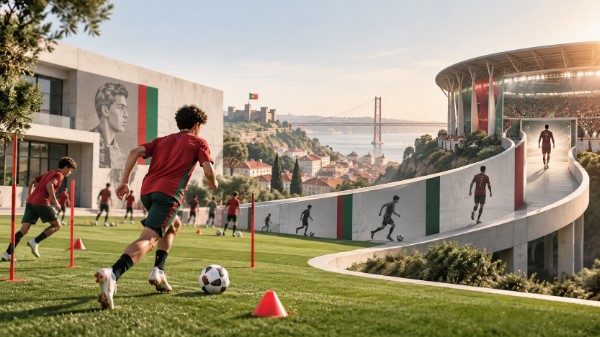
Cristiano Ronaldo is the most famous example. He is not the whole explanation.
Portugal has repeatedly moved players from youth football into elite European competition. Luís Figo and Ronaldo belong to earlier generations; Bernardo Silva, Rúben Dias, João Cancelo, João Félix, João Neves and Nuno Mendes followed later.
The individual careers differ. What persists is the development pipeline behind them.
Three major academies keep feeding the system
Sporting CP, SL Benfica and FC Porto have all supplied Portuguese national teams with academy-trained players.
An FPF study covering national-team call-ups from under-15 level upward between July 2005 and December 2015 found that 18.5% of the players came from Sporting’s development system. Benfica accounted for 17.2% and Porto for 15.2%.
Those figures matter because they show that Portugal’s talent production is not confined to one extraordinary academy or one generation.
Sporting has produced Cristiano Ronaldo, Nani, João Moutinho and Rui Patrício, among many others. Benfica Campus has developed names such as Bernardo Silva, João Cancelo, Rúben Dias, Renato Sanches, João Félix and João Neves. Ballon D’Or contender Vitinha and Diogo Costa came through the Porto ranks.
Ten of 14: Sporting’s extraordinary Euro 2016 footprint
Portugal’s Euro 2016 final provides an unusually clear example.
Fourteen players appeared for Portugal during the 1-0 victory over France. UEFA identified ten of them as Sporting academy graduates: Rui Patrício, Cédric Soares, José Fonte, William Carvalho, Adrien Silva, João Mário, João Moutinho, Nani, Ricardo Quaresma and Cristiano Ronaldo.
It was not simply a starting XI packed with players from the same domestic club. Many had already moved elsewhere. Their common link was where an important part of their football education had taken place.
Youth football needs a bridge to the senior game
Producing technically gifted teenagers is only the first stage. They still need matches where mistakes carry adult-level consequences.
Depending on the player and club, that bridge can involve:
- UEFA Youth League football;
- B-team appearances;
- U23 championship (Liga Revelação) appearances;
- senior domestic cup matches;
- loans;
- first-team minutes in Portugal;
- a later transfer abroad.
Former Benfica academy and B-team coach Renato Paiva has explained why the B-team stage can be especially revealing. Youth sides may dominate possession so heavily that defenders spend relatively little time under sustained pressure.
Senior football changes the test. A young centre-back can suddenly face experienced professionals, physical duels and long stretches without the ball. Paiva cited Rúben Dias as an example of a defender who accumulated substantial B-team experience before establishing himself higher up the ladder.
Development also creates transfer value
Portugal’s big clubs have another incentive to keep the pathway moving. A young player who performs in senior football becomes easier for overseas clubs to evaluate.
First-team minutes provide evidence that youth tournaments cannot. Scouts can see how a teenager responds against experienced opponents, handles tactical responsibility and performs when points matter.
When a graduate leaves, another prospect can take the available minutes. The cycle turns player development into both a sporting resource and a source of transfer value.
Portuguese prospects are followed long before they leave
Scouting is no longer confined to professional recruitment departments. Supporters watch UEFA youth competitions, follow B-team prospects and discuss transfers before a teenager has completed a full senior season.
Once these young players reach first-team football, their progression creates a continuous cycle of engagement for adult sports followers worldwide. Modern fan behaviour relies heavily on second-screen mobile habits, where viewers constantly monitor live statistics and shifting dynamics during a match. Recognising this demand for immediate digital context, many active sports enthusiasts utilize RolsBet to enhance their live viewing experience with real-time updates and interactive markets. Football media, statistical databases, and interactive platforms may serve separate primary purposes, yet they all respond to this exact same thirst for instant matchday data. Ultimately, Portugal’s regular supply of elite talent ensures that this audience always has fresh careers to track every single season.
International football amplifies the attention. A prospect can progress from academy competition to senior club football and the Portugal squad while attracting interest from leagues abroad. An existing user might open a RolsBet login during a Portugal match while another supporter follows tactical analysis or live statistics. The common element is the second screen, where information about players now travels almost as quickly as their careers do.
Portugal’s advantage is therefore not one golden generation. Sporting, Benfica, Porto and the wider domestic structure have repeatedly created steps between youth football and senior pressure – the stage where potential has to become professional performance.
