
Heavy rain can change the character of a football match long before the referee considers whether conditions are suitable for play. A pitch that cannot move excess water away efficiently may become softer, less predictable and increasingly difficult to manage as rainfall continues.
For grounds teams, however, dealing with water is not simply a matter of reacting when a storm arrives. Maintaining a playable natural-grass surface requires ongoing management of drainage, irrigation, soil conditions and the infrastructure beneath the turf.
In Portuguese football, where pitches can face very different weather conditions over the course of a season, effective water management is one of the less visible aspects of preparing a surface for training and competition.
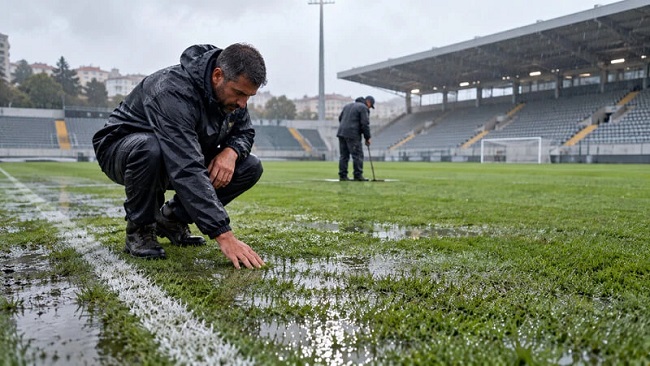
Why heavy rain can become a problem for football pitches
A football pitch needs moisture, but too much water can create problems when the soil reaches the point where it cannot accommodate or move excess water quickly enough.
Persistent rainfall can leave the surface saturated. If water begins accumulating faster than it can drain away, wet areas or standing water may develop.
This matters because the behaviour of the playing surface changes. A very wet pitch can become softer underfoot, ball movement can become less predictable, and repeated traffic from players can place additional stress on vulnerable areas.
Compaction is another consideration. Football pitches experience concentrated use, and heavily trafficked areas can behave differently from sections receiving less wear. Soil structure, construction, maintenance practices and existing moisture levels can therefore all influence how a pitch responds to rainfall.
For a grounds team, the objective is not simply to remove visible puddles. It is to maintain a soil and drainage environment capable of managing water while supporting healthy turf and a consistent playing surface.
How football pitch drainage systems work
Drainage provides excess water with a route away from the playing surface.
The exact design varies according to the construction of the pitch, soil profile, available infrastructure and other site-specific factors. In general terms, water needs to move from the surface through the underlying profile and eventually towards a drainage network or suitable discharge point.
A well-functioning system therefore depends on more than the pipes beneath the pitch. The condition of the upper layers matters because water must be able to move through them.
If the soil becomes heavily compacted or the surface profile loses permeability, rainfall may remain near the top even when drainage infrastructure exists below.
This is why pitch maintenance and drainage cannot be treated as entirely separate subjects. Grounds teams may use appropriate maintenance practices to manage compaction, encourage movement of water through the soil profile and maintain the characteristics required by the turf.
Drainage infrastructure also needs attention. Outlets and accessible parts of the system can require inspection, particularly when a pitch begins behaving differently from its usual pattern during wet weather.
A consistently problematic area does not necessarily prove that a drain has failed. Differences in levels, soil conditions, wear and other factors may also affect how water behaves. Identifying the cause is more useful than assuming every wet area has the same explanation.
Irrigation is just as important as drainage
Managing a football pitch is not only about removing water. During drier periods, the challenge can be precisely the opposite.
Natural grass requires appropriate moisture to remain healthy, and irrigation systems allow grounds teams to supply water when rainfall does not meet the needs of the pitch.
The objective is controlled application rather than simply using as much water as possible.
Weather conditions, soil characteristics, turf condition and existing moisture all influence irrigation decisions. Applying water to a pitch that already contains sufficient moisture can be unnecessary, while insufficient irrigation during dry conditions can place additional stress on the grass.
Uniformity also matters. If irrigation coverage differs significantly across the playing surface, some areas may receive more water than others. Sprinkler performance and the wider distribution system therefore form part of maintaining consistent conditions.
This creates a balancing act throughout the season: drainage must deal with excess water when necessary, while irrigation needs to provide sufficient moisture when natural rainfall is inadequate.
Both depend on infrastructure that largely remains invisible during a football match.
When excess water is not caused by rain
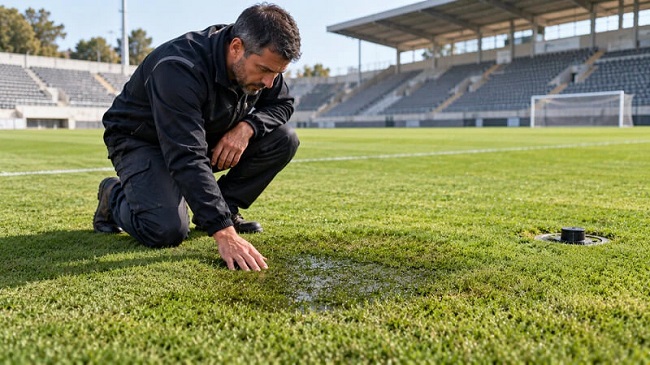
Weather is an obvious explanation for a wet football pitch, but it is not the only possible source of excess water.
If one area remains unusually wet during otherwise dry conditions, or repeatedly behaves differently from the surrounding turf, the irrigation system and associated water infrastructure may be among the factors worth investigating.
Underground supply pipes, connections, valves and irrigation components can potentially develop faults. A hidden loss of water may create persistent localised moisture, waste water and alter ground conditions without producing an obvious above-ground leak.
The presence of a wet patch does not prove that an underground pipe is leaking. Irrigation patterns, drainage performance, soil characteristics and other factors need to be considered. Comparing the affected area with weather conditions and irrigation activity can help establish whether further investigation is justified.
When a buried leak is suspected but cannot be identified visually, diagnostic techniques can help narrow down its location before disruptive excavation is considered. Different water leak detection methods can be appropriate depending on the pipework, accessibility and characteristics of the suspected fault.
Acoustic techniques, for example, can be useful in suitable circumstances by analysing sounds associated with water escaping from pressurised pipework. Tracer gas is another option for certain installations and types of investigation.
Thermal imaging can sometimes contribute by identifying differences in surface temperature that justify further examination. It should not, however, be understood as a technology that simply sees water or pipes through the ground.
The appropriate approach depends on the specific situation. No single diagnostic method can be assumed to locate every underground leak, and different techniques may be complementary.
For a football facility, determining the likely location of a problem before excavation is particularly valuable because unnecessary disturbance of the pitch creates its own maintenance challenge.
Maintaining a playable surface throughout the season
Good pitch maintenance is a continuous process rather than a response reserved for periods of extreme weather.
Monitoring how different areas react to rainfall can reveal changes over time. A section that suddenly drains more slowly than it did previously may justify closer inspection, even if it has not yet developed serious standing water.
The same principle applies to irrigation. Observing sprinkler coverage, looking for unusually wet or dry areas and checking accessible components can help identify anomalies before they become more disruptive.
Soil condition is equally important. Because the movement of water through the surface is influenced by the physical condition of the pitch profile, managing compaction and maintaining appropriate soil characteristics form part of effective water management.
The maintenance programme must also reflect use. Goal areas, touchline zones and other heavily trafficked sections can experience different stresses from less intensively used parts of the pitch.
Weather then adds another variable. Maintenance decisions that make sense during a prolonged dry period may be inappropriate during a sequence of wet days.
The result is a process of observation and adjustment rather than a fixed formula that works in every stadium or training ground.
Drainage and irrigation need to work together
Drainage and irrigation may appear to perform opposite jobs, but they form part of the same water-management system.
Irrigation provides controlled water when the pitch requires it. Drainage helps move excess water away when rainfall or other sources exceed what the surface can accommodate.
Problems can arise when either side of that relationship stops behaving as expected.
Poor drainage can leave parts of the surface excessively wet. An irrigation fault can apply too much water to one area or allow water to escape from underground infrastructure. Conversely, inadequate irrigation during dry conditions can result in uneven moisture across the pitch.
For grounds teams, the useful question is therefore not simply whether a pitch is “too wet” or “too dry”, but why a particular area is behaving differently and which part of the wider system may be contributing to it.
That distinction helps maintenance remain targeted rather than reactive.
The infrastructure behind a good football pitch
Supporters watching a match naturally focus on the grass they can see. Beneath that surface, however, is an infrastructure that plays an important role in how the pitch performs throughout the season.
Drainage routes help manage excess rainfall. Irrigation networks supply water when conditions are dry. Underground pipes connect parts of those systems, while the soil profile determines how readily water can move through the playing surface.
None of these elements works entirely in isolation.
Maintaining a football pitch therefore involves much more than cutting grass and repairing visible wear. It requires monitoring the interaction between turf, soil, weather and water infrastructure, while responding to changes before they develop into larger problems.
Heavy rain makes that hidden work particularly noticeable. When drainage, irrigation and routine maintenance are functioning effectively together, the result is something players and supporters may barely think about: a playing surface capable of coping with the demands of football and the changing conditions of a long season.
