
-
From Blois to Académico de Viseu

Hugo Gambor was born on 30 December 2002 in Blois, France, where his football journey also began. He spent most of his youth development at Blois Football 41, remaining at the club for 12 seasons before joining US Orléans in 2019 at the age of 17.
A year later, he caught the attention of Paris FC, where he signed his first professional contract. Despite joining a Ligue 2 club, Gambor featured mainly for the reserve side in National 3, occasionally operating as a defensive midfielder.
His first major opportunity came in 2022. With limited first-team opportunities in Paris, Gambor joined Dunkerque, then competing in France’s third tier, and quickly established himself in the side. His first season ended with promotion to Ligue 2. At the higher level, Gambor later admitted that rather than the physical demands, it was the reduced margin for error that surprised him most.
His performances at Dunkerque eventually earned him a move abroad. In January 2024, he joined Gent, his first experience outside France. After a gradual introduction, he earned more playing time the following season, although injuries interrupted periods of regular involvement.
In August 2025, Gambor returned to France on loan at Troyes, with his 2025/26 Ligue 2 campaign forming the statistical basis of this analysis.
Although born in France and previously involved with the French U18 setup, Gambor later chose to represent the Central African Republic, his father’s country of origin, making his senior international debut in September 2024.
A new chapter followed in September 2026, when the 23-year-old completed a permanent move to Académico de Viseu, adding Portuguese football to a career already spanning France, Belgium and international football.
-
The recruitment question
Following his 2025/26 season at Troyes, what type of centre-back is Hugo Gambor, and how could his profile fit the current demands of Académico de Viseu?
-
Methodology — from data to game context
The analysis focuses on Gambor’s 2025/26 season at Troyes. He made 20 appearances across all competitions, while the statistical sample used in this study is restricted to his 16 Ligue 2 appearances and 1,098 minutes played.
Data collected from SofaScore was benchmarked against 65 Ligue 2 centre-backs with at least 1,000 minutes played, using nine metrics covering defensive actions, duels and distribution. Gambor’s performance was converted into percentiles to contextualise his position within the cohort.
His profile was then compared with Académico de Viseu’s current centre-backs, using 2025/26 data to maintain consistency between samples. His potential fit, however, was assessed against Académico’s current 2026/27 context, supported by match observation.
Finally, five full Gambor matches were analysed, using the data to identify questions for video investigation rather than assuming the footage should confirm the numbers.
Data identifies signals and raises questions; video helps explain how and why those signals emerge, and can reveal behaviours the numbers do not capture.
-
What does the data tell us?
Gambor’s statistical profile shows a clear contrast: he ranks among Ligue 2’s most efficient centre-backs in possession, while recording significantly lower numbers across several duel metrics.
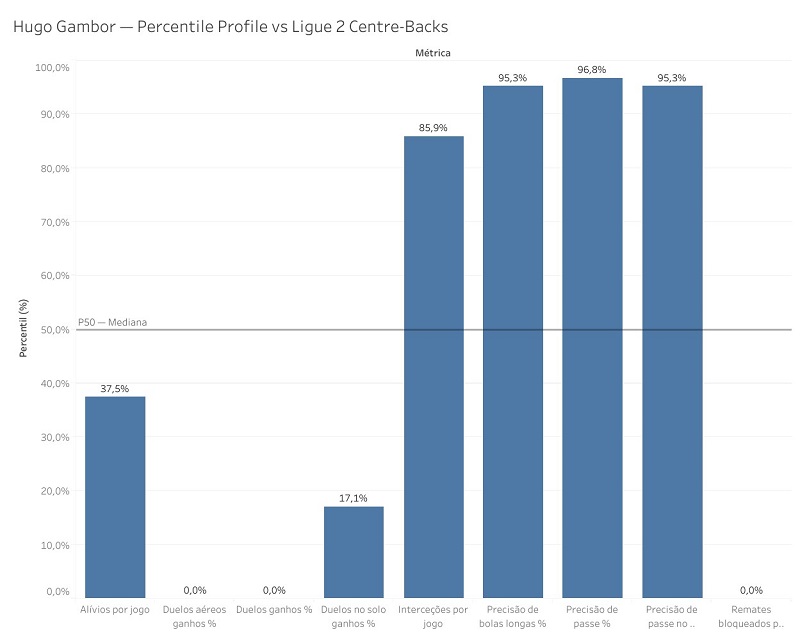
In possession, Gambor recorded 93.02% pass accuracy (P97), 85.88% accuracy in the opposition half (P95) and 62.69% long-ball accuracy (P95). These numbers point to a highly efficient distributor, although accuracy alone does not reveal pass difficulty, risk or progression.
Out of possession, his 1.25 interceptions per game (P86) provide another strong signal, raising questions around his ability to read passing lanes and anticipate play.
The picture changes significantly in the duels. Gambor won 44.33% of his overall duels (P0), 51.11% of his ground duels (P17) and 38.46% of his aerial duels (P0). These numbers warrant attention, but do not explain the underlying causes: positioning, timing, opposition, duel difficulty and tactical context may all influence the outcome.
The same caution applies to his zero blocked shots (P0). Rather than treating this as evidence of poor box defending, the more relevant question is broader: how does Gambor actually defend his own penalty area?
The data therefore provides an initial hypothesis: a highly efficient distributor with strong interception output, but significant questions around his duel performance.
-
How does he compare with Académico’s centre-backs?
To understand what Gambor could add to the squad, his profile was compared with Académico’s current centre-backs — Nikolaos Michelis, Anthony Correia, Pedro Barcelos and Rúben Pereira — using 2025/26 data.
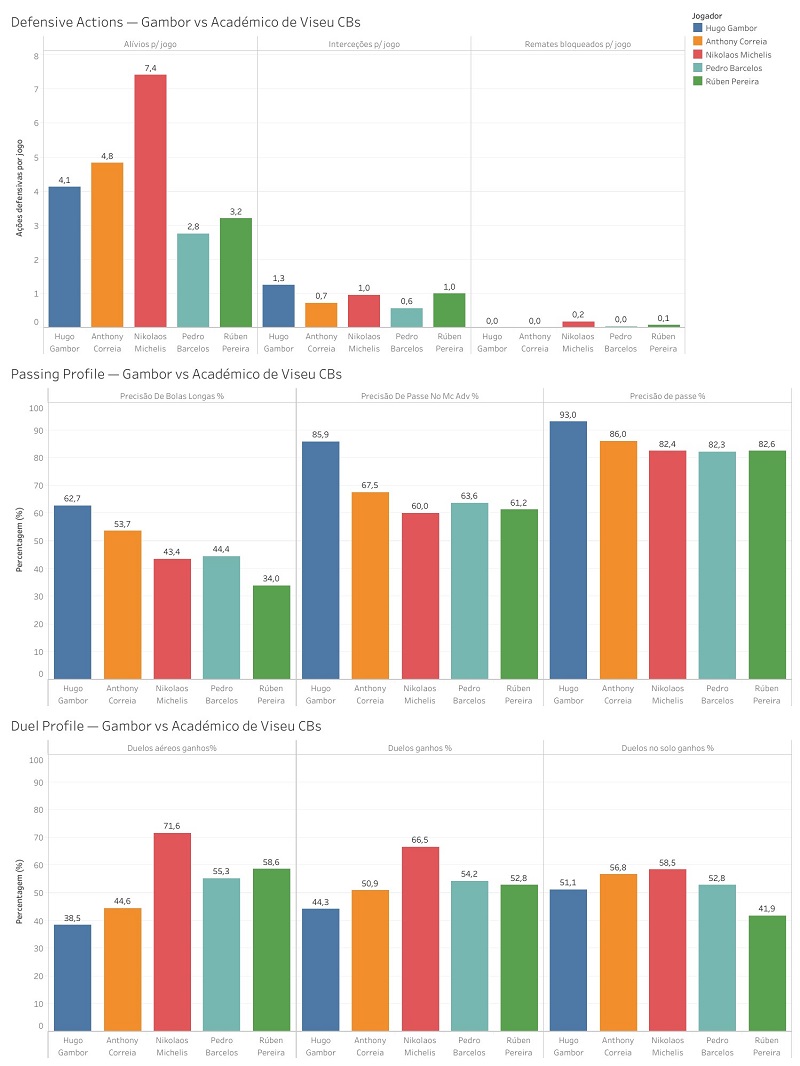
The clearest difference again comes in possession. Gambor leads the internal comparison across all three distribution metrics: 93.02% pass accuracy, 85.88% opposition-half pass accuracy and 62.69% long-ball accuracy. He also records the highest interception rate at 1.25 per game.
The contrast remains in the duels. His 44.33% overall duel success and 38.46% aerial duel success are the lowest figures in the comparison, while his 51.11% ground-duel success places him above Rúben Pereira but below the other three centre-backs.
This comparison is not intended as a ranking. The players competed in different contexts, while Pedro Barcelos and Rúben Pereira recorded fewer than the 1,000 minutes required for the Ligue 2 benchmark. Instead, the aim is to identify what Gambor could add to the group and which aspects of his profile require further investigation.
The internal comparison therefore reinforces the initial picture: distribution and interceptions differentiate Gambor positively, while his duel performance remains the main area of uncertainty.
6. From data to video
Five full matches were analysed to provide context to the statistical signals — and the data and video did not always tell exactly the same story.
For interceptions, the video supported the data. Gambor’s 1.25 per game (P86) were reflected in his recurring ability to anticipate trajectories, recognise opposition movements and occupy space before the receiver.
In possession, the footage also supported his strong statistical efficiency. Gambor generally looked secure in build-up, capable of reading pressure and finding both inside and longer options. However, he tended to favour lower-risk solutions and showed occasional issues with body orientation against blind-side pressure and with his final decision after longer carries.
The main discrepancy appeared in the duels. Despite ranking at P17 for ground duels and P0 aerially, Gambor won 8 of the 12 clear ground duels and all 4 clear aerial duels identified across the five matches.
The video sample is too small to override the season data, but it also does not support treating these areas as confirmed weaknesses. Three of the four ground duels he lost resulted in fouls, making his approach and management of contact worth monitoring. Aerially, the gap between the season numbers and the observed sample would justify further assessment.
Video also provided greater context to his box defending. Despite recording zero blocked shots, Gambor produced several positive actions through cross clearances, anticipation and tackles in dangerous areas. However, two goals from crosses highlighted issues with tracking and controlling opposition references inside the box.
Overall, the footage supported some statistical signals, challenged others and revealed behaviours the data could not capture.
7. Profile and fit at Académico de Viseu
Combining data and video, Gambor profiles as a quick, technically secure centre-back suited to playing in build-up, with distribution, long passing, anticipation and depth control among his most notable qualities.
There are also areas of uncertainty. He can be conservative in possession, while his scanning and body orientation under pressure showed some inconsistency. His decision-making after longer carries and his control of opposition references against crosses also require attention, while the season-level duel numbers remain an open question.
To assess how those characteristics could translate to his new environment, four full Académico matches of this season were observed. Recurring patterns included short build-up from the goalkeeper, strong involvement from the centre-backs and the deepest midfielder regularly dropping alongside or between them. Centre-backs were also able to carry forward when space became available.
This context appears compatible with Gambor’s security in possession and passing quality. His speed and anticipation could also be valuable when Académico defend higher, particularly when controlling space in behind or when a centre-back steps out to engage an opponent.
However, those same demands make some of his uncertainties particularly relevant. Short build-up increases the importance of scanning, body orientation and decision-making under pressure, while his occasional issues tracking opponents from crosses and the uncertainty surrounding his duel performance remain areas to monitor.
Overall, Gambor appears to offer Académico a differentiated profile through his distribution, anticipation and ability to defend space in behind, with several characteristics aligned with the patterns observed in the team.
-
Recruitment conclusion
Gambor presents a potentially interesting profile for Académico de Viseu, particularly through his distribution quality, anticipation, speed and depth control.
Questions remain around his duel performance — particularly aerially — as well as his tracking of opposition references from crosses and decision-making under pressure. Based on the evidence collected, he would warrant progression to a further stage of assessment, focused specifically on these areas of uncertainty.
The purpose of that next stage would not be to confirm a predetermined conclusion, but to reduce uncertainty before a final recruitment decision.
