

Sporting have sacked manager Rui Borges and replaced him with Paulo Fonseca. Portuguese football journalist Kevin Fernandes gives his opinion on the decision.
Rui Borges was announced as Sporting Clube de Portugal manager in the festive Christmas period (December 26th, 2024), had his contract renewal announced on Portugal’s labour day (May 1st, 2026), only for it to be terminated on The Day of the Dead (November 2nd, 2026). Both parties are yet to reach an agreement regarding the rescission.
Ironic, or illustrative? Tiago Fernandes may have held the official title to guide Sporting through a tough test against Shakhtar, but Rui Borges was already an interim in spirit – in other words, a dead man walking – after initially guiding the Lions to two trophies in his first six months in charge.
A gift and a curse
The status of the man from Mirandela contrasted heavily to his predecessors, the former top-level players and Portuguese internationals, Ruben Amorim and João Pereira.
Borges’ humility was once his greatest strengths, as the coach was willing to accommodate the squad he inherited by respecting the dynamics implemented by Ruben Amorim in an authentic interim-style job.
Sporting weathered the storm under Borges, who survived an unprecedented wave of debilitating injuries, recovering the squad’s hunger and drive, who mourned and moped after losing their affectionate father-figure Amorim, on the way to conquering two trophies: the Liga Portugal title and the Taça de Portugal, the double that I had never seen Sporting do in my (relatively short) lifetime.
 |
For that, every Sportinguista will be eternally grateful. Rui Borges’ name will be written in the history books, without any question marks or asterisks.
From “Onde Vai Um Vão Todos” to “Tiki Taska”
In his first full season, Sporting went trophyless. The ‘cherry on the cake’ of both campaigns was the Portuguese Cup final, with diametrically opposing outcomes. From the enthralling high of beating eternal rivals SL Benfica in 2025, to the lamentable low of being defeated in extra-time by Liga Portugal 2 side SCU Torreense in 2026.
Accusations of lacking hunger, humility, histrionics in the midst of humiliation were more than Rui Borges’ fragile stature could withstand. Despite numerous votes of confidence by the board, the evaluation of the masses resulted in the impression that Borges’ days were numbered.
The game model was never the fundamental issue as his sides showed themselves capable of playing attractive football at times, even warranting the label “Tiki Taska”, which is a play of words with the well-known Spanish style of short-passing football, tiki-taka, and the Portuguese word for a rudimentary bar, a tasca. The phrase helps explain his defined ceiling as Rui Borges never truly received the widespread consideration and respect that Ruben Amorim’s natural charisma, standing in the game and concise, captivating communication style warranted from minute one.
Ruben Amorim was defined by the slogan that translates into “Where one goes, we all go” – an eloquent catchphrase uttered upon his presentation and which became a mantra among the Sporting staff and supporters alike. Rui Borges was defined by a well-intentioned yet comparatively degrading play on words relating to typical Portuguese bars/taverns where the working class frequent.
The underdog couldn’t embrace becoming top dog
Rui Borges’ understated (passive) nature was seemingly insufficient in ruthless contexts of great expectation. Paradoxically, he enjoyed unrivalled success in the Champions League, where the stringent demands were replaced by freedom afforded by lack of expectation.
Sporting made history against the likes of Paris Saint-Germain, Athletic Club and BFK Bodø/Glimt, finishing in the top 8 of the league phase of the UEFA Champions League and reaching the quarter-finals, where they were narrowly beaten by eventual finalists Arsenal. Yet the same side that went toe to toe versus Europe’s elite failed to beat Braga, Benfica and Porto in any of the six league fixtures against them. A repetitive inability to hold onto leads in domestic matches was another black mark against Borges.
The inability to take command during complete matches and captivate the crowd outside of the biggest European nights led the Sporting hierarchy to attempt a drastic transition into a new era, revolutionising the squad and moving on from the key figures that had underpinned the previous successes. The likes of Morten Hjulmand, Pedro Gonçalves and Francisco Trincão, among other, were sold, but the board withstood from substituting the least secure protagonist of all, Rui Borges.
President Frederico Varandas defended the credentials and successes of his manager after planning an entire season under his leadership, proceeding with what proved an untimely contract renewal in the midst of a run of dropped points against relegation favourites, which saw Sporting temporarily drop out of the Champions League places.
A lack of foresight and proactivity had become increasingly apparent and the project was condemned to failure.
Needless to say, Rui Borges had his faults.
Among other aspects, Sporting often lacked sufficient confidence to manage leads in a manner befitting of an ambitious club, while breaking down compact, deeper defensive blocks became increasingly lethargic and turbulent affairs.
In some aspects, it seemed that the manager was reverting to his old ways after feeling initially obligated to adopt some of the principles that had underpinned the club’s previous successes. This current Sporting side have mirrored some behaviours which would more appropriately befit Rui Borges’ former clubs of lesser ambitions and working conditions.
The discourse became repetitive as Borges cited his background as a motive behind the negative atmosphere circulating his name and while faults seemed to be overstated in comparison with his contemporaries, the trajectory of his spell was evident.
Competitive fixtures became the trojan horse
Criticised for his lack of action on the sidelines, poor use of the bench and failing to identify and/or rectify problem areas within the squad, the clock was ticking.
In pre-season, Sporting enjoyed success, playing against sides in earlier phases of preparation, Rui Borges implemented the following dynamics:
- A more aggressive press with a 4-1-3-2 structure
- A double midfield pivot including Silas Andersen
- Issa Doumbia as an interior forward on the left side of the attack
- Flávio Gonçalves in a freer No10 role to mirror the dynamics of the departed Francisco Trincão (creative in small spaces)
- Eduardo Felicíssimo providing a calmer head in the heart of the defence
Fast-forward ten league matches later and none of these dynamics were maintained, with switches in personnel and tamed intentions impacting the fluidity and comfort of his squad.
The switch from small-space mastery to explosive transitional dependence was spearheaded by the unbalanced squad reconstruction which goes beyond the manager. But mentality is what separates the elite from the rest, and despite some promising results, Rui Borges was clearly better tailored to specific contexts and it seemed that a ceiling was becoming self-imposed.
His squad needed a contrasting, friendly face in 2024, but subsequently the ruthlessness of a firm figurehead was evidently missing to maximise Sporting’s potential.
Enter Paulo Fonseca… in controversial fashion
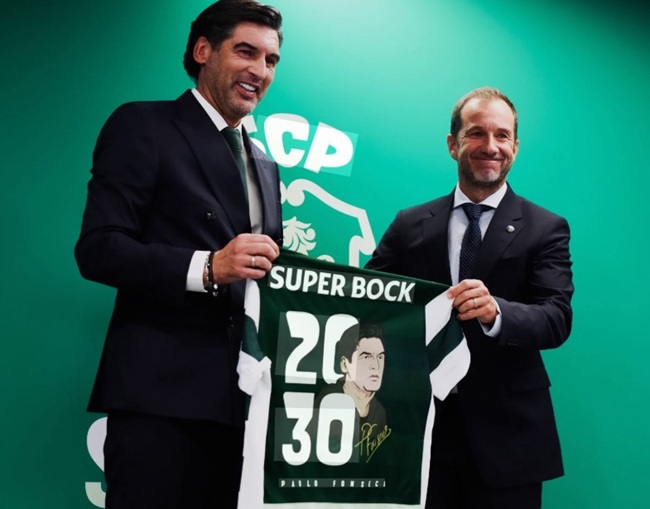
One game away from becoming a centurion and forever written in the history of Sporting Clube de Portugal (one of their most successful eras in recent times), Rui Borges was seemingly used as an interim while the hierarchy negotiated a deal for his intended successor, Paulo Fonseca.
Frederico Varandas is quick to invoke his moral compass in criticisms of rival clubs and their leaders, but led an operation which was conducted in less than appropriate and befitting fashion. Agreement is yet to be reached with the coach entitled to around five million euros, who refused to take charge of preparations for the Shakhtar match despite being requested to do so by Varandas, given the self-serving posture of the club.
Paulo Fonseca’s arrival from Lyon has another twist of irony to it. Sporting were victims of mid-season manager poaching, when Manchester United swooped to whisk away Ruben Amorim in 2024, and now the Lisbon club have become the benefactors of the same strategy, to the detriment of Lyon.
Promising themes expected
At his presentation, Fonseca expressed his historical affection for Sporting, describing how he would excitedly watch several of the club’s past heroes in his formative years.
In the YouTube video entitled DAY 1 | Paulo Fonseca, the theme was intensity, with the interventive coach pushing for fast action with and without the ball. One scene of the compilation ended with the phrase “they have to run” while he chuckled.
The goal: to create an environment to breed excellence and superiority
In his first pre-match press conference, multiple quotes were particularly interesting as the Luso-Mozambican identified the necessity to patiently evolve in positional attacks and his desire to defend his way.
The 53-year-old coach said that the best way to defend was by having the ball, that his sides will press man-to-man across the pitch in an ambitious manner, praising sides like Académico de Viseu, Porto and Gil Vicente for their approaches.
Paulo Fonseca has become renowned for his attacking philosophy and successfully platforming young talents, which are aspects of his coaching that will captivate the masses from the get-go.
Renewed hunger, assurance in posture, desire to dominate and evolve. The mentality that Paulo Fonseca transpires is what Sporting currently seem to lack in various forms.
UEFA Champions League fixtures against Manchester United and AS Roma, and a Liga Portugal fixture at runaway leaders FC Porto in the next month represent monumental challenges. But before the international break, tonight at Alvalade, Moreirense represent the first opportunity for Paulo Fonseca to spearhead a step in the right direction.
