
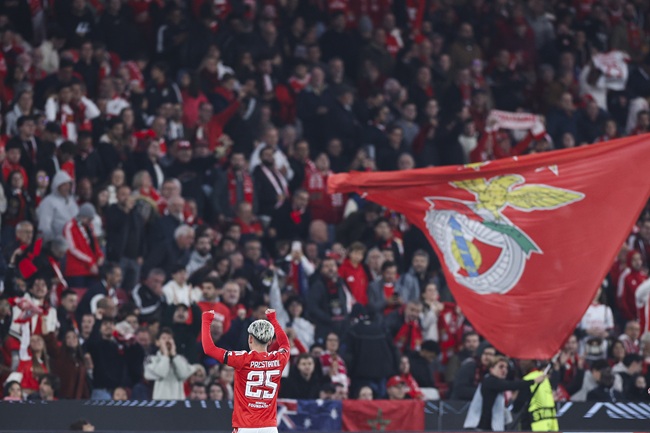
Benfica went through a whole league season without losing and still finished third. Set next to the NFL, that strange fact says a lot about how differently the two footballs behave, and about why forecasting them is a completely different job.
Thirty-four league games, 23 wins, 11 draws, no defeats. Benfica’s 2025-26 season under José Mourinho was the club’s first unbeaten Primeira Liga campaign since 1977-78, and it ended in third place, eight points behind champions FC Porto and two behind Sporting. For the third season running, Benfica finished on 80 points. It just wasn’t enough.
In the NFL, that sentence could not exist. A team that never loses in American football wins everything, because there is almost nothing in between. Since the start of the 2022 season, the league has played 1,276 regular-season and playoff games. Four of them ended in a tie.
I started pulling numbers on this after spending a few weeks with nflpredictions.ai, a site that publishes a forecast for every NFL game, and a large part of college football, before kickoff, then grades every call in public afterwards. The more I looked at its record, the more I wanted to know how the same questions would play out in a league I know far better. So I went through every Liga Portugal match since August 2024, 710 of them, and every NFL game since 2022, and put the two side by side.
The draw changes everything
In Liga Portugal over that period, the home side won 41.8% of matches, the away side 32.5%, and 25.6% ended level. One game in four, roughly, with no winner at all.
That is the single biggest reason football is so hard to call match by match. When I took the side the pre-match market rated as favourite, it won only 56.8% of the time in Portugal. A further 25.7% were draws, and the underdog won the remaining 17.5%. In the NFL, where a draw almost never happens, the favourite won 67.3% of games. Same idea, very different numbers, and nearly all of the gap is the draw.
Ask Benfica. Each of their eleven draws last season was two points short of a win, and they were chasing a Porto side that drew only four times all year.
Portugal’s other kind of certainty
And yet, at the very top, Portuguese football is about as predictable as the sport gets. Since August 2024, Benfica, Porto and Sporting have played 211 league games against the rest of the division. They won 168, drew 31 and lost 12. That is four wins in every five games, and a defeat roughly once every 18 matches. They scored 2.43 goals per game in those fixtures and conceded 0.68.
The NFL is built to stop that from happening. The salary cap keeps squads roughly level in spending, and the draft gives the first choice of new players to the teams that finished worst. The effect shows up clearly in the data. In the most one-sided games on paper in Liga Portugal, 119 of them, the favourite won 88.2% of the time. In the NFL’s most one-sided games, 292 of them, the favourite won 78.8%. A heavy favourite in Portugal is a safer thing than a heavy favourite in the NFL.
The big three are a different story when they meet each other. There have been 13 league games between them since August 2024, and six ended in draws, close to half. The Clássico is the one fixture in Portugal where the usual certainty disappears.
One score in five against one in forty-three
The scorelines tell the same story from another angle. In Liga Portugal, 1-0 (to either side) was the most common result, in 20% of matches. One game in five. Add 2-1, 2-0 and 1-1, and you have covered more than half the league.
The NFL has no equivalent. Those 1,276 games produced 481 different final scores. The most common, 20-17, came up 30 times, which is 2.35% of games, or about one in 43. Points arrive in threes and sevens, so the margins bunch up around those numbers: 15.4% of NFL games were decided by exactly three points and 8.2% by exactly seven. More than half were settled by eight points or fewer, a single score.
This is where nflpredictions.ai caught my eye in the first place. For this Sunday’s game between the Miami Dolphins and the Indianapolis Colts, the model’s most likely final score is 20-17 to the Colts, the most common result in the sport. Next to it, the site prints the chance of that exact score happening: 0.9%. I like that it shows the number. A football pundit who calls 1-0 will be right fairly often. Anyone calling an exact NFL score is almost always going to be wrong, and the model says so up front.
Rest matters more than people think, in both sports
The part of this that surprised me most was rest.
Portugal’s big three spend a lot of autumn playing on Wednesday or Thursday in Europe, then again at the weekend. So I split their league games against the rest of the division by how much rest they had. With six days or more since their previous match, they won 86.4% of the time (70 wins, 8 draws, 3 defeats in 81 games). Within four days of a European night, that fell to 78.5% (51 wins, 10 draws, 4 defeats in 65 games). The pre-match market barely moved between the two: it rated them about as likely to win in both cases. Sixty-five games is a small sample, so treat it as a hint rather than a law, but it points the same way as the NFL numbers.
In the NFL, the equivalent is the bye week and the short Thursday turnaround. When one team had at least three more days of rest than its opponent, which happened 158 times since 2022, the better-rested side won 63.9% of the time. Before kickoff, those teams had been rated at about 56%.
Rest is one of the things the nflpredictions.ai model builds in on purpose, which is part of why I trust it. The method is classic sports analytics. Each team gets a rating in points, how much better or worse than an average team it would be on a neutral field, plus a second number for how it tends to move a game’s total. Quarterback form feeds into both, which makes sense in a sport where one position decides so much. Then come rest, home field and division games, where opponents meet twice a season and know each other’s habits, a little like a Clássico. Out comes a projected score for every game, split by quarter, along with a projected box score and lines for each side’s quarterback, running back and leading receivers.
How the NFL model is doing
Each game on the site gets three calls: who wins, how the margin will look and whether the teams will score more or fewer points than a given total. The calls go up a few days before kickoff, they are never edited afterwards, and each one is marked right or wrong once the game is over. Nothing is taken down.
At the time of writing, the results page holds 915 graded calls from 306 games since October 10, 2026: 603 right and 312 wrong, a success rate just under 66%. In the NFL alone it is 70.2% (146 right, 62 wrong). College football, a sprawling world of well over a hundred top-level teams with huge gaps in talent and rosters that change every year through the transfer portal, is harder to read, and the model still gets 64.6% of its calls right there.
The figure I found most convincing is the confidence table. Every call carries a rating, and the higher it is, the more often the call has landed: 76.3% for calls rated 90 or above, 68.8% in the 80s, 64.6% in the 70s, 52.7% in the 60s and 51.4% below 60. The model knows when it is on firm ground and when it is close to a coin toss, and it tells you which is which. That is the hardest thing for any forecaster to get right, in any sport.
The site is careful with all of it. A note at the top of the results page reminds readers that six weeks is a short stretch. There are no adverts, everything can be read without an account, and the full record can be downloaded as a spreadsheet for anyone who wants to check the counting. It is a clean, honest piece of work, and I have ended up opening it every Thursday before the first NFL kickoff.
What it would make of a Clássico
It is tempting to imagine what a model like this would do with Porto against Benfica. Most of its ingredients would travel. Rest after a Champions League night would matter. So would home ground at the Dragão or the Luz, and the familiarity of two sides who have played each other hundreds of times. The quarterback would become whoever runs the midfield.
The one thing it could not bring across is the certainty of a result. A sport without draws lets a forecaster say who wins and be right two times in three. In a league where the top three meet and draw almost every other time, and where a side can go 34 games unbeaten and still finish third, even the best model has a third outcome to worry about.
That is what makes the comparison so interesting to me. Liga Portugal is predictable at the top and stubborn in the middle. The NFL is built to be unpredictable and still gives a good model room to work. With the playoffs coming in January and Super Bowl LXI on February 14 at SoFi Stadium, near Los Angeles, nflpredictions.ai is the place I will be following it from.
