
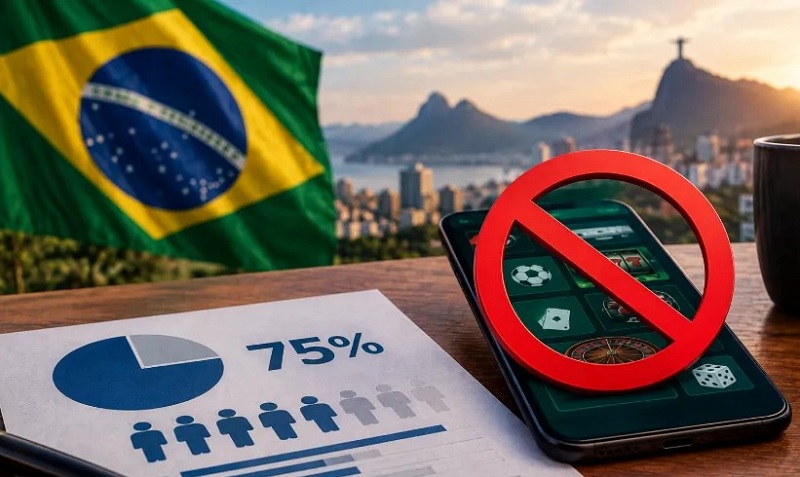
Brazilian President Lula da Silva signed a provisional measure banning online casinos and sports betting platforms. The decision was driven by rising household debt and a wave of gambling addiction that the president himself compared to a tumour capable of destroying the country. The ban immediately provoked protests, above all from the football industry, which is deeply dependent on betting sponsorship money. The outcry was particularly sharp given that Africa is becoming the main battleground for the online sports betting market, and Brazil, because of the ban, is being knocked out of the competition.
In Portugal, the situation has raised a natural question about whether a similarly drastic scenario could be applied at home. Economists, football bodies, medical experts from the Institute for Addictive Behaviours and Dependencies (ICAD), the government, and the Livre party have all offered their assessments. No consensus emerged, yet all parties acknowledge the scale of the problem.
Brazilian football hooked on betting money
The consequences of the ban for Brazilian clubs were immediate. The president of Flamengo publicly questioned how the club would pay Lucas Paquetá’s contract in January. Flamengo’s sponsorship deal with a betting operator brings in 258.5 million reais per year (approximately €45.78 million), covering 38.6% of expenditure on wages, image rights, and bonuses.
Palmeiras has a comparably smaller share, at 16.9% of its wage bill, but the blow is still significant. The gap between clubs illustrates how unevenly dependence on betting sponsorship money is distributed, and shifts the debate to the Portuguese context.
“It would be chaos”
Former professional footballer, now economist and financial consultant Diogo Luís, speaking to Renascença, gave an unequivocal assessment of a hypothetical ban in Portugal. In his view, the consequences would affect the entire system, since numerous clubs are sponsored by bookmakers, Liga Portugal itself receives such funds, and indirect revenues flow through the Special Online Gambling Tax. Luís stresses that it is now critically important for clubs and sports organisations to diversify their revenue streams without waiting for regulatory shocks.
He also draws attention to the asymmetry of the impact. Losing 10% of income means something entirely different for a large club than for a small one, and it is precisely the smaller teams that would find themselves in the most vulnerable position.
16 of 18 Primeira Liga clubs are tied to the gambling industry
The scale of betting money’s penetration into Portuguese football is striking. Of the 18 clubs in the top flight, only two have no sponsorship deals with online gambling platforms: recently promoted Académico de Viseu and Nacional from Madeira. All the others carry the logos of Betano, Betclic, Bwin, Placard, Solverde, Lebull, or GoldenPark Casino on their shirts.
Regional examples are telling. Arouca had worn the logo of its president’s construction company on its shirt since entering professional football in 2010, but switched to Bwin this season. Marítimo, whose historic shirts were associated with the bank Banif and the Madeiran beer brand Coral, also replaced its sponsor with a bookmaker. These cases illustrate how the gambling industry is displacing even locally significant brands.
A tax that returns money to sport
Since 2015, Portugal has operated under the Legal Framework for Online Games and Betting (Regime Jurídico dos Jogos e Apostas Online). The regulator is SRIJ (Gambling Regulation and Inspection Service), which administers and distributes the Special Online Gambling Tax (IEJO). Its mechanism works as follows:
- For fixed-odds bets (apostas à cota), the tax is 8% of all amounts staked by players, regardless of outcome.
- For peer-to-peer (exchange) betting, where players bet against each other, the rate is 35% of the operator’s commission.
- For casino games (roulette, slots), 25% of gross gaming revenue (GGR) is levied.
Since IEJO was introduced, Portuguese football has received €408.9 million out of a total €521.73 million in receipts from sports betting — that is, 78%. Over the entire period, FPF (the Portuguese Football Federation) has accumulated €302.54 million, while Liga Portugal (LPFP) has collected €106.38 million. In 2025, FPF received €38.8 million, representing 52.77% of the €73.52 million directed to sport. In 2024, football accounted for an average of 71.6% of all bets placed. Any restriction would immediately affect this financial flow.
Risk to broadcasting rights and the centralised model
Economist and ISEG professor António Samagaio believes that a ban could only be implemented as a medium-term measure with a transition period and time to find alternative revenues. He highlights an important detail: bookmakers “pay locally for global visibility,” since match broadcasts reach audiences far beyond Portugal.
For the operators themselves, the benefit is clear. They gain not merely broad reach, but an audience of fans who admire their idols, trust them, and transfer that trust to the brand on the club shirt. The data we have examined shows that no-KYC casinos with no-deposit bonuses can rapidly acquire players. But those platforms must first become known, and sponsoring a football club remains the shortest path to brand recognition. This is precisely why betting sponsorship money is so tightly woven into the economics of broadcasting.
Against the backdrop of the ongoing centralised sale of broadcasting rights, this creates an additional threat. In Samagaio’s view, a fall in club revenues would reduce broadcasters’ willingness to pay a high price for transmission rights. Diogo Luís allows that centralisation could partially offset the loss of betting funds, but argues that any deterioration in the quality of the “product” will inevitably affect its commercial appeal.
Liga Portugal acknowledges risks but fears illegal operators more
Liga Portugal declined to disclose the value of its contract with Betclic, citing commercial confidentiality. The organisation acknowledged the risks of excessive gambling and emphasised its responsibility to protect minors and vulnerable groups. At the same time, Liga Portugal noted that the current regulatory regime provides for funding of social welfare through the social security budget.
The organisation identified combating illegal operators — who exploit competitions without paying taxes and without player protection mechanisms — as its main priority. Liga Portugal stated its readiness to participate in discussions on improving regulation.
The government stays silent on legal betting
The Secretariat of State for Sport, in response to a request from Renascença, focused exclusively on the problem of unregulated betting, noting that it is already prohibited by law, and referred to the Macolin Convention within the Council of Europe framework. No direct answer was given to questions about possible advertising restrictions or an outright ban on legal platforms.
The context of this silence is highly revealing. In next year’s budget, the state expects to collect approximately €900 million from taxes on casinos and online betting. The Treasury’s financial stake in the sector is evidently tempering any regulatory enthusiasm.
Livre against the “Brazilian recipe”
Livre MP Paulo Muacho is convinced that a ban would merely push users towards illegal casinos and create a stigma that would prevent people from seeking help. The party is advancing an alternative set of measures:
- Restrictions on advertising along the lines of the model that exists for tobacco and alcohol.
- Mandatory addiction risk warnings on every product.
- A ban on public figures and influencers advertising gambling.
Muacho is counting on support from part of the PSD parliamentary majority for some of these initiatives, as a similar provision already featured in the government programme. The MP warns that the costs of treating the consequences always exceed the costs of prevention, and that household debt and mental health problems could, in the longer term, outweigh today’s tax revenues. He also cites the experience of the Florida Senate, which is intensifying its crackdown on illegal gambling.
118% growth in two years and three pillars of reform
Psychiatrist João Marques, ICAD’s expert on gambling, points to an alarming trend. Over the past two years, the number of patients with gambling disorder at the institute has grown by 118%. At the same time, both the volume of spending and the total number of players are rising.
Nevertheless, Marques shares Livre’s scepticism about an outright ban. In his view, a ban creates a barrier but is not a treatment, and may trigger a migration of people with gambling disorder to illegal platforms. The expert identifies three lines of action: improving access to therapy for people with gambling disorder, strengthening player protection mechanisms, and — most importantly — reducing advertising exposure.
Normalisation of gambling through football and the English lesson
The mass presence of bookmaker brands in football broadcasts creates what Marques describes as a “normalisation of gambling” in the minds of viewers. When this information is absorbed from an early age, the likelihood of developing an addiction increases substantially. Portugal, with 16 clubs carrying bookmaker logos and full broadcast coverage of all Primeira Liga matches, sits in a zone of particular risk.
The English Premier League has already taken steps. From the current season, gambling industry sponsors are banned from the front of match-day shirts. The number of advertising stimuli in the first round fell by 48.64% compared with the last season before the ban. However, clubs have found workarounds: Manchester United, for example, signed a deal with Betway worth £20 million (€23.84 million) for logo placement on the training kit during pre-match warm-ups.
Marques draws an unambiguous conclusion for Portugal. Restrictions must cover not only match shirts but also stadium structures, press zones, and any other advertising surfaces. Otherwise, the measures will prove far too easy to circumvent.
From outright ban to robust regulation
Ultimately, the expert debate centres on several scenarios of varying severity:
- An outright ban along the Brazilian model, which most specialists consider counterproductive.
- Partial restrictions focused primarily on advertising and sponsorship in football.
- A thorough overhaul of the 2015 regulatory framework, which has not been updated since 2020 and does not reflect the current scale of gambling’s penetration.
- Stronger action against the black market, which both Liga Portugal and the government are pressing for.
In parallel, football bodies are being advised to prepare financially for any changes. Diogo Luís puts it simply: it is necessary to live within one’s means and broaden revenue sources without waiting for an external decision to bring down the existing model. Liga Portugal, for its part, asserts that revenue diversification and enhancing the value of its competitions remain its constant priorities.
