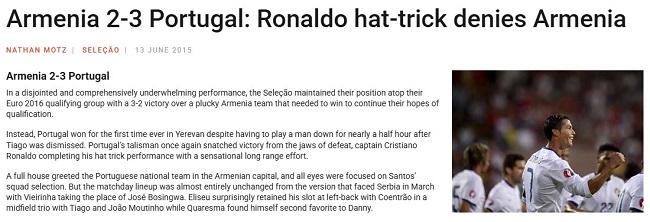
“In a disjointed and comprehensively underwhelming performance, the Seleção maintained their position atop their Euro 2016 qualifying group with a 3-2 victory over a plucky Armenia team that needed to win to continue their hopes of qualification…”
So began Nathan Motz’s match report on PortuGOAL of Armenia 2-3 Portugal in June 2015 as the Seleção took another step towards qualifying for Euro 2016 under new manager Fernando Santos.
It is interesting to read the less-than-complimentary comments regarding the Seleção who would lift their maiden major trophy on that magical night in Paris just one year after this match.
Commenter Oliver, however, was remarkably prescient: “Most important thing is 3 points--and we keep getting them. That's big. It may just be that Santos’ Greek style is what will get us farthest. If that’s the case, I will take it…”
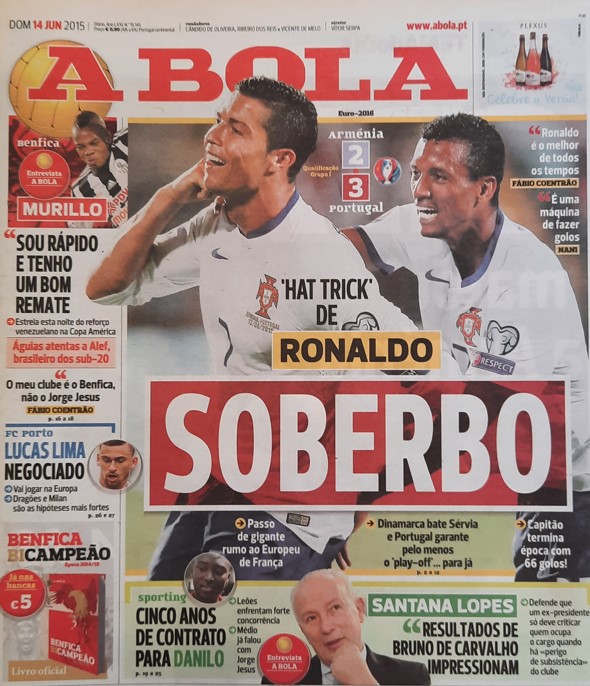
This match was also a perfect example of how a peak Cristiano Ronaldo would bail Portugal out time and time again when the team was not clicking. The front cover of A Bola the next day would focus on the national team captain with the simple headline, SUPERB.
Post-match quotes from Fábio Coentrão – “Ronaldo is the greatest of all time” – and Nani “He’s a goal machine” – also made the cover, with another sub-headline pointing out that CR7 had finished the 2014/15 season with 66 goals!
Fernando Santos would famously go on to guide Portugal to glory at the 2016 European Championship, with several youngsters playing a key role in France, such as Raphaël Guerreiro, Renato Sanches and João Mário, but during qualification the coach relied heavily on experienced performers.
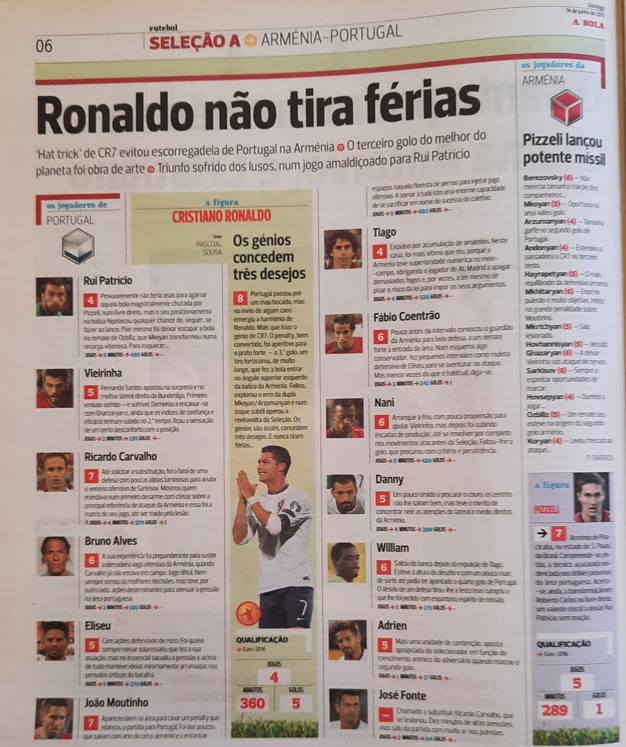
Ricardo Carvalho was one of the most highly rated Portugal players against Armenia at the ripe old age of 37, with Bruno Alves (33), Eliseu (31), Tiago (34), Danny (31) and José Fonte (31) also seeing the pitch. Ronaldo himself had also turned 30, although as the following decade has proved, his ageing process is different to other mere mortals.
To read the Armenia 2-3 match report click here. Portugal play Armenia in Yerevan on Saturday in their first qualifying match for World Cup 2026.
Nobody expects suffering to be so exquisitely arranged that it becomes a kind of music.
And yet, Portugal.
A nation small enough to disappear on some maps, large enough to have once drawn the map for everyone else. A country with one foot in the sea and another in a dream, where fishermen talk to the wind like an elder cousin and where balconies lean over cobbled streets to eavesdrop on the chatter of fate. A place where the tiles — azulejos — tell stories in indigo, and the guitars weep in alleys lit by the patience of old saints. You came here for football, for the clean arithmetic of goals and games; Portugal will give you theatre, poetry, and a syllabus in longing.
This is a team that does not merely play; it remembers. It remembers ships leaving and not returning on time. It remembers loves that were missed by inches. It remembers semifinals, finals, penalties taken with history hanging from the ankle like iron. It remembers and then it runs.
Call it destiny if you want. Portugal calls it saudade.
Football in Portugal is not sport; it is theatre, ritual, confession. It is the mirror in which a nation sees its own unfinished story. Sociologists might call it collective memory, the way generations store the traumas and glories of their ancestors and replay them in symbolic form. But the Portuguese know it instinctively. They know that when the ball rolls, it carries not only the present but the weight of the past — explorers lost at sea, empires dissolved, poems unfinished, hearts broken yet never hardened. Football is where longing takes shape, where saudade plays itself out in public. And like all great dramas, it is never only about the ending. It is about the ache of striving, the exquisite suffering of almost.
The weight of longing
When Eusébio da Silva Ferreira stepped onto the stage of the 1966 World Cup, he was more than a striker. He was the child of Mozambique, the echo of colonial entanglement, the embodiment of Portugal’s complex identity. In him burned both the marginalised grief of Africa and the hungry pride of Lisbon. His goals — nine of them in that tournament — were cannon shots fired not only at opponents but at history itself. Against North Korea, with Portugal trailing 3–0, Eusébio exploded, scoring four in one of the game’s great reversals. It was not simply a comeback; it was saudade made flesh, longing refusing to be silenced, absence turned into presence through the violence of a boot striking a ball. And yet, when England eliminated Portugal in the semi-final, Eusébio wept openly on the Wembley grass. His tears were not his alone. They were a nation’s. He cried because victory had been so close, yet remained out of reach — the eternal paradox of Portuguese football. To watch Eusébio was to understand that Portugal’s destiny was not merely to win or lose but to ache magnificently in the space between.
Decades later, when Luís Figo, Rui Costa, Fernando Couto, and their companions emerged as the Geração de Ouro, the Golden Generation, Portugal once more stood on the cusp of rewriting its story. This was the late 1990s and early 2000s, a time when the Portuguese game seemed to hold all the ingredients of triumph: artistry, intelligence, technical mastery, and a collective belief that history was waiting to be bent. Euro 2000 was their stage, and for a time it looked as though the dream would become reality. Rui Costa glided through midfields with the elegance of a poet’s penstroke, Figo thundered forward with a restless intensity that spoke of unfinished quests. And yet, in the semi-final, Zinedine Zidane’s golden goal ended it. Once again, Portugal was left with longing, with saudade renewed.
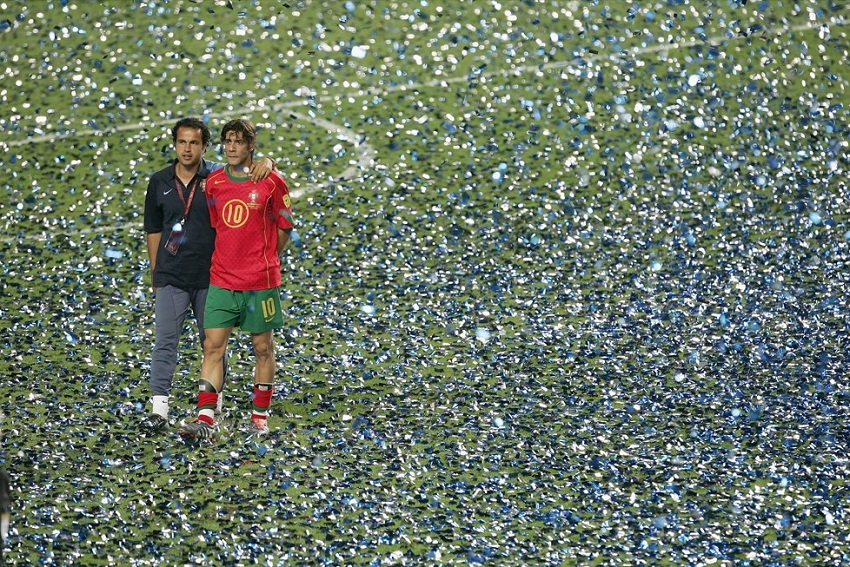
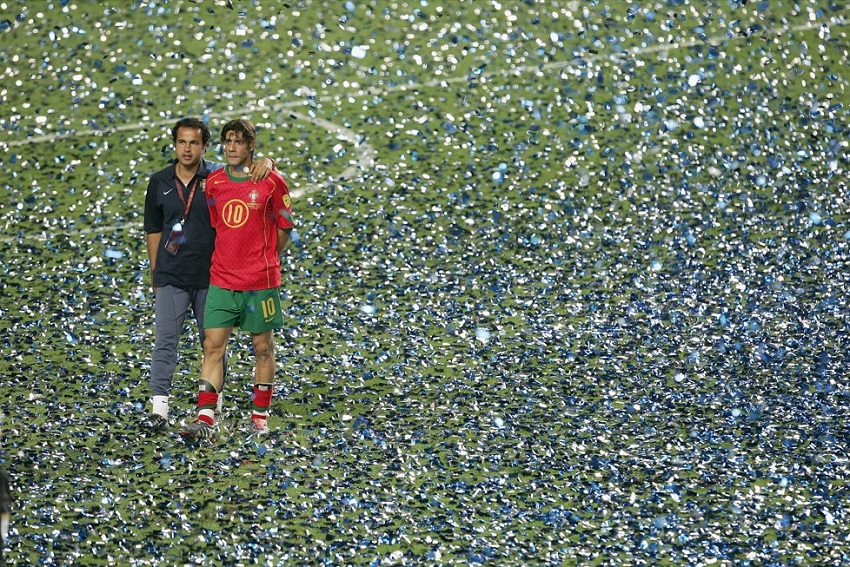
But no ache stung more deeply than Euro 2004. To host a tournament is to feel history breathing on your neck, whispering promises of destiny. Portugal believed. They believed when Figo surged, when Deco orchestrated, when Ronaldo, young and unpolished, leapt into the future. And yet, destiny is not a promise; it is a trickster. In the final, it was not Spain, not France, not Italy, but Greece — austere, defensive, improbable Greece — who snatched the trophy. A nation prepared to crown itself was left in mourning. Fans sobbed in Lisbon’s squares as if history had mocked them personally. It was not just a loss; it was an existential betrayal. To be Portuguese was to ache once more, to carry saudade not as theory but as wound.
Sociology teaches us that collective suffering can bind communities, that shared trauma becomes the glue of identity. Portugal after 2004 became more Portuguese, not less. Saudade deepened. The people wore their heartbreak like armour, their defeats like secret medals. And yet, from this ache emerged a new figure, one who did not so much embody saudade as attempt to conquer it: Cristiano Ronaldo.
Ambition and absence: how desire shapes victory
If Eusébio had wept with it, and Figo had danced with it, Ronaldo declared war upon it. He was saudade inverted, ambition weaponised, longing transfigured into relentless hunger. Every sprint, every leap, every goal was an act of defiance against absence. He refused to accept “almost.” He would not be the heir to tears; he would be the author of victory. His career became a rupture in Portugal’s narrative: a man whose personal will threatened to overturn centuries of collective melancholy. Ronaldo was not poetry; he was machinery. Not saudade sung with guitars, but saudade hammered into iron. And yet — here lies the paradox — even Ronaldo, the conqueror, could not escape it entirely. For when the Euro 2016 final arrived in Paris, Ronaldo was struck down by injury. He left the pitch in tears, not of weakness but of longing, of power undone. Once again, Portugal’s greatest son stood on the edge of almost.
But then, in the most poetic twist of all, Portugal won without him. Éder — a substitute, a man not cast as hero in any script — struck from distance and shattered France’s dreams. It was not Ronaldo’s boot, nor Figo’s artistry, nor Eusebio’s fire that delivered Portugal’s first major trophy. It was the collective will of a nation that had lived too long with ache, that had endured too many almosts, that had carried saudade through generations. Eder’s goal was not only a strike; it was the exorcism of absence, the alchemy of longing turned into joy. On that night, Portugal tasted what it had always desired: glory. And yet, even in that triumph, saudade did not disappear. Because saudade is not an enemy to be defeated. It is the companion that makes glory sweet. Without centuries of ache, that night in Paris would have been another victory. With saudade, it was transcendence
But the script did not end in Paris, nor with the Nations League of 2019. Portuguese football, like the sea it faces, never truly rests. It continues to offer moments where destiny appears close enough to touch, yet slips, then returns unexpectedly with a different face.
At Euro 2024, the story bent once again toward paradox. In the round of sixteen against Slovenia, Cristiano Ronaldo — the man who had carried Portugal since the Golden Generation faded — stood over a penalty. This was the familiar scene: the greatest player of his age, perhaps of all time, preparing to strike as he had done for decades. Yet Jan Oblak, unshaken, saved. Ronaldo wept, his tears not of weakness but of history pressing down. For all the years he had bent fate with his will, here he was undone by the simplest of gestures — a ball stopped by a pair of hands. The match dragged into penalties, and in that space where the old king faltered, a new figure stepped forward. Diogo Costa, scarcely more than a boy in international terms, saved three consecutive penalties. It was a reversal of roles: the legend in tears, the novice unshaken. Portugal advanced not through Ronaldo’s fire but through the composure of youth. The paradox deepened: a nation built on longing had found relief in the hands of one too young to carry its ghosts.
And yet, Portugal’s journey ended in the quarter-finals, undone by France on penalties. Once more, the ache remained — close, almost, but not quite. Saudade persisted, now written across two generations: the tears of Ronaldo, the defiance of Costa, the silence of another near-miss.
But football has a way of circling back. In 2025, at the Nations League final against Spain, Portugal’s script found another twist. Spain struck first, as they so often do, with control and precision. Yet it was Nuno Mendes, one of a new generation of Portuguese talent, who restored balance. Spain went ahead again, but destiny demanded symmetry. At forty years old, Ronaldo — still relentless, still unwilling to leave the stage — equalised. It was not a gesture of domination but of refusal: refusal to be erased, refusal to let the story continue without him. The match slid into penalties, and this time it was Portugal who endured. Victory belonged not to one man, but to a collective that spanned eras: Mendes, Costa, Ronaldo, and the others who now form a team of extraordinary quality.
To witness Portugal in these years is to see saudade stretch itself across generations. The old warrior still scoring, the young keeper redefining heroism, the new talents stepping into light — all of them held together by a national rhythm that makes longing not a weakness but a resource. Portugal does not resolve the ache; it carries it forward, allowing each generation to write its own unfinished chapter.
The lesson of longing
To love Portuguese football is to understand that glory is not the opposite of failure. Glory is failure’s last word, spoken after centuries of silence.
Look closely, and you’ll see it: a people who laugh with sadness, who lose with style, who suffer beautifully. Football here is not about domination — it is about dramatization. It is theatre where tears are choreography, and every goal is sung twice, once with joy and once with regret.
Portugal is small on a map, but infinite in longing. Its footballers are not just athletes — they are translators of saudade, interpreters of a language too complex for words .
And that is why the world falls in love. Because in Portugal’s game we recognise our own ache. Our own near-misses. Our own desire to turn suffering into song. From saudade to glory — that is the emotional DNA of Portuguese football. Not a sequence of trophies. A sequence of feelings.
Portugal doesn’t just play football. It teaches us why we play it at all.
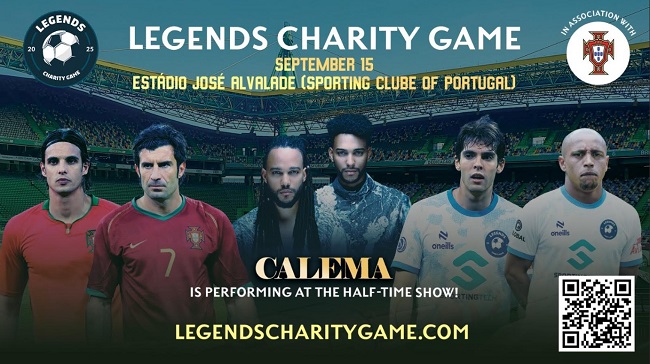
Luís Figo, Kaka and Michael Owen are among football icons participating in charity event in Lisbon
The inaugural Legends Charity Game, organised by Sport Global, will be staged at Sporting CP’s Estádio José Alvalade, marking the start of a series set to run annually until 2030.
The match will see Portugal Legends face off against World Legends on Monday 15th September 2025, with Calema performing live at half-time, and all in support of the goal of raising €1 million for charity.
The venue confirmation came after the Champions League schedule was finalised, introducing Estádio José Alvalade as the host of the opening match of the series. Kick-off is scheduled for 20:00, with player arrivals at 18:00 and gates opening at 18:30. Fans can enjoy a pre-game show at 19:40, while half-time will feature a live performance by Calema, the São Tomé and Príncipe-born, Portugal-based duo known for their blend of pop and Afrobeat, performing in front of 50,000 fans and millions watching worldwide.
The Portugal side will be captained by Luís Figo and include a host of stars from the nation’s greatest footballing moments. Figo said: “It’s always a pleasure to come back to my country and play football! Hope to see a full stadium in my hometown, Lisbon, for this amazing Legends Charity Game and raise funds for important charity causes.”
Joining him are Euro 2016 winners Ricardo Quaresma, Nani, Eliseu, Bruno Alves, Ricardo Carvalho, and Pepe, along with Champions League winners Fábio Coentrão, Maniche, Pauleta, Vítor Baía, José Bosingwa, and Deco. Other confirmed legends include Beto, Jorge Andrade, Dani, Tiago Mendes, Simão, Hélder Postiga, Nuno Gomes, and Costinha, who will also serve as team manager.
Legendary forward Quaresma added: “Wearing the Portuguese shirt has always filled me with pride, and winning Euro 2016 was the greatest moment of my career. I’m really looking forward to representing Portugal again, especially for such a good cause. Football has the power to bring joy and hope, and using that to support families affected by war and conflict is incredibly important. Playing at home in Lisbon, for something that matters this much, makes the Legends Charity Game even more special.”
Nuno Gomes, one of Portugal’s most recognisable attacking players of the 1990s and 2000s, added: “Being called up to represent Portugal has always carried a deep sense of responsibility and national pride, and that feeling is no different ahead of the upcoming Legends Charity Match. Supporting those less fortunate has long been a personal priority.”
The World Legends squad will provide formidable competition, featuring international icons including Kaká, Peter Schmeichel, Petr Cech, Edwin van der Sar, Rene Higuita, Carles Puyol, Roberto Carlos, John Terry, Cafu, Javier Zanetti, Marco Materazzi, Gheorghe Hagi, Youri Djorkaeff, Christian Karembeu, Krasimir Balakov, Gaizka Mendieta, Marek Hamsik, Javier Saviola, Michael Owen, Henrik Larsson, Alessandro Del Piero, and Hristo Stoichkov.
All proceeds from the match will be donated through the Sport Global Charitable Foundation to four charities:
Cruz Vermelha Portuguesa (Portuguese Red Cross): Delivering emergency response, healthcare, training, and social support nationwide.
Cáritas Portuguesa: Providing critical support to marginalised communities in Portugal and abroad.
International Alert: Working across divides to resolve conflict and build lasting peace.
Ukrainian Red Cross Society: Delivering urgent care, shelter, food, and psychological support to those affected by war.
Rasmus Sojmark, Founder of Sport Global, said: “With the Legends Charity Game, we are connecting fans, legends, music and communities for something bigger than the game itself. This match will bring generations together, and Estádio José Alvalade is a fantastic host for what promises to deliver the best in entertainment for a great cause. I would also like to take the chance to thank the Portuguese Football Federation, along with all our sponsors and partners, for helping us make this a reality.”
About the Legends Charity Game The Legends Charity Game is an annual event organised by Sport Global and will run until 2030.
* Sport Global Charitable Foundation is a restricted fund under the auspices of Prism the Gift Fund (UK registered charity no. 1099682). All profits from the Legends Charity Game will support the Foundation’s beneficiary charities.
Seleção coach Roberto Martínez has announced the squad for Portugal’s first two World Cup qualifiers, away to Armenia and Hungary next week.
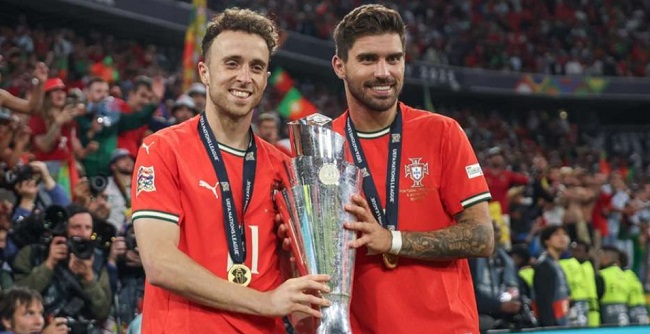
There are no surprises with the only absentees in relation to the squad selected for the triumphant Nations League tournament in June being the injured Rafael Leão, Porto’s Rodrigo Mora, who has barely played this season, in addition to Diogo Jota, who tragically lost his life in a car accident in July.
Before the squad was announced, Martínez explained that Jota’s No21 shirt would be worn from now onwards by his close friend Rúben Neves in honour of Jota.
“It was not a decision made by the coach or by the Portuguese Football Federation. It was the decision of Diogo Jota’s family,” said Martínez.
“We know what Diogo represented for each one of us, the impact he had on our lives. We want to honour his memory every day. He will be with us and he will give us extra strength to achieve our targets.
“Diogo Jota’s example is a light for us. We will carry his spirit in our heart. We will win for Diogo, for his brother, André, and as always for all the Portuguese people.
“In this squad announcement on the road to World Cup 2026 the number of players is 23 plus one - Diogo Jota.”
Roberto Martínez começou a conferência de imprensa com uma homenagem a Diogo Jota. pic.twitter.com/gyUaido2C1
Portugal play Armenia in Yerevan on Saturday 6 September, before travelling to Budapest to face Hungary three days later.
Full Portugal squad for World Cup qualifiers against Armenia and Hungary
Goalkeepers: Diogo Costa (FC Porto), Rui Silva (Sporting CP), José Sá (Wolverhampton Wanderers)
Defenders: Diogo Dalot ( Manchester United), João Cancelo (Al Hilal), Nuno Mendes (PSG), Gonçalo Inácio (Sporting CP), Rúben Dias (Manchester City), António Silva (SL Benfica), Renato Veiga (Villarreal)
Midfielders: João Palhinha (Tottenham Hotspurs), Rúben Neves (Al Hilal), João Neves (PSG), Vitinha (PSG), Bruno Fernandes (Manchester United), Pedro Gonçalves (Sporting CP), Bernardo Silva (Manchester City)
Forwards: João Félix (Al Nassr), Francisco Trincão (Sporting CP), Francisco Conceição (Juventus), Pedro Neto (Chelsea FC), Gonçalo Ramos (PSG), Cristiano Ronaldo (Al Nassr)
In September, the Portuguese national team will kick off its World Cup 2026 qualifying run. In this article, we analyse the odds offered by bookmakers for the first matches of Roberto Martinez’s team.
Armenia v Portugal (06.09.2025)
In the opening match of the World Cup 2026 qualifiers, the Portuguese national team will play away against the Armenian national team. The game will take place on September 6, 2025, in Yerevan at the Republican Stadium. The Best Betting experts believe that Roberto Martinez’s team will start their qualifying run with a confident victory. Bets on the away team’s victory are accepted with odds of 1.17. You can bet on a draw at 6.90 odds, or Armenia’s victory with 17.00 odds.
Cristiano Ronaldo and his side are 1.50 favorites to cover the -1.5 handicap. Bookmakers are also confident that the match in Armenia will be successful: bets on a total of over 2.5 goals are accepted with odds of 1.56.
Please note that the last time the rivals met was in the EURO 2016 qualifiers. On those occasions the Portuguese national team won twice: 1-0 in the home match and 3-2 away, thanks to a Cristiano Ronaldo hat-trick.
Hungary v Portugal (09.09.2025)
On September 9, 2025, three days after the match in Yerevan, the Portuguese national team will visit Budapest. Here, they will play a match in the second round of the World Cup 2026 qualifiers against the Hungarian national team. According to experts representing well-known bookmakers, Roberto Martinez’s team has a decent chance of earning three points in this match. You can now bet on Portugal’s victory with odds of 1.65 - best betting tips. The probability of a draw is estimated at 4.25, while bets on the home team’s victory are estimated at 4.40.
At EURO 2020, which was postponed to the summer of 2021 due to the COVID-19 pandemic, both national teams met in the opening round of the group stage. Back then, Rafa Silva, Rafael Guerreiro, and Cristiano Ronaldo scored and secured a 3-0 win.
Portugal’s World Cup 2026 qualifying match schedule
In the 2026 World Cup qualifying tournament, the Portuguese national team will play in Group F. In this group, Martinez’s team is considered the main contender for first place and direct entry into the tournament. Here is the schedule for teams hitting the pitch in the qualifiers:

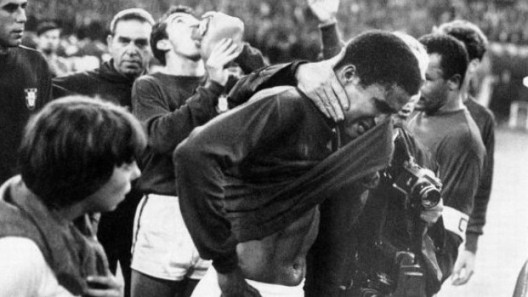 When Eusébio da Silva Ferreira stepped onto the stage of the 1966 World Cup, he was more than a striker. He was the child of Mozambique, the echo of colonial entanglement, the embodiment of Portugal’s complex identity. In him burned both the marginalised grief of Africa and the hungry pride of Lisbon. His goals — nine of them in that tournament — were cannon shots fired not only at opponents but at history itself. Against North Korea, with Portugal trailing 3–0, Eusébio exploded, scoring four in one of the game’s great reversals. It was not simply a comeback; it was saudade made flesh, longing refusing to be silenced, absence turned into presence through the violence of a boot striking a ball. And yet, when England eliminated Portugal in the semi-final, Eusébio wept openly on the Wembley grass. His tears were not his alone. They were a nation’s. He cried because victory had been so close, yet remained out of reach — the eternal paradox of Portuguese football. To watch Eusébio was to understand that Portugal’s destiny was not merely to win or lose but to ache magnificently in the space between.
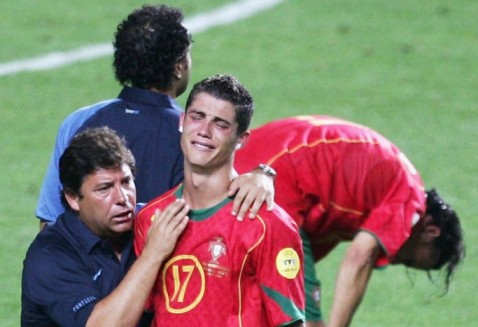 But no ache stung more deeply than Euro 2004. To host a tournament is to feel history breathing on your neck, whispering promises of destiny. Portugal believed. They believed when Figo surged, when Deco orchestrated, when Ronaldo, young and unpolished, leapt into the future. And yet, destiny is not a promise; it is a trickster. In the final, it was not Spain, not France, not Italy, but Greece — austere, defensive, improbable Greece — who snatched the trophy. A nation prepared to crown itself was left in mourning. Fans sobbed in Lisbon’s squares as if history had mocked them personally. It was not just a loss; it was an existential betrayal. To be Portuguese was to ache once more, to carry saudade not as theory but as wound.
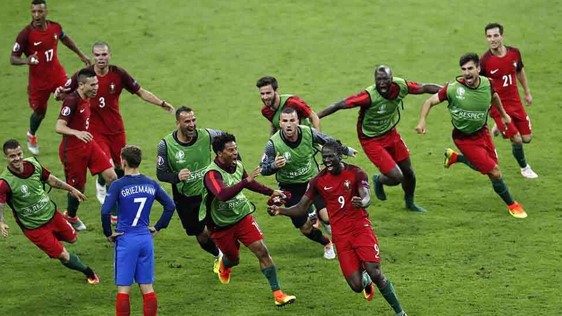 But then, in the most poetic twist of all, Portugal won without him. Éder — a substitute, a man not cast as hero in any script — struck from distance and shattered France’s dreams. It was not Ronaldo’s boot, nor Figo’s artistry, nor Eusebio’s fire that delivered Portugal’s first major trophy. It was the collective will of a nation that had lived too long with ache, that had endured too many almosts, that had carried saudade through generations. Eder’s goal was not only a strike; it was the exorcism of absence, the alchemy of longing turned into joy. On that night, Portugal tasted what it had always desired: glory. And yet, even in that triumph, saudade did not disappear. Because saudade is not an enemy to be defeated. It is the companion that makes glory sweet. Without centuries of ache, that night in Paris would have been another victory. With saudade, it was transcendence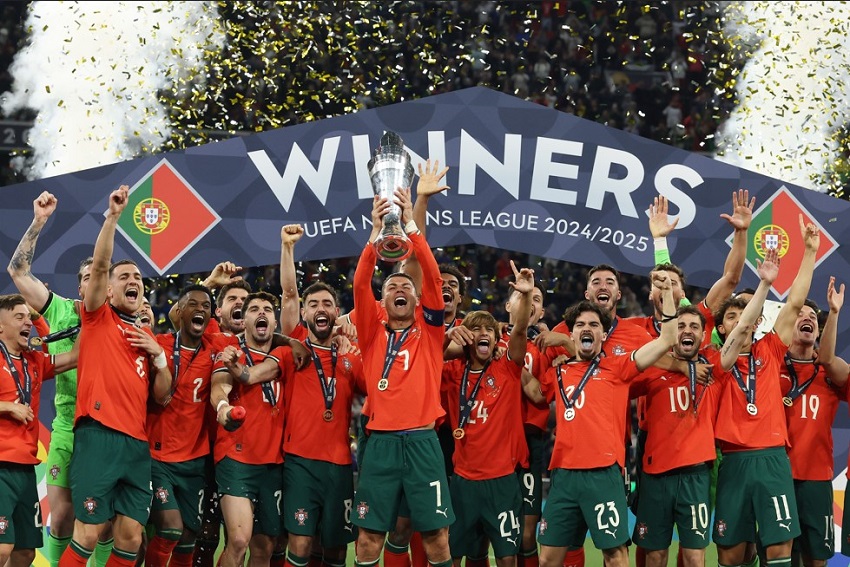
 Seleção coach Roberto Martínez has announced the squad for Portugal’s first two World Cup qualifiers, away to Armenia and Hungary next week.
 In September, the Portuguese national team will kick off its World Cup 2026 qualifying run. In this article, we analyse the odds offered by bookmakers for the first matches of Roberto Martinez’s team.