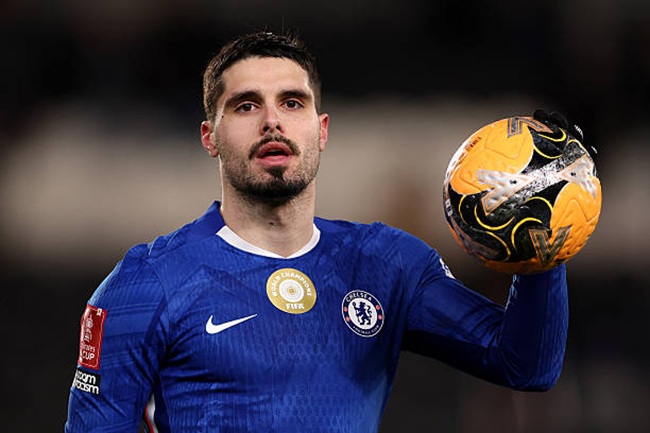
Portugal international Pedro Neto scored the first senior hat-trick of his career as Chelsea breezed past Hull City and into the fifth round of the FA Cup.
The Blues missed some good opportunities before Neto finally opened the scoring at the MKM Stadium five minutes before half time with a superb left-footed shot. His second made it 2-0 five minutes after the re-start, with Neto’s corner evading everyone and finding the net. Brazilian youngster Estêvão made it 3-0 before Neto completed his treble, this time with a right-footed finish on 70 minutes for his 10th goals of the season.
“Really pleased,” the Seleção man said after the match. “I think the mentality of the team was amazing. We came to a tough place, winning 4-0 away. This competition is really tough. So we are really happy to go through to the next round.
“To be honest, on the second goal, I was in doubt if it was mine or not. At the end of the game, I went to the referee and asked whether it was a hat-trick or not. Did I have the right to the ball? He said, "Yeah, yeah, you have the right!”
“Jorrel said to me, "It’s your goal, I didn’t touch the ball!!" I didn't celebrate a lot of the goal because I didn't notice; there was a lot of confusion. But in the end, I'm really happy it was. I'm really happy to score three goals, but most of all happy that the team went through.
“But most of all, I'm happy that we went through. We did an unbelievable performance against a tough team away and I think it's a well-deserved win.
“It's my first senior hat trick. “So we'll have a party tonight! It means a lot. I will continue to work hard to give the fans and my teammates happiness and more goals like this. So I’m really happy.
“We have to keep winning, but first of all, we have to keep improving. I think there are more details that can take us to the next step. So we are really working hard on that.”
Neto world class – Rosenior
It is also the first time Neto has hit double figures for goals in all competitions, with his third putting him one ahead of last season's tally of 9 in his first campaign in London. Chelsea manager Liam Rosenior, who is enjoying a solid start to his role, was in high praise of Neto after the match. Neto was a huge favourite of previous boss Enzo Maresca at Stamford Bridge and it appears Rosenior is similarly taken by the former Braga man.
“For me, he’s a world-class player, a world-class winger,” Rosenior said. “And what I love about him, as talented as he is and as gifted as he is, what he sacrifices for the team is top.
“He's going to be really, really important for us for where I think we can get to and what we can achieve for the rest of the season.”
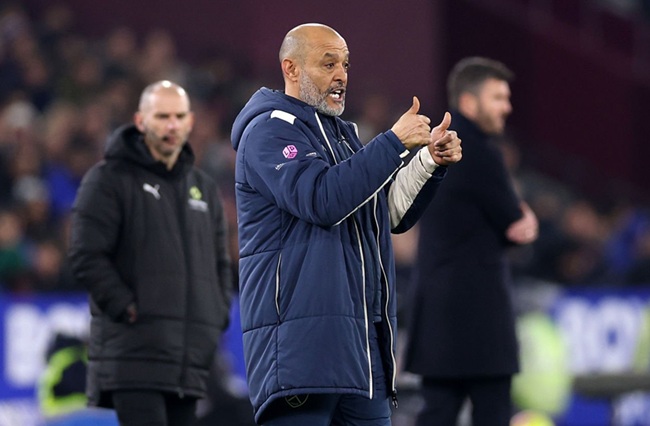
Nuno's West Ham were denied victory late on (Getty Images)
West Ham United 1-1 Manchester United
Nuno Espírito Santo admitted it was difficult to accept just a point after watching his West Ham United side concede a late equaliser to Manchester United in the Premier League.
Nuno’s team, with Mateus Fernandes in midfield, continued their recent strong form by ending United’s four-match winning streak, but having controlled their opponents’ attacks for much of the game the Portuguese boss was left frustrated with the draw.
Both teams came into the match strong on confidence, with the Hammers winning four of their previous five matches in all competitions, progressing in the FA Cup while re-igniting their hopes in the relegation battle. United arrived in the capital with Diogo Dalot and Bruno Fernandes in the line-up, on the back of a run of four straight victories, which put them 4th place in the standings.
West Ham coped superbly with the United threat throughout the encounter, reducing their opponents to few opportunities before going ahead 1-0 through Tomas Soucek on 50 minutes. United struggled to pose a threat during the remainder of the game, but after a generous seven minutes of injury time were added, the Red Devils struck with a 96th-minute leveller by Benjamin Sesko.
“We’re disappointed of course, all of us – the players, the fans, ourselves… to take this final blow in the final moments of the game,” Nuno said. “But we competed really well. We’ve been able to contain a very good team that was in a good dynamic. I think we did a good game, the boys worked hard. But it was not to be. It’s a draw that gives us sadness. But this is the way. The way we competed today was very good.
“You can see the quality, the effort of the players, the organisation. The way we started the second half was really positive, we scored and we defended really well, with some exceptions. But overall a very positive in the defensive aspect of the game. And also in the final moments we had two or three moments where we should put the game to bed.
“We have been able to react, to bounce back from these difficult moments. The boys have been able to react and compete. There’s no other way. We have to keep on going. Today we competed well. We showed the way, our standards are high. We have to keep them.
“We showed everybody today that we have to keep believing, because competing like this we’re going to be okay.”
The result leaves West Ham continuing in 18th place, where they moved two points behind Nuno’s former club Nottingham Forest in their bid to maintain their Premier League status.
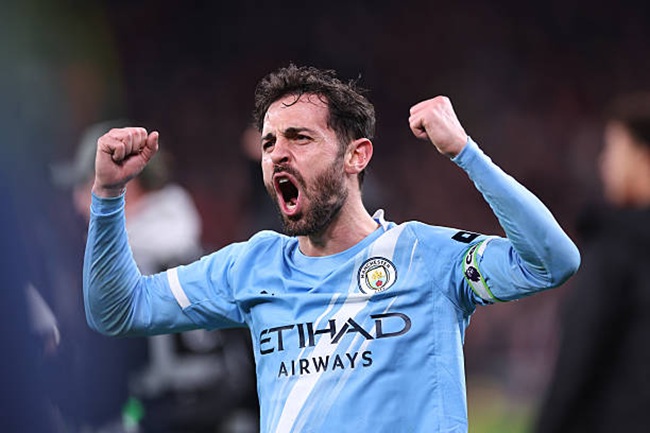
Bernardo one of the best ever - Guardiola (Getty Images)
Liverpool 1-2 Manchester City
Manchester City manager Pep Guardiola lavished praise on captain Bernardo Silva after the Portuguese scored a vital goal in a comeback win over Liverpool at Anfield in the Premier League.
City found themselves trailing to a stunning free-kick from Dominik Szoboszlai (74’) which threatened to leave them nine points behind league leaders Arsenal. However, Bernardo popped up with a vital equaliser (84’) before playing an exquisite pass for fellow Portugal man Matheus Nunes to draw a foul from Liverpool goalkeeper Allison and earn a penalty from which Erlin Haaland scored the winner.
Speaking after the match, City boss Guardiola made special mention of Bernardo, whom he describes as one of their greatest players and an inspiration to everyone – including himself. Surprisingly, the goal was Bernardo’s first in the Premier League this term, but comes after a run in which the Seleção man had provided three assists in his previous five matches in all competitions.
“The first half was exceptional but many times we are not composed enough in the final third,” Guardiola began. “We have to be a little bit calmer, to take the right decision in the box and take a coffee. As a defender and as a striker.
“We are young in many things. Second half we knew they would push a little bit harder.
“In the second half the ball came quick and it came back quicker. After that we allowed the crowd to be involved. After hats off for the goal from Szoboszlai - copy and paste from the Arsenal game.
“At the end we were guided by our incredible player, one of the best ever to play or train - our captain Bernardo.
“We follow him, I follow him too. He puts the team in front of himself. He does things through his own example. Everybody follows him, me the first.
“He scored the first one from the Erling assist, and made the assist for Matheus for the penalty.
“We won finally at Anfield. Always it’s so difficult. I’m happy with the result for the guys because we were there.”
It is the first time City, who introduced Rúben Dias on the hour mark, have recorded a double over Liverpool in the English top flight for 89 years. Bernardo was named Player of the Match and admitted that there was a necessity to take all three points from what is typically viewed as the toughest fixture in the team’s seasonal calendar.
“Obviously coming here, for me it’s the toughest place in the Premier League by far,” Bernardo said. “And usually for most teams a draw is not a bad result but we needed another goal. When I scored I was happy but we needed another one. Erling got us that one.
“I feel the whole team knew before the game, if we lost then probably the title race was over. We felt like we needed to win the game. That puts us a bit closer. The hope is there. We’re going to fight until the end. Six points is still six points. We’re happy but we need to keep doing our job.
“Obviously we’re very happy. But these points count as much as any other points in other games that we slipped. It was frustrating in the beginning of the year because in my opinion we didn’t do our job properly. We could have been closer to Arsenal.”
Manchester United have won four Premier League matches in a row for the first time in two years, after comfortably seeing off Tottenham Hotspur at Old Trafford.
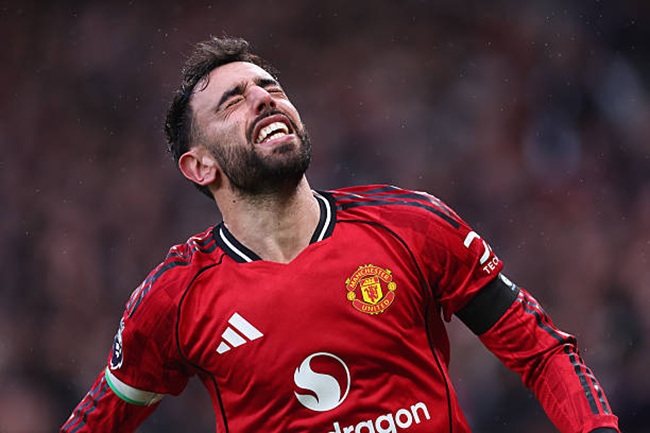
Bruno Fernandes scored the clinching goal from a Diogo Dalot cross to ensure United overcame João Palhinha’s Spurs, who spent most of the match with ten men following captain Cristian Romero’s early sending off.
It has been just over a month since United sacked Portuguese manager Ruben Amorim after a fallout with the club hierarchy. The initial response of the team under caretaker manager Darren Fletcher was to slump to a 2-2 draw with Burnley and an FA Cup defeat at home against Brighton and Hove Albion. However, under interim boss Michael Carrick, the Red Devils have embarked on a tremendous run.
The task to overcome Spurs, who had Palhinha in midfield, was made easier when Romero was given a straight red card on 29 minutes for a clumsy challenge on Casemiro. United then broke the deadlock on 38 minutes with a perfectly-worked corner routine: Fernandes slid the ball to Kobbie Mainoo near the byline for the young midfielder to pick out Bryan Mbeumo, who slotted home.
United rarely gave Spurs much of a sight of goal, but there was clear relief when Fernandes made it 2-0 ten minutes from time. Dalot received the ball on the right flank and delivered a low cross to the back post, which was met by the United skipper’s precise finish into the far corner to maintain Fernandes’ record of scoring or assisting in all six matches since his return from injury.
Bruno Fernandes’ goal against Tottenham from the stands #MUFC
United remain in 4th place but closed the gap between themselves and Aston Villa to just three points this weekend after the Midlands side dropped points. Having defeated Manchester City, Arsenal and Marco Silva’s Fulham already, the three points against Spurs continues Carrick’s 100% record in his second interim stint in charge.
“We’ve had moments where it’s not great and it still [today] was like that,” Fernandes told TNT Sports after the match. “Obviously not at the end of the game and obviously the energy is different now because we’re winning games. When you win games, everything looks brighter. We’re very happy ourselves and also to give this to the fans.
“How have things changed so quickly under Carrick? This is football and football changes from one game to another. Michael came in with the right ideas of giving the players some responsibility but also the freedom to take decisions on the pitch which were needed. He’s very good with words.
“I think he still remembers what I told him last time he was manager. I was sure Michael could be a great manager and he’s showing it. We hope we can help him even more, so everyone can see that not just we are good players, that’s why we’re at Man United, but also the staff is very good.
“Helpful that Carrick understands the club? No I think everyone understands the pressure of playing for this club. If you don’t understand you start to understand very quickly, because this is a massive club and everyone knows the expectations around it. So I don’t think that’s changed. But obviously Michael has won everything here and he knows what it means for the club to win.”
United travel to London on Tuesday evening looking to extend their winning run against Nuno Espírito Santo’s relegation battlers West Ham, who this weekend cut the gap between themselves and safety in the Premier League to just three points after a 2-0 win at Burnley.
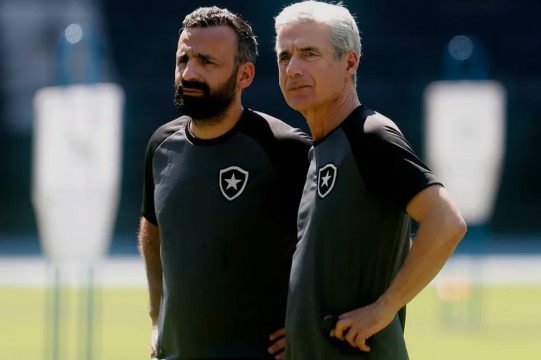
Vítor Severino has spent over a decade working alongside Luís Castro (Photo: Vítor Silva/Botafogo)
From Ukraine to Qatar, from the United Arab Emirates to Saudi Arabia to Brazil, Vítor Severino has coached in just about every corner in the world over the past seven years, but it was in Portugal where he first came to grips with management.
Born on 16 August, 1983, Vítor Severino grew up in the seaside parish of Ferrel before turning 18 and heading north for Coimbra University, where he graduated with a degree in sports science. Instead of returning home, he started teaching at the academy and coaching high school students and players in Académica de Coimbra’s youth ranks, with the generous support of his parents helping him to pursue his coaching dreams with an unpaid, part-time role. Similarly to others like Michael-John Tate, Severino was able to get his foot in the door with youth football coaching with Académica before eventually getting his big break and making the move to Porto, where he mentored future stars like Diogo Costa, Diogo Dalot, and Rúben Neves across his two years as an assistant coach for Porto’s U-15 and U-17 side. He then departed the Dragão in 2016 and followed outgoing Porto B manager Luís Castro to Rio Ave.
The rest, as they say, is history: Severino has spent the past decade as Castro’s assistant, guiding Rio Ave, Chaves and Vitória to top-six finishes before departing his homeland in 2019 and making the move to Shakhtar Donetsk, where they won the Ukrainian Premier League title in 2019/20. Spells at Qatari side Al-Duhail and Brazilian powerhouse Botafogo would follow before they linked up with Cristiano Ronaldo at Saudi giants Al-Nassr, lasting just over a year before being given the axe. And after a fleeting spell at Emirati outfit Al Wasl, they decided to return to Brazil at the end of 2025 and set up shop in Porto Alegre with Grêmio. PortuGOAL spoke to Severino.
You watched Portugal miss out on quite a few major tournaments as a youngster…fast-forward to today, and they’re one of the most powerful teams in the world. How do you think that growing up amid Portugal’s golden generation helped your own development?
Portugal has a very strong football culture that is born immediately into the children’s homes. I remember growing up at home with my parents, and we talked about football all the time. My father watched football and talked about football, and the only games in the street and at school were football.
It was an era when the Portuguese national team didn’t even participate in World Cups and Euros, and it was normal for my group of friends and me, who grew up with that culture of football and collecting stickers, sticker albums, calendars, and all that football-related stuff, it was normal for us to support another national team. We usually supported Brazil due to the language, proximity, the great players, and the culture itself. I remember watching the 1990 FIFA World Cup in Italy and the 1994 FIFA World Cup in the United States and anxiously waiting for the Brazilian team to play, because we really wanted to support a team, and Portugal usually wasn’t there.
After that, Portugal really experienced significant growth in terms of developing young coaching talent and began to have a very strong presence in major tournaments. Today, it’s a powerhouse in world football, a talent factory, and I myself feel proud to have participated, obviously as a small part, but I worked in youth development for many years in Académica and Porto with great players that I see playing for our national team today, like Diogo Dalot, Diogo Costa, Rúben Neves, as well as others who didn’t make it to the national team but who are professionals and play at an elite level.
For me, that’s a source of pride, and I look back on it with great satisfaction because, as a child who started playing football in the street, in a very small environment, I myself wanted to be a football player, but there weren’t as many options as there are today. Playing football itself was a selective process, because there was little space, there were few clubs that offered space to play, but fortunately, children now have space to express themselves and play, and we also know that the processes of player development are asymmetrical. Nowadays, there is room to develop this talent and also to channel it, sometimes, into other sports.
In other words, things are more structured. I’m happy. I was that kid who loved football and played football in the street every day, but I also understood that I wouldn’t be a football player at the level I wanted to be. I was lucky. And it was a coincidence to grow up in an era of great Portuguese coaches, with José Mourinho at the forefront. Mourinho made my generation of coaches believe in ourselves, he motivated us and dismantled the idea that in order to become a top coach, you had to have been an elite football player, and Portugal became even more of a great school, not only for players, but also for coaches.
It’s safe to say that you’ve been joined at the hip with Luís Castro…how exactly did that relationship come about?
As I was rising through the Académica ranks, I met Castro, who was the coach of the Porto B team as well as the general coordinator of the entire academy. There was a colloquium, and the vice president of Académica called me and said: “Look, there’s a UEFA seminar in Madrid. Six Portuguese clubs were invited, including us, and I’d love for you to represent us during those three days in Madrid.” The Federation sent a delegation of Porto, Benfica, Sporting, Braga, Paços de Ferreira, Vitória de Setúbal, and Académica representatives. I don’t know why, but these clubs were chosen based on certain criteria.
We spent three days there in Spain, doing talks, watching training sessions, visiting the Academy of Real Madrid, talking to the coordinators of some clubs, and that’s where I met Castro, who represented the Porto bloc. We exchanged some ideas, shared some reflections on football and training, and then, a few months later, he needed a person and called me, and I accepted. He then called me again when he was going to Porto, even though we weren’t in the same department for two years. He was on the B team, and I was coaching the Under-19s with Antônio Folha, where we were national champions for two years running, another memorable moment for me.
Then Luís said, “Look, I’m leaving Porto, I don’t know if you’re interested or not, but I’m going to Rio Ave. I’m going to restart my career in the Primeira Liga. I want to take someone with me to be my main assistant, and I’d like it to be you. When I heard the invitation, I already knew the answer. I said this is what I want. I’d completed my journey here, now was going to be the assistant of a senior team in the first division. That’s where I really wanted to get to without forcing it.
I was happy at the Porto youth ranks but I had a dream of coaching in the Champions League and facing the best players and the best coaches, reaching the elite level and being able to play in the biggest competitions in the world, and for that, I had to leave. So I accepted and went with him to Rio Ave, and we’ve been together ever since for the past decade, going from three clubs in Portugal, then Ukraine, Qatar, Brazil, Saudi Arabia, the United Arab Emirates, and now, Brazil again.
You’ve spent the past decade as an assistant coach, but have you ever considered going solo and trying out an experience as a head coach?
I’ve already had real and concrete approaches, including from Brazil and Portugal, but I never thought it was the right timing for various reasons. I want to be a head coach, I have this desire, but I’m not in a hurry, I don’t look at things that way where I have to be at this age, or I have to be this by now, or I’ll do another year or two, and then I’ll go. I don't look at it that way. I like to be happy. I like to feel fulfilled, and I feel good in my role. I have space to work, I know my place in the hierarchy, and I know that one day I’ll have my opportunity to be a head coach. I don't know if I’ll be successful or not, nobody knows that, but I know I’ll have that opportunity. I want to be one, but I don't know when that will be. As long as I feel happy and fulfilled, I can work as an assistant.
If I stop being Luís Castro’s assistant, obviously I’d wager that the next step for me will be to become a head coach, because I’ve been an assistant for many years. I have a very strong relationship with Luís. The last time I got an offer from a club, Luís and I had just left Al-Nassr midway through the season, something that had never happened before, and I spoke to Luís, who always makes me feel comfortable, and who said: “Vitor, it’s your decision. I don’t want you to leave, but whenever you want to, I’ll give you my full support.” I told Luís it wasn’t the time to leave because I wanted to accompany him on his next project, and move on to another challenge. That’s why I don’t make plans. I have this motivation, I know I’ll have this opportunity and I’m looking at it very, very naturally. I don't spend much time thinking about it, honestly.