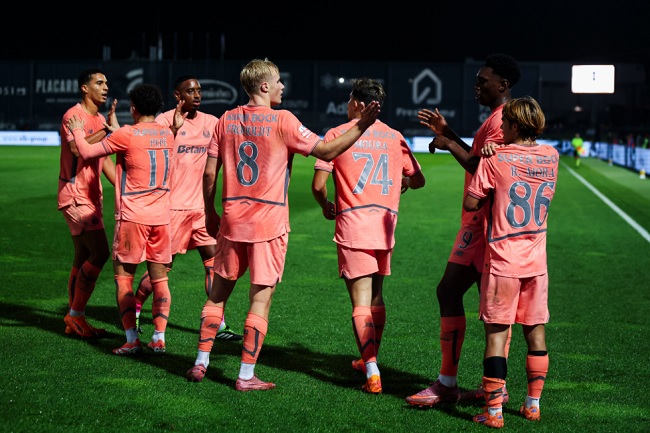
Porto registered an eighth consecutive victory under Francesco Farioli following a convincing 4-0 win in Arouca.
Samu scored in the 14th minute before Pepê saw his goal ruled out for offside. Borja Sainz tested João Validot before a howler from the goalkeeper resulted in Francisco Moura hitting the post.
An injured Samu went off at half-time and Martim Fernandes was sent off in the 48th minute but the Dragons’ dominance continued.
Pepê assisted Deniz Gül in the 51st minute and Moura made it 3-0 on the hour mark. There was more humiliation for Arouca, their capitulation complete in the 85th minute when Zaidu Sanusi converted Alberto Costa’s cross from close range.
Arouca 0-4 Porto
Gabri Veiga volleyed wide early on but Porto’s persistence paid off with the opening goal coming in the 14th minute. Jan Bednarek’s long pass picked out Victor Froholdt who saw his shot blocked by Tiago Esgaio, the ball falling for Samu who stroked the ball into an empty net.
Pepê found the net not long after but Borja Sainz was found to be offside by the VAR. Samu picked up another knee injury with nobody around him, got some treatment and stayed on the pitch.
The chances kept coming for the Dragons, Sainz getting on the end of Pepê’s cross and shooting straight at João Validot. The goalkeeper was then spared after coming out and colliding with Esgaio, Francisco Moura picking up the spoils and heading against the post.
Samu off injured
Samu was unable to recover at half-time and replaced by Deniz Gül. There was no let up from Francesco Farioli’s side, Moura’s shot saved and Sainz firing over the bar.
Porto were reduced to 10 men in the 48th minute. Martim Fernandes, who had been booked in the first half, lost possession and fouled Pablo Gozálbez in an attempt to recover the ball, referee Fábio Veríssimo showing the teenager a second yellow card.
Pablo Rosário replaced Gabri Veiga three minutes later and was immediately involved in Porto doubling their advantage. He sent the ball forward where Gül gave the ball to Pepê, the Brazilian doing well to draw defenders and poke the ball through to Gül who finished from close range.
Ten men dominate eleven
The numerical disadvantage was having no effect on the visitors who made it 3-0 in the 60th minute. Froholdt went on a long run, Sainz threading the ball through to Moura who found the bottom corner.
Farioli brought on Dominik Prpic, Zaidu Sanusi and Alberto Costa in the 69th minute as the chances kept coming, Jakub Kiwior firing into the side netting. Arouca’s atrocious defending contributed to Porto’s fourth goal in the 85th minute, Costa crossing to Sanusi who scored from a yard out.
Porto keep rolling
Porto made it eight straight wins under Francesco Farioli, the only goal conceded coming in the 2-1 victory against Sporting CP at Estádio José Alvalade. Scoring three goals with 10 men was impressive and highlighted their superiority.
Everything Farioli touches is turning to gold and his side will start as overwhelming favourites on Thursday when they host Red Star Belgrade at Estádio do Dragão. Samu’s injury is a concern but his half-time withdrawal didn’t slow the Dragons down in Arouca.
Porto deserve a lot of credit but there are few words available to accurately describe the debacle that was Arouca’s defence. Vasco Seabra is one of the most overrated managers in Portugal and I find it amazing that he continually convinces top flight teams to give him a job.
Nacional beat Braga 1-0 in an entertaining clash at the Quarry.
Chuchu Ramírez struck in the 6th minute following a swift move down the left wing, Braga going closest on the stroke of half-time when Ricardo Horta hit the post.
The Warriors were unable to turn the tide in the second half, Nacional substitute Witi missing two glorious chances in added time.
The defeat was a new low for Carlos Vicens who appears to have run out of ideas, influence and support.
Braga 0-1 Nacional
Nacional got off to a great start at the Quarry where they took the lead in the 6th minute. Paulinho Bóia released José Gomes who raced past Gustaf Lagerbielke and sent a perfect cross into Chuchu Ramírez who steered the ball past Lukas Hornicek.
It took Braga 30 minutes to fashion their first shot of the game, João Moutinho’s harmless effort sailing over the bar. Ricardo went to close to equalising before the break, playing a 1-2 with Rodrigo Zalazar and firing a shot that hit the post and rebounded across the face of goal.
Carlos Vicens made a triple switch at the break with Moutinho, Zalazar Gabri and Bright Arrey-Mbi making way for Jean-Baptiste Gorby, Diego Rodrigues and Gabri Martínez.
Braga began to turn up the heat with Gabri heavily involved, but the Warriors were not getting close to testing Kaique.
The Warriors were leaving themselves exposed at the back, Pablo Ruan and Ramírez testing Hornicek before Vicens introduced Pau Victor and Florian Grillitsch for Fran Navarro and Víctor Gómez.
Gabri’s cross was diverted wide by Chico Gonçalves but that’s the closest the hosts got to drawing level.
Nacional should have made it 2-0 in added time when Gomes broke clear and teed up the unmarked Witi. The substitute had the goal at his mercy but decided to turn the gift into a comedy shot, shooting straight at Hornicek and sending the follow up effort against the post.
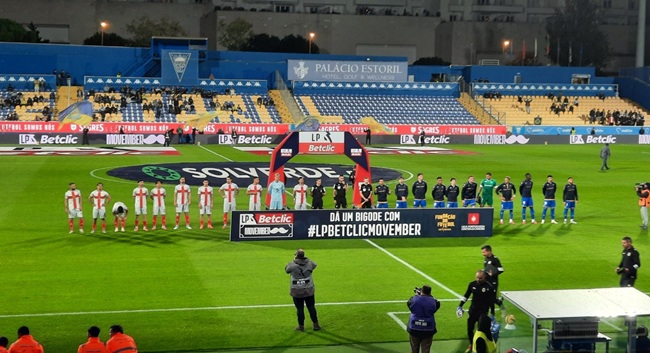
An early goal by Luis Suárez was enough for Sporting to earn the three points at neighbours Estoril and ascend to joint top of the table – at least until Porto play Arouca on Monday.
The Lions dominated the first half and could have increased their lead against an Estoril team with just one win to their name this season, Suárez taking a certain goal off teammate Pedro Gonçalves’ foot, although at the other end it needed a sharp save from Rui Silva to deny Alejandro Marques after a crass mistake by Zeno Debast.
The second half was a non-event with Sporting seemingly conserving energy for their Champions League clash in Italy against Napoli on Tuesday, while the hosts were unable to carve out opportunities against a discipled visiting defence.
Sahir Bhojwani and Tom Kundert report from the Estádio António Coimbra da Mota.
***
Rainy night on the Lisbon coast
The heavy rainfall made it difficult for any fluid passing sequences to occur in the opening minutes. Both teams attempted long balls into the opponent’s half early on. The first opportunity of the match fell to Morita in the eighth minute. Gonçalves’ corner landed at the Japanese midfielder’s feet, who plucked it out of the air. His attempt, however, went past the left post.
Sporting kept applying pressure and were rewarded in the 12th minute after Hjulmand played a beautiful diagonal cross-field pass that found Araújo charging down the left wing. The full-back did well to catch the ball in the air and angle it back towards Suárez, who was waiting in the box. The in-form striker took care of the rest, smashing a low shot into the right corner to open the scoring.
Holsgrove responded shortly after the goal, recording Estoril’s first shot on target. It was a powerful shot from the Scotsman, but aimed directly at Rui Silva, who was able to push it away.
The recalled Morita played a key role in the first 30 minutes, creating several chances and even firing a long-range effort just over the goal in the 23rd minute.
Mix-up prevents second Sporting goal
Quenda got involved in the 32nd minute, playing a beautiful one-two down the right wing to create some space for himself. The 18-year-old winger then placed a low cross into the six-yard box, which should’ve been put away. Gonçalves and Suárez both could’ve converted the chance, but ended up getting in each other’s way, and neither could apply the finishing touch, with the ball flying over the net after and both players lying on the floor after colliding.
Things went from bad to worse for the Estoril when Ricard Sánchez, who has been one of the club’s most consistent performers this season, limped off with an injury in the 34th minute.
Sporting continued to dominate in the possession and shots category. Suárez looked dangerous throughout the night, his speed and elusiveness causing problems for Estoril’s back line.
Rui Silva saves Debast’s blushes
A mistake from Debast in the 41st minute, however, almost allowed Estoril back into the game. The Belgian defender was careless, losing the ball just outside the box and allowing Alejandro Marqués an opportunity to level the match. The striker did well to snatch the ball off the defender and found himself one-on-one with the keeper, but his chip was well saved by Silva.
Pedro Amaral then had another effort for Estoril, connecting with a brilliantly weighted long ball from João Carvalhal, his spectacular first-time volley flashing across the goal.
Second-half snore-fest
Sporting continued to push forward in the second half as they looked to close out this one and secure all three points.
Patrick de Paula picked up the first yellow of the match in the 48th minute, a sloppy lunge on Suárez. The Colombian was slow to get up, but managed to continue.
Kochorashvili, who was brought on at halftime, looked to play his part. The midfielder forced a good save from Robles in the 53rd minute, a goal that wouldn’t have counted though, as it was ruled to be offside.
Estoril’s manager Ian Cathro made a double change in the 64th minute, replacing Marqués and de Paula, who were both on a yellow. Georgian midfielder Nodar Lominadze and forward André Lacximicant would have approximately 25 minutes to influence this game, which was still up for grabs.
Sporting answered with changes of their own. Quenda, Suárez and Vagiannidis making way for Iván Fresneda, Geny Catamo and Fotis Ioannidis in the 73rd minute.
Pedro Carvalho had a half-chance in the 76th minute, connecting with a corner from Hosgrove. His shot ballooned well over the goal.
Defences dominate
Estoril did their best to break a Sporting back four that have conceded just four goals in the league this season, but apart from a few tame crosses and some unsuccessful through balls into the box, they were unable to create that one quality chance to level the match.
The final whistle confirmed Sporting’s fourth straight win in all competitions and the Green and Whites will now wait to see how Porto respond on Monday. As for Estoril, it is not panic stations yet, but Ian Cathro will be keen to kick-start his season with a seemingly favourable run of fixtures in the immediate future.
Estoril 0-1 Sporting highlights
Estoril Praia: Joel Robles, Kévin Boma, Ferro, Felix Bacher, Ricard Sánchez (Pedro Carvalho, 34’), Jordan Holsgrove, Patrick de Paula (André Lacximicant, 64’), Pedro Amaral (Fabrício Garcia, 75’), Rafik Guitane (Yanis Begraoui, 75’), Alejandro Marqués (Nodar Lominadze, 64’), João Carvalho
Benfica and Gil Vicente gave the supporters at the Estádio da Luz a thrilling contest on Friday in a highly entertaining match. The two clubs provided some fast-paced and flowing football with plenty of opportunities for both sides on the night. Both teams went after the three points, and the creative players on both ends of the pitch were given the space and freedom to express themselves.
This clash had been discussed all week, with many expecting it to be a tough challenge for Mourinho and his men. Going into Jornada 7, this was a battle between the third and fourth-placed teams in the Primeira Liga, with plenty on the line. Benfica were aiming to keep the pressure on FC Porto and Sporting CP, while Gil Vicente were looking to prove themselves against one of the biggest clubs in Europe after a strong start to their campaign.
Gil Vicente were outstanding on the night, taking an early lead in the 11th minute. Benfica fought back through their star striker Vangelis Pavlidis, who was once again spectacular. In the end, the Eagles were able to hang on for a vital 2-1 victory and take all three points.
Mourinho takes the pitch with new-look attack
Mourinho began the game with a reconstructed lineup after a disappointing 1-1 draw on Tuesday against Rio Ave. The veteran manager spoke about Lukébakio’s fitness levels midweek, but opted to start the newly signed attacker after his impact off the bench against Rio Ave. Winger Schjelderup was also given the nod, with Mourinho possibly looking to give his side some more width to unlock a well organised Gil Vicente defence.
Gil Vicente manager César Peixoto started the match with his preferred back four of Jonathan Buatu Marvin Elimbi, Ghislain Konan, Zé Carlos, and, why not? The Barcelos club had conceded just twice so far this season and had five clean sheets over their first six matches. Only FC Porto had allowed fewer goals this season.
Pablo Felipe has been the danger man for Gil Vicente, and Peixoto looked to the forward to once again provide the goals. Murilo Souza and Agustín Moreira were sent out to support the striker on the wings. Midfielders Luís Esteves, Cáseres and Santi García were tasked with matching Benfica’s talented midfielders.
Gil Vicente apply early pressure
The visiting side wasted no time in getting going, almost breaking the deadlock within 30 seconds. A beautiful pass from Pablo carved open the Benfica backline and found Murillo, who was somehow completely alone just outside the six-yard box. The striker connected well, but a brilliant save from Trubin (arguably his best of the season) prevented a nightmare start for the home side.
In the ninth minute, it was once again Gil Vicente that threatened. Moreira earned a free kick just outside the penalty box from a counterattack. Esteves, who has been brilliant over the last few months, curled a right-footed shot around the wall and into the right-hand side of the net. It was a shocking start that silenced the home supporters. Trubin did well to get a hand to it, but the powerful connection from the No. 10 left the keeper without much of a chance.
Benfica responded moments later, with Schjelderup winning a free kick in shooting range. Sudakov’s shot, however, sailed over the goal and allowed the visitors to regroup
At the quarter-hour mark, Gil Vicente seemed to be in complete control, holding on to the majority of possession and keeping the ball out of their own half for the most part.
Lukébakio tried his best to create something down the right wing, but his early crosses were handled easily.
Pavlidis fires in sixth and seventh goals of the season
In the 18th minute, it was Pavlidis to the rescue once again. The striker has been Benfica’s top scorer this season, and recorded his sixth goal of the campaign when a cross from Schjelderup found its way into the box. A low shot from Pavlidis went right through the keeper. It wasn’t the typically well-worked goal we have become accustomed to from Benfica, but one that definitely settled the crowd down after a shaky start.
In the 24th minute, Lukébakio reminded the supporters why Mourinho had put his faith in him. A beautifully timed run in the box saw the Belgian connect with a remarkable long ball from Otamendi. His masterful touch allowed him to turn and get away from the two centre-backs, and when he was pulled down in the box, the referee had no option but to award a penalty. Pavlidis once again stepped up and placed the ball into the roof of the net.
The game remained open after the goal, with neither side backing down. There were gaps for both sides to exploit all over the pitch. Pablo had another chance in the 23rd minute, but his long-range effort failed to test Trubin.
Lukébakio makes his presence felt
Lukébakio continued to look dangerous down the right wing, his left-footed effort drifting just wide in the 30th minute. In the 34th, he had a similar attempt, again going across the goal, and again just missing the right post. The former Sevilla player had another glorious opportunity to give Benfica some breathing room in stoppage time. A driving run down the right side saw the attacker alone with the keeper, but facing a tough angle. He once again tried to target the far side of the goal, this time with his right foot, but his low shot missed once again.
Dodi Lukébakio wins the penalty that Pavlidis converted and which turned out to be the winning goal
Benfica went into the half with the lead, but there was still an uneasy feeling amongst the Benfiquistas as the two teams headed into the dressing rooms.
Gil Vicente fail to capitalise on second-half chances
It was once again Gil Vicente that started the second half on the front foot. Within the first minute, they forced a double save out of Trubin. The resulting corner produced another great opportunity to level the match. This time, it was García's creative attempt that came off the crossbar.
Moments later, Gil Vicente did finally have the ball in the back of the net. Some brilliant build-up play down the left wing from Konan led to a cross from Fernandes, which found Pablo. The striker tapped the ball in, but learned seconds later that it had been called back for offside. It was, however, a clear signal to the Eagles that the visitors were intent on approaching the second half as they did the first.
In the 54th minute, it was Murillo’s turn to try his luck. The Brazilian rocketed a left-footed attempt from distance. It looked to be going in, but bounced off the crossbar, leaving the forward with his hand on his head in disgust.
Conceding late goals is becoming a bit of a trend for Benfica, and it’s an issue that could’ve once again hurt the Eagles on this occasion. Gil Vicente were knocking on the door. They continued to play some dazzling football with the crowd growing restless as the game progressed.
In the 68th minute, Pablo connected with a cross from Fernandes but couldn’t get enough of the ball to angle it towards goal.
Benfica hang on for three points
The reinforcements finally came in the 69th minute. Mourinho could see his side were struggling, and decided to bring on Franjo Ivanovic and Leandro Barreiro for Lukébakio and Schjelderup.
The manager did well to fortify his side as the match went on. Gil Vicente continued to press, but were unable to break through Benfica’s stubborn back four. The pressure piled up, and a late red card for Hevertton summed up a frustrating night for the visitors. Gil Vicente produced a valiant display and can consider themselves unfortunate not to have taken anything from this game.
The fanfare surrounding Mourinho’s return to Portugal has finally started to die down, and the focus for Benfica over the next few weeks should be purely on football instead of off-field drama. The Lisbon giants have had an underwhelming start to the campaign for their usual high standards, and the fixture list doesn’t get any easier over the coming weeks. Benfica face Chelsea, FC Porto, Chaves and Newcastle United, all away from home, over the next 25 days.
It is one of the biggest rivalries in Portuguese football, and perhaps you have never heard of it. For decades, the area from the Aveiro district that connects Santa Maria da Feira, Ovar, São João da Madeira, Santa Maria de Lamas, and Oliveira de Azeméis has been fertile in tense, often violent, and undoubtedly unforgettable rivalries.
One of the fiercest is the one that opposes Feirense and Lusitânia de Lourosa, two clubs from the same council that represent very different takes on how to play the game. On Sunday 28 September they will face off in the same tier for the first time since 1984/85, but two years ago, a play-off between the clubs once again drew the spotlight in an area known as the Bermuda triangle of Portuguese football.
PortuGOAL’s resident football historian Miguel Lourenção Pereira reports.
***
It was Rosa Santos, the celebrated Portuguese referee from the 1980s who officiated in the 1988 and 1992 European Championships, who once said the worst matches he had ever had to endure were the ones that opposed Feirense, Lusitânia Lourosa, Ovarense, União de Lamas and Oliveirense. Four sides that sit in an area that stretches no more than 30 km from each other and that represent a voracious and primal sense of rivalries that goes way beyond football.
The “Bermuda Triangle” of Portuguese football
Rosa called it the “Bermuda Triangle” of Portuguese football as all sorts of values were lost in that connection of lands, souls and lost dreams. Lourosa and Feirense are both from Santa Maria da Feira, but while the Blues come from the council’s main city, Lourosa is a working-class setting that always looked with contempt on the big boys in town. In the words of the great local journalist José Bastos, for those who lived in Lourosa, it was customary to hear them say they only visited Feira, which sits less than 10 km from their home, “to pay taxes or to be arrested”. Nothing more.
That voracious mentality is what has defined the Black and Yellow over the years. They are the last Gaul village in the region, a setting where memories of the past linger, with a club run by the iron fist of the local businessman Hugo Mendes, who has invested heavily in it with a dream of turning them into a first division side like neighbouring Arouca has accomplished under the leadership of the Pinho family.
Immediate punishment
He famously, after a defeat in a local derby in São João de Ver in a cup tie, told the squad to return home on foot and sent the bus to return with no-one on board. It was only a couple of miles, but the message said it all. Win at all costs or pay the price. Lourosa have never played first division football, and yet the die-hard love for the club in town is one of a kind. Even when they were playing in the fourth and third tier, the club regularly drew attendances of more than 5,000 spectators, more than many first division sides, let alone sides from the second tier.
They are likely the best followed club in the Aveiro district, an area where there are not many clubs with long spells in the first division (Beira-Mar remains the symbol of the region) but whose faithful supporters always manage to guarantee a vibrant atmosphere in home matches, particularly when clubs face bordering towns. And there was such a crowd when the two biggest sides of the Feira council met for the play-off that would decide who would play in the second tier in 2024/25.
The play-off clash and all it entailed was widely covered by the Portuguese media
“Anyone but them!”
Feirense had had a poor season, and for a while, supporters were already prepared for the worst. In the final months of the Liga II campaign, their greatest fear wasn’t just to be relegated but to do so at the expense of Lourosa, who were fighting for promotion from Liga 3. In the end, the most dreaded outcome unfolded. Lourosa failed to grab one of the two automatic promotion places, while Feirense avoided automatic relegation but were forced to face their rivals in a play-off that was much more than just about football.
The last time they had played against each other was back in 1984/85, when they were both in the second-tier northern section (at a time when the second division was divided into three geographical areas). They both ended with 27 points in the table, with Feirense gaining the upper hand thanks to the favourable head-to-head results. After those encounters, the two clubs suffered different fates. The sides were separated administratively the following season, with Feirense playing in the centre division and Lourosa remaining in the north section.
Lusitânia were relegated to the third tier in 1988, while Feirense were promoted to the first division the following season. They had never met since then, so expectations couldn’t have been higher going into the two-legged play-off.
Welcome to hell
The first match was due to be played in Lourosa and was sold out instantly. The locals had a decent and ambitious project that vigorously aimed to be among the professional leagues, and Feirense’s dynamics were poor at best. The eight kilometres that separate both grounds turned out to be a via crucis for the Fogaceiros, who had all the pressure to perform. They knew hell was waiting for them once the Lusitânia ground appeared on the horizon, and they got the welcome everyone expected. It was going to be an old-fashioned derby; the kind of match Portugal football had forgotten existed by turning its back on its regional and local divisions. Even the football league was aware of what was about to happen, appointing the international referee Artur Soares Dias to officiate the match.
Brazilian striker Jefferson Nem gave Lusitânia Lourosa the advantage after the first leg
The locals, coached by Jorge Pinto, soon took control of the match as everyone imagined they would. In the first ten minutes they won four corners and two free-kicks, permanently harassing the Blues’ defence, who knew they were in for a hard time. In the 17th minute, the locals opened the scoring with the ball entering João Costa’s net after a rumble in the box, but it was eventually disallowed. The now FC Porto goalkeeper saved his side time and time again as both teams stayed in position, Lusitania having much more of the ball and creating danger at ease, and Lito Vidigal’s men suffering stoically and waiting for a chance to counter.
Costa’s goal finally breached
The first time Feirense caused any harm to the locals’ defensive line happened on the brink of the hour, but Antoine’s shot was feeble with José Costa saving easily. Once again, the run of play turned in Lusitânia’s favour as the side kept pressing to find an opener. In the 70th minute they finally got a much-deserved reward when a cross by Zapka took everyone from Feirense by surprise. A few fumbles later, but ball luckily found its way to Jefferson Nem at the far post, and the Brazilian striker only needed to tap it in the net. The crowd went wild after more than an hour of nervous suffering while the Feirense players looked at each other, knowing they had it coming.
But if you thought they would set themselves for a fightback, you would be mistaken. It was Lourosa who fiercely pressed for a second goal while Vidigal desperately shouted at his men to hold on for the rest of the match, figuring that a one-goal deficit wouldn’t be enough to deter them from reaching their goal in a week’s time in the home leg. And so the match ended with the locals once more causing mayhem on João Costa’s box, but with the goalkeeper performing to expectations to salvage the day time and time again.
In the end, while the supporters celebrated enthusiastically, Jorge Pinto seemed worried. He knew that Lourosa’s home advantage was one of their biggest weapons, especially in such a demanding emotional derby, and they had squandered a golden opportunity to score more than just the single goal. He was proved right, sadly for Lusitânia.
Feirense too strong at home
Days later, at the Marcolino Castro, probably one of the most underrated pitches in Portugal, Feirense came out on top. Now spurred on by their own fanatical fanbase, the Fogaçeiros came out victors, netting three past José Costa, with Sérgio Conceição, the son of the then Porto manager of the same name, netting a brace, and Henrique Martins scoring an own-goal in the dying minutes of the tie.
By then, as the away side searched madly for a goal that would level the tie on aggregate, that own goal triggered an eruption in celebrations not only at Santa Maria da Feira, but even in the neighbouring county of Lamas, who joined Feirense’s party simply to enjoy their local rival’s demise. Feirense won the right to play another season in Liga 2, where they once again struggled to stay up, although this time they did so without the need of a last-minute playoff.
Sérgio Conceição, son of Sérgio Conceição, was the hero for Feirense in the second leg
Lourosa on the up, Feirense standing still
Lourosa learned from their mistakes and have invested further in infrastructures as they remained focused on getting promoted, which they eventually did by topping their Liga 3 section, thus avoiding unnecessary drama. It is now the first time in four decades that the sides will be playing against each other in the second tier, and expectations are high as Oliveirense, also a local rival from Oliveira de Azeméis, is also one of the 18 clubs in Portugal’s second tier striving to get into the top flight.
With historical clubs such as Sporting de Espinho, Beira-Mar and Ovarense down in the lower leagues, as well as Sanjoanense and União de Lamas, the Portuguese Bermuda Triangle is alive and well in the professional football leagues once more. Expect tension, drama, fanatical local supporters and old scores to settle. Everything Portuguese football usually lacks. As Bette Davis’ character in All About Eve says, “it’s going to be a bumpy ride.”