
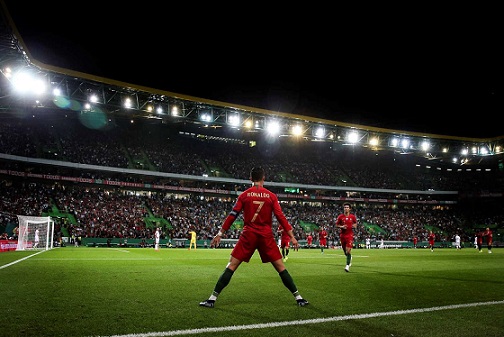
Cristiano Ronaldo will arrive at his sixth FIFA World Cup having scored in five different editions and still operating as the focal point of Portugal’s attack. He will also be 41 years old when the tournament begins, and the gap between sentimental favourite and serious Golden Boot contender has rarely been wider. Prediction markets currently price him a long way behind Kylian Mbappé and Harry Kane. The question worth asking is whether that pricing is fair, or whether it leaves room for a final reward.
What Ronaldo’s World Cup record actually says
Five tournaments. Eight goals. Never more than four in a single edition.
That is the full World Cup ledger for the all-time leading international goalscorer. His best individual tournament came in Russia 2018, when three of those four goals arrived in a single match against Spain. The 2022 edition in Qatar produced one goal from the penalty spot and a quarter-final exit against Morocco. Ronaldo has never finished a World Cup in the top three of the Golden Boot race.
The historical pattern matters here because Golden Boot winners typically come from teams that go deep. Of the last ten winners, only one (Russia’s Oleg Salenko in 1994) failed to reach the quarter-finals. Mbappé got eight in 2022 with France finishing as runners-up. Kane managed six in 2018 with England reaching the semi-finals. James Rodríguez did the same with Colombia at the 2014 quarter-final stage.
For Ronaldo to score six or more in a single World Cup, Portugal would need to reach at least the semi-finals. Even then, his career best at any major international tournament is five goals, at Euro 2020, where he edged the Golden Boot on the assist tiebreaker over Patrik Schick.
Group K and the path forward
Roberto Martínez’s 27-man squad plays its three group fixtures in Houston and Miami. Portugal opens against the Democratic Republic of Congo on 17 June, faces Uzbekistan on 23 June, and finishes against Colombia in Miami on 27 June.
On paper, two of those three fixtures favour high scorelines. DR Congo and Uzbekistan are among the weaker sides at the tournament. Uzbekistan in particular is making its first World Cup appearance and sits at +199,900 implied to win the tournament, which is essentially a rounding error. Portugal will be heavy favourites and likely to dominate possession in both games.
Colombia is the real test. They have genuine attacking quality in Luis Díaz and James Rodríguez, and the group decider in Miami on 27 June is likely to determine seeding for the new Round of 32, the knockout round added for the 48-team format.
If Portugal tops the group, the Round of 32 path opens with a probable mismatch against a third-placed side. That extra match is one of the structural reasons traders think the Golden Boot total could climb higher than the historical six-to-eight range, simply because the deepest-running strikers get one more game to score in.
Minutes, rotation and the penalty question
The honest constraint on Ronaldo’s Golden Boot case is not motivation. It is minutes.
Martínez has not been shy about rotating his forward line during qualifying and the recent friendlies against the USA and Mexico. Gonçalo Ramos, João Félix, Rafael Leão, Pedro Neto, Gonçalo Guedes and Francisco Conceição all earned places in the 27-man group, and several of them can play centrally. If Portugal builds a comfortable lead in the DR Congo or Uzbekistan games, the likelihood is that Ronaldo comes off on 60 to 70 minutes to protect his legs for the knockout fixtures. Cumulative minutes across the tournament are unlikely to match Mbappé’s or Kane’s, both of whom will play almost every available minute if fit.
Penalty duties are the second variable. Bruno Fernandes has taken a number of penalties for Portugal across recent qualifying campaigns and Nations League fixtures, and the on-pitch hierarchy between him and Ronaldo has shifted more than once. With Bruno arriving at the tournament off a Premier League assists record and his fifth Manchester United Player of the Year award, his standing within the squad is at a high point. Whether Ronaldo takes every spot kick or splits them with Bruno is the kind of detail that could mean two or three goals in a Golden Boot race.
How the field is priced
Going into June 2026, prediction-market aggregates make Mbappé the clear favourite at around 15 per cent implied probability, with Kane second at roughly 13 per cent. Haaland, Yamal, and Oyarzabal cluster between 5 and 9 per cent. Ronaldo sits around 4 to 5 per cent, level with Lionel Messi and just ahead of Luis Díaz.
That places him in the second tier of contenders rather than the second tier of outsiders, which itself is a statement on his durability. The Kalshi market alone has cleared more than $200,000 in volume on this question, with 32 different forwards trading. For the live picture of where prediction markets are pricing Ronaldo alongside the rest of the field, DeFi Rate’s tracker of the Golden Boot winner market aggregates Kalshi and OG odds using a volume-weighted average and updates hourly.
For comparison, Mbappé at 15 per cent suggests prediction markets see him as roughly three times more likely to win the award than Ronaldo. The gap reflects tournament depth, age curve, and minutes profile more than raw talent. France is a much shorter outright price than Portugal (around 17 per cent versus around 10 per cent), and Mbappé is 14 years younger.
What a realistic Ronaldo Golden Boot path looks like
For Ronaldo to lift his first major World Cup top-scorer trophy at 41, several things have to break correctly. He needs to start all three group games and stay on long enough to score in two of them, probably from open play rather than spot kicks alone. Portugal needs to top Group K to draw the easier Round of 32 fixture. He needs to play 75 minutes or more in every knockout game without picking up a soft-tissue issue. And Portugal needs to reach the semi-finals at least, since no Golden Boot winner has gone home before the quarter-final since 1994.
None of those are impossible. None are particularly likely either. Which is more or less exactly what a 4 to 5 per cent implied probability is meant to capture.
