
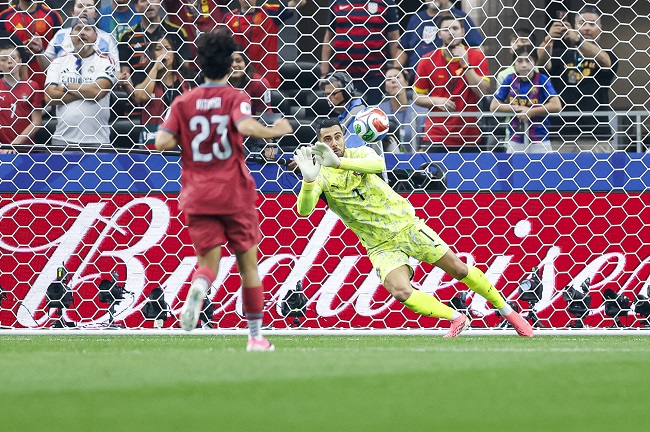
Portugal has learned, more than once, that one goalkeeper can decide everything. Hockey has built its whole way of thinking around that idea, and one prediction model shows just how far it can take you.
On a warm June night in 2004, at the Estádio da Luz in Lisbon, Ricardo did something nobody in the stadium expected. With the quarter-final against England deep into a sudden-death shootout, he pulled off his gloves, stared down Darius Vassell and saved his penalty with his bare hands. Then he picked up the ball, placed it on the spot himself and scored the kick that sent Portugal through.
Two years later, on 1 July 2006 in Gelsenkirchen, he did it again. Same opponent, same stage of a major tournament, and this time Ricardo saved three of England’s four penalties, from Frank Lampard, Steven Gerrard and Jamie Carragher, before Cristiano Ronaldo finished the job.
Eighteen years after that, to the day, Diogo Costa stood in a goal in Frankfurt. It was 1 July 2024, the round of 16 at Euro 2024, and Portugal were being frustrated by Slovenia. Ronaldo had seen an extra-time penalty saved by Jan Oblak and was in tears. Late on, Costa had already kept the tie alive by blocking Benjamin Šeško when he was clean through. In the shootout he saved from Josip Iličić, Jure Balkovec and Benjamin Verbič, three out of three, and became the first goalkeeper to save three penalties in a European Championship shootout.
Ask any Portuguese supporter about those nights and they will tell you the same thing. Sometimes the most important player on the pitch is the one wearing gloves, or, in Ricardo’s case, the one who has just taken them off.
Football’s blind spot
And yet, when football tries to look ahead, the goalkeeper is usually an afterthought. Previews of a big Portuguese night are about the striker’s form, the midfield battle, the pressing, the injuries in defense. Even the modern numbers that football has fallen in love with, expected goals above all, mostly describe the chances a team creates and concedes. What the goalkeeper does with those chances tends to be measured afterwards, as a correction, rather than built into the forecast from the start.
There are good reasons for that. A football goalkeeper might face three or four shots on target in a match, sometimes fewer. The sample is small, the moments are rare and a single save or mistake can look like either genius or luck. It is hard to build a forecast around a player who might only be tested twice.
Hockey has no such excuse, and it has never pretended otherwise.
Where the goalie comes first
In ice hockey, the goaltender faces something like thirty shots a night. Every one of them is a small test, and over a season those tests turn into a very clear picture of who is hot, who is struggling and who is about to be replaced. The key number is save percentage, the share of shots a goalie stops. The difference between a good night and an ordinary one is tiny on paper and enormous on the scoreboard. Over thirty shots, a goalie stopping 92 percent instead of 90 percent saves his team about six tenths of a goal every single game. In a sport where so many games are decided by one goal, that is often the whole story.
Which is why, in hockey, the first question before a game is not "who is in form up front?" It is "who is starting in goal?"
I found that philosophy laid out unusually clearly on NHLPredictions (nhlpredictions.ai), a site that forecasts hockey games with a data model, from the NHL across to the leagues of Europe. I came to it as someone raised on Portuguese football, mildly curious about how a sport as chaotic as hockey could be predicted at all. I stayed because it treats the goalkeeper the way Portugal’s best nights suggest we all should.
A model built around the man in the mask
The model starts by estimating how many goals each team is likely to score. To get there it looks at shots, shooting percentage and save percentage, at special teams and, crucially, at who is starting in goal. It then adjusts for home ice, recent form, rest and back-to-back games, hockey’s version of the fixture congestion a Portuguese club knows after a Thursday night in Europe. Out of all that comes a projected final score, a chance of overtime and a forecast for every period.
The goalie section on each game page is the part a football fan will find most striking. Before puck drop it names the confirmed starters. For each one it shows the save percentage and goals against over his last ten starts, which is exactly the kind of form guide football never gives its goalkeepers. If a team surprises everyone with a different starter, the page flags it.
After the game, the site does something even braver. It puts its projected numbers, save percentage included, right next to what actually happened. And if the game went all the way to a shootout, the timeline shows it round by round, shooter by shooter. For anyone who lived through Ricardo’s nights and Diogo Costa’s, reading through a hockey shootout like that feels oddly familiar.
The model does not publish a prediction on every game, either. It only makes a call when its numbers see the game differently from the general expectation, so some games show a projected score and nothing more. That kind of restraint is rare, and I liked it a lot.
Does it work?
This is where the site won me over. Every prediction is graded once the game ends, and every result stays on a public record, the misses as well as the hits. When I last checked, on 12 November 2026, the record began on 11 October and covered 33 days. In that time the site had graded 9,593 predictions, 5,902 of them correct, a hit rate of 61.5 percent across 52 competitions in 22 countries and regions.
For a sport with this much randomness built in, that is a genuinely strong number. The breakdown is even more telling, and it fits the goalkeeper story neatly. On the winner of a game, overtime and shootout included, the model was right 62.2 percent of the time. On goal margin it was right 65.3 percent of the time. But its best category was the total number of goals, where it called the outcome correctly 67.2 percent of the time, 1,608 out of 2,394. Two out of three on goals is exactly what you would hope for from a model that takes goaltending seriously. Know who is in net and how he is playing, and you know a great deal about how many pucks will end up behind him.
The hardest question in hockey is the result after 60 minutes, with a tie as a real third option, the closest thing the sport has to a football draw. More than one in five NHL games is still level when the third period ends, and those are often decided by a goalie duel in overtime or a shootout. Even there the model was right 51.5 percent of the time, which is a solid return with three outcomes on the table.
What impressed me most was the confidence table. Every prediction comes with a confidence score out of 100, and the site sorts its record by that score. Predictions rated under 60 were right 50.9 percent of the time. From 60 to 69, 63.1 percent. From 70 to 79, 70.2 percent. From 80 to 89, 84 percent. It is a staircase that climbs almost exactly the way it should, which means the confidence figure actually means something. The games the model rates highest overall, on a game-level score of 90 or more, went 115 right and 34 wrong, a 77.2 percent rate.
It is steady, too. In 33 days of games, not a single day finished below 50 percent, and most landed between 56 and 66. October closed at 61.8 percent over more than seven thousand predictions, and November was holding at a similar level when I looked. The site itself calls this early days and prints the number of games behind every figure, which only made me trust it more.
What football could borrow
Reading those goalie pages, I kept thinking about how differently a big Portuguese night would look if football previews worked the same way. Imagine a Clássico preview that opened with each goalkeeper’s last ten games: how many shots they had faced, how many they had stopped, how they had handled the chances they were expected to concede. Imagine the forecast changing when a coach made a surprise call in goal, the way the hockey page changes when a backup is named.
Ricardo in 2004 and 2006, and Diogo Costa in 2024, were not freak accidents. They were reminders that the goalkeeper is the one player who can tilt a match on his own. Hockey has built that idea into its numbers. Football, for the most part, still treats it as a story we tell afterwards.
A site worth bookmarking
Beyond the goalies, NHLPredictions is simply a pleasure to use. Every forecast is open without an account, along with the full record, the team and competition pages, and a downloadable spreadsheet of past results for anyone who wants to check the figures. More than 700 teams have a page of their own, from the NHL and the AHL to the KHL, Sweden, Finland, Switzerland, Germany, the Czech Republic and Canada’s junior leagues. There are apps for iPhone and Android, and the design is clean and quick.
It is also refreshingly independent. The site takes no wagers, runs no advertising and links to no bookmaker. It does not publish profit figures. The only thing it claims is how often it is right and over how many games, and it shows every one of them. It is meant for adults, and it presents every prediction as an opinion built on data, never as a guarantee.
Portugal learned the value of a great goalkeeper the dramatic way, on nights in Lisbon, Gelsenkirchen and Frankfurt. Hockey learned it long ago and turned it into a method. NHLPredictions takes that method seriously, shows its work in public and, on the evidence of nearly ten thousand predictions, does it very well. If football ever decides to give its goalkeepers the attention they deserve, it could do worse than start here.
