
It wasn’t pretty, that’s for sure. When Portugal faced off against the Netherlands in the 2006 World Cup last sixteen, few were expecting a bloodbath. Two of the most exciting national sides from the past decades met in Nuremberg as they fought for a place in the last eight. Although tension was to be expected, no-one realised how brutal this event would turn out to be.
For the Netherlands, the match had massive relevance. They had been beaten by Portugal on the road to the 2002 World Cup and failed to qualify for the first time since 1986. In all the previous three editions, they were seen as contenders for the world crown, so that one hurt. Just as much as the semi-final of the following Euros, played at the new José Alvalade stadium. The Dutch had been the best side in the group stage and were tipped to go all the way, but were ousted by the home side, who were experienced a crescendo after a poor start. So, it was personal.
Portugal, though, looked at the match differently. It was the last opportunity for the remaining survivors of the Golden Generation to make a name for themselves in the world’s most prestigious stage, and for recent newcomers to the international arena, such as Deco or Cristiano Ronaldo, two of the most decisive players of the season, it was the opportunity to assert their value. It was meant to be a tie for the ages, and turned out to be so. Only for all the wrong reasons.
***
Rebuilding from the wreckage of 2002
The pain after the 2002 World Cup was too much to bear. So were the consequences. Portugal was out even before the real party started, and for many high-profile internationals, players who had helped to raise the nation’s profile over the previous decade, 2002 was the end of the road. João Vieira Pinto was suspended by FIFA after his punch landed on Argentine referee Elizondo Gonzalez went all over the news, and in the following months, other high-profile players started to feel they were an unwelcome presence for the Portuguese Football Federation.
With the Euros around the corner, FPF president Gilberto Madaíl was a man living in a permanent state of anxiety, fearing that all the effort put into staging the competition would collapse with a poor performance from the hosts. He decided that, for the first time in decades, the moment was ripe to once again turn to a foreign manager for the national team. No coach in Portugal was seen as strong enough to build a winning project. Carlos Queiroz had turned his back on the Federation, Artur Jorge had retired, Humberto Coelho proved to be a on-off and António Oliveira was out of the door immediately after the disaster in South Korea.
Scolari appointment unpopular
There was simply no-one else to take the reins, even if the name of Fernando Santos was mentioned for the first time as a potential contender. In fact, Portugal had enjoyed its best-ever performance at the international stage with a Brazilian in charge, Otto Glória. The same man responsible for taking Benfica to another level in the mid-1950s was key to Portugal’s glorious campaign in 1966, even if his return, fifteen years later, was less enthusiastic. Again, it was in Brazil that Madaíl found the answer to his prayers.
Luiz Felipe Scolari, who had arrived in Japan as the most criticised manager in the history of the Brazilian national side, took the Seleção Canarinho to their fifth world title before leaving and he was up for grabs. It cost a fortune, but finally Madaíl got his man, even if the negotiations lasted for months, as the under-21 national manager, Agostinho Oliveira, played the first friendlies organised to prepare the squad for the Euro 2004 finals, a time he used to give an opportunity to untested promising players he knew well from the youth ranks.
Scolari’s arrival was not popular. The growing resentment towards Brazil had begun to fester within Portuguese society, after decades of cultural assimilation, reflecting the increasing immigration of the South Americans to Portugal. The national game was home for hundreds of Brazilian footballers at every level, but having one leading the national side seemed preposterous to many, with former internationals taking the stage to criticise the appointment.
Xenophobia rears its ugly head
Worst, when Scolari gave the go-ahead for the inclusion of Deco, who had just got his Portuguese nationality after showing promise with FC Porto, many started to doubt if the national side was, in fact, national. That xenophobic stance, which would later develop in the rising right-wing movements that populate the nation today, conveniently forgot how many players from Africa, and indeed Brazil, had performed heroically for the national side over the decades and the fact that, by 2002, almost every football nation had nationalised or assimilated players. Even England was being coached by a Swede.
Scolari immediately started his project from scratch and began by banning some high-profile internationals after a couple of friendlies. He remained trusting of the likes of Fernando Couto, Rui Costa, Costinha, Pauleta, Nuno Gomes and Luís Figo, but players like João Vieira Pinto, Sérgio Conceição, Jorge Costa, Paulo Sousa and, crucially, Vítor Baía, were never called up again. The goalkeeper would be crowned Europe’s best goalkeeper in the following two seasons, as José Mourinho’s Porto swept up all the silverware available to them domestically and at the continental level, but Scolari remained adamant that Ricardo Pereira would be his goalkeeper.
Scolari rings the changes, momentum builds
He also promoted Jorge Andrade as Couto’s partner in defence, with Ricardo Carvalho as backup, and called upon the likes of Miguel, Paulo Ferreira, Nuno Valente, Maniche, Deco, and a young, promising newcomer by the name of Cristiano Ronaldo. Portugal’s side was a mix of the Golden Generation of the 1990s, Porto’s successful side and promising young internationals, a concoction that took its time to connect but, when it did, took the side to the European Championship final in 2004, only to tragically lose to Greece on home soil.
But momentum seemed to be on Portugal’s side, especially after cruising to the 2006 World Cup. A record of 30 points in twelve qualifying matches, without a single defeat to their name, saw the Seleção ranked alongside England, Germany and Brazil as favourites to claim the crown. An easy draw that included Angola, debuting in the event, Iran and Mexico seemed to help their cause even further. Deco was now bossing the Champions League-winning Barcelona midfield, Ronaldo was already a Premier League star, and Simão Sabrosa and Luís Figo still had it in them to run a game from the wings.
100% Portugal march into the knockouts
Based in Marienfield, which Porto had spent their pre-season training camp prior to the all-conquering 2003/04 campaign, Scolari’s men had their eyes set on the prize, but after an early goal by Pauleta, couldn’t raise their game in their debut against Angola, in Cologne. Andrade’s injury meant Fernando Meira was now partnering Carvalho, while Miguel had won the battle with Paulo Ferreira for the right-back berth. Petit and Tiago had replaced Costinha and Maniche, with Figo, Ronaldo, and Simão operating behind the Azorean striker. Hugo Viana and Maniche came on in the second half to no effect, as some doubts started to creep in.
The team showed a better version of themselves against the Iranians. Deco was now back in the starting eleven alongside his former partners Costinha and Maniche, with Simão, Tiago and Petit moving back to the bench. The naturalised Portuguese scored the first goal in the second half, and then Ronaldo netted from the spot with ten minutes to go. Portugal had booked a place in the knock-outs for only the second time in their history, Scolari rewarding the rest of the squad with playing time in the final match against Mexico. Maniche opened the scoring before Simão Sabrosa added a second. Mexico pulled one back, but the likes of Fernando Caneira, Hélder Postiga, Nuno Gomes, Luís Boa-Morte and Tiago proved to be reliable options as the tournament moved onto the knockout phase.
The perfect start meant Portugal were, alongside Brazil and the hosts Germany, the only side with a 100% winning record. Next up was the Netherlands, who had tied with Argentina on seven points but ended up runners-up in the group due to the South Americans’ routing of Yugoslavia, with Lionel Messi scoring the sixth and final goal, his first in the competition. The world didn’t know then, but the rivalry between he and Cristiano Ronaldo, two stars emerging out of this World Cup, was about to change the game completely.
Euro 2024 in reverse!
The duel against the Dutch was staged in Nuremberg on the 25 June, late at night. When the two sides prepared to come on to the pitch, they already knew England would be waiting for them in the last eight after beating Ecuador with a David Beckham goal. Ever the superstitious, Scolari was quick to point out to the players that, on route to the Euro 2004 final, Portugal had played the English before meeting the Dutch, and now it would be the other way around.
Yet, this was a very different Netherlands team from the one they had encountered in Lisbon. Coached by former legend Marco van Basten, the Netherlands had proven to be a more defensive side than many would expect from a nation essentially known for their fast-forward attacking mindset. The three times Balon d’Or winning striker remained true to the traditional 4-3-3 but selected players like Khalid Boulahrouz, André Ooijer, Joris Mathijsen, Mark van Bommel and Philip Cocu, true warriors ready to give their all for the squad, while other more talented artisans such as Rafael van der Vaart, were kept as alternatives on the bench. Even in the attacking line, alongside the young, promising Robbie van Persie and the talented winger Arjen Robben, van Basten had preferred to go with the strong-willed Dirk Kuijt instead of the prolific goal-scorer Ruud van Nistelrooy.
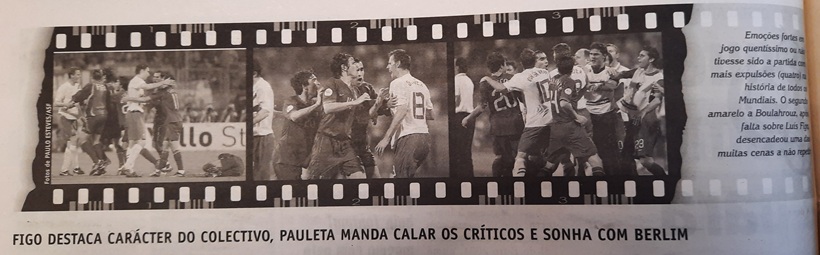
Netherlands go Neanderthal
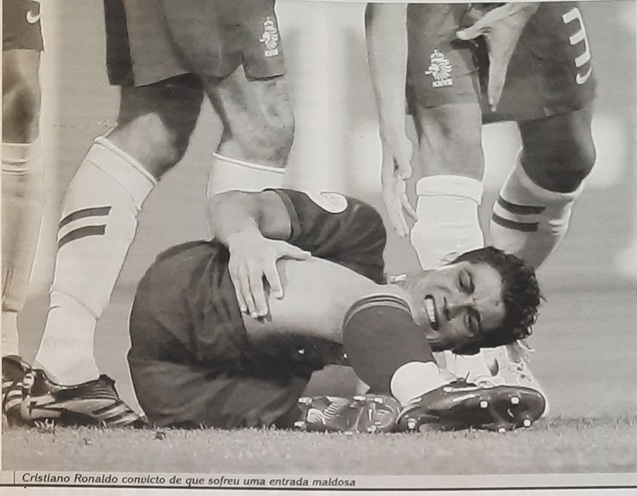
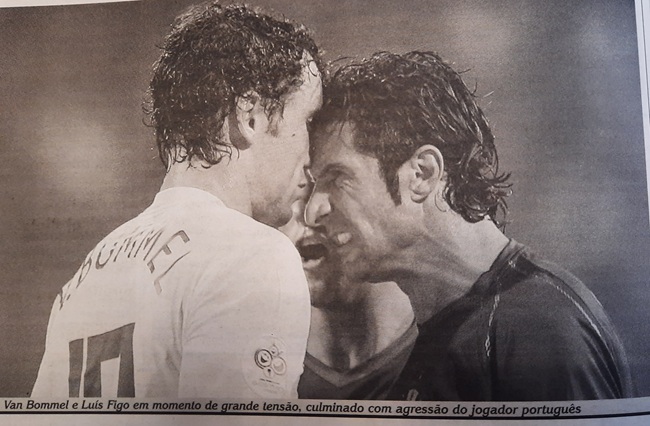
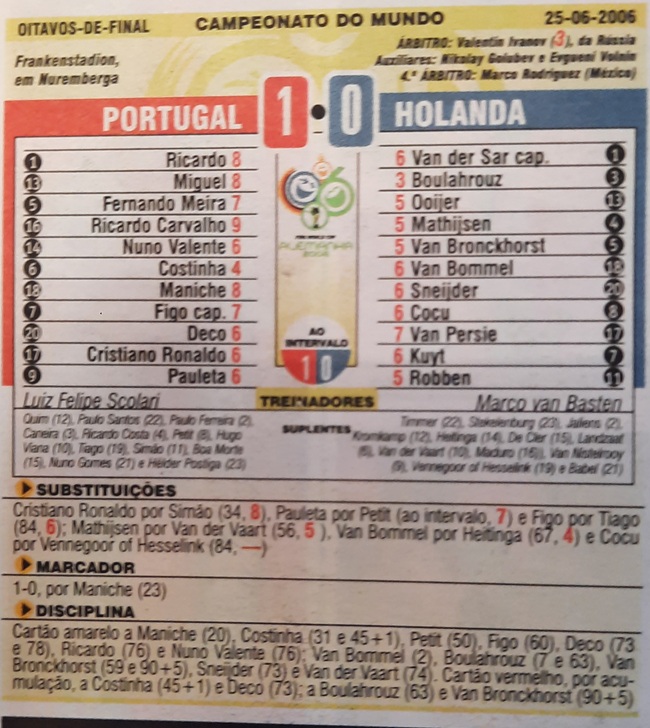
As expected, Scolari remained true to his usual starting eleven, knowing this would be a tense affair right from the start. Few, however, would imagine just how much. During the first minutes, the Dutch showed what their approach would be. Violent tackling, intense pressure and every trick in the book was utilised to block the Portuguese from playing their usual game from the middle. In the second minute, the referee, Valentin Ivanov, had already been forced to show a yellow card to Mark van Bommell for a cruel foul on Ronaldo. Five minutes later, it was Boulharouz who was also yellow-carded after badly hurting Ronaldo with a disgraceful foul, and as the Portuguese started to repay in the same coin, Maniche was also yellow-cared in the twentieth minute.
The game was ugly from the start and scarce in opportunities, with van Basten’s men shooting from distance without menacing Ricardo’s goal too much and the Portuguese unable to come close to Edwin van der Sar’s goal either.
Slick goal out of keeping with the match
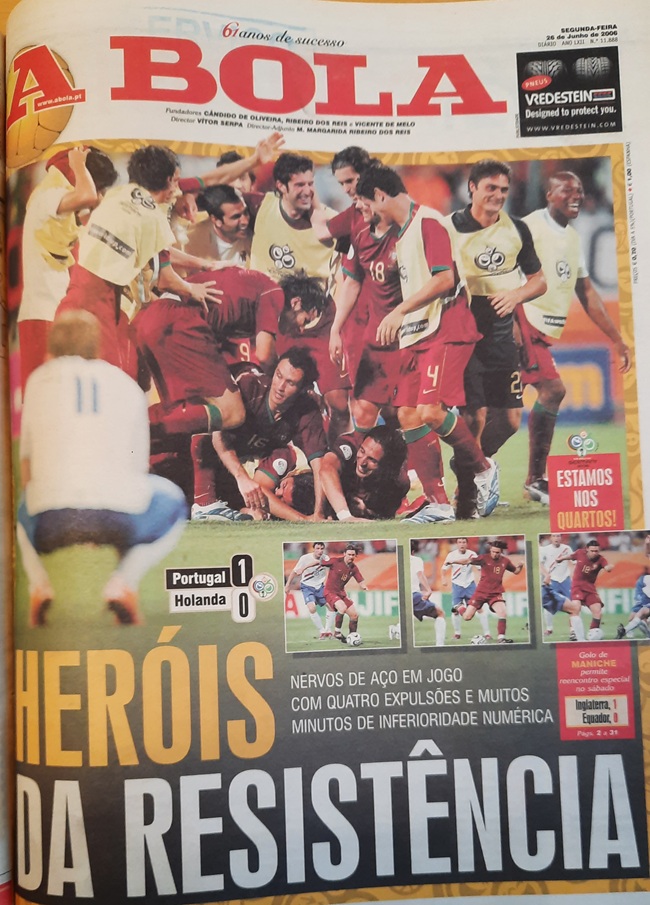
Then came the only goal of the night. Portugal moved from the right, with Miguel connecting with Deco, and the attacking midfielder blasted a cross to the box where Pauleta, back on goal, held the ball up and left it to Maniche, who came from behind, dribbled past Ooijer and shot home before running to embrace the crowd. Wearing an all-red kit for the first time – a tradition that would last until the end of the 2010s – Portugal seemed to have found a well-deserved lead, one they would cling on to for the rest of the match, but not without consequences.
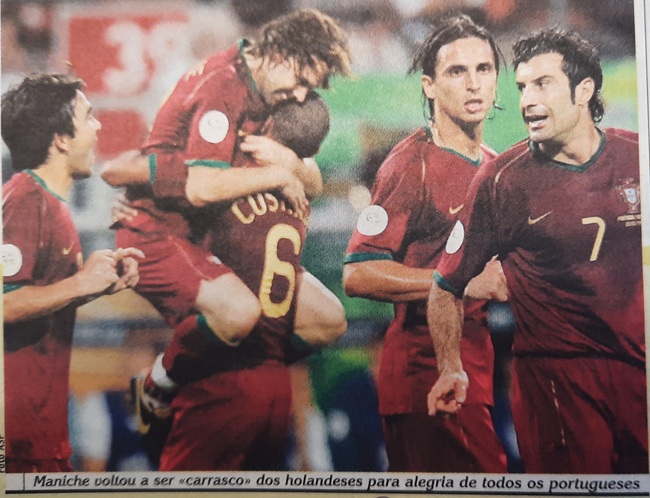
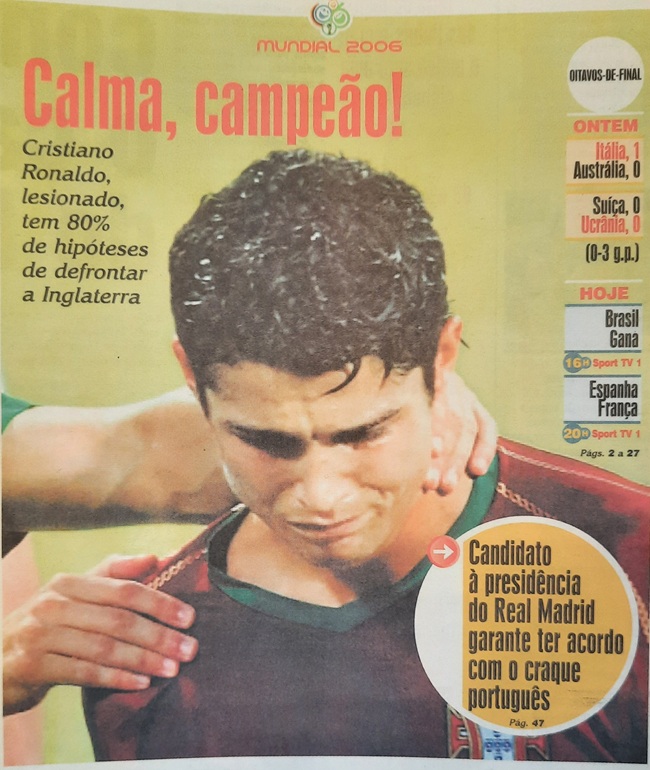
By then, Ronaldo had already been assisted twice after Boulharouz’s criminal tackle, and he eventually couldn’t cope with the pain, and was replaced by Simão before half-time, leaving the pitch in tears. Then came the full-on battle between both sides. Players stopped searching for the opposition’s goal and began to search for their opposite numbers. Costinha was yellow-carded on the half-hour and then again before the break, leaving Portugal playing with ten men. When the match restarted, Ivanov was forced to book Giovanni van Bronkhorst, Wesley Sneijder, Figo and Deco in quick succession.
Referee starts to run out of ink
Things were escalating fast. Petit, who had come in for Pauleta, as Scolari decided to play a striker-less formation once Costinha was sent off, was yellow-carded a few minutes after coming on, and so was van der Vaart, who replaced Mathijsen as van Basten searched desperately for the equaliser, which looked like it had been coming with the man-advantage and van Persie hitting the woodwork.
In the 63rd minute came the second red card of the night. Boulharouhz, who had already managed to take Ronaldo out of the equation, elbowed Figo as he was outsprinted by the veteran winger and duly made his way into the dressing room upon the referee’s orders. A brawl broke out between players and staff as the tension levels rose even more. By then, in football terms, the game was completely in the Netherlands’ hands with Portugal incapable of creating any danger.
Even the normally placid Deco loses it
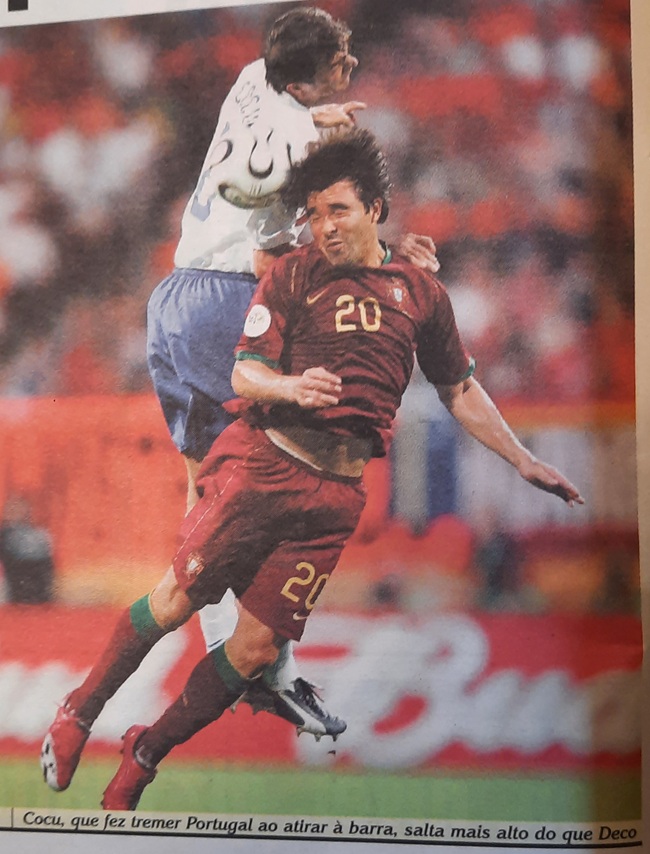
Scolari had spent two of his three possible substitutions on the injured Ronaldo and the sent-off Costinha, so he was holding his cards close to the chest before making a third to see how things unfolded. Portugal tried to gain time, but things went sour again when they knocked the ball off the pitch so that Simão could be assisted, and the Dutch refused to give it back to them, breaking with the usual fair play tradition. As Heitinga tried to cavalcade with the ball on his feet, a livid Deco hacked him down from behind, which triggered another brawl. Five minutes later, Deco was sent off as well, when he refused to give the ball back to Cocu, who threw him to the floor and went without punishment.
In the following play, Dirk Kuijt had the best shot on goal for the Dutch, but Ricardo saved it brilliantly. Portugal knew they would have to suffer for the rest of the match, but referee Valentin Ivanov wasn’t finished as he also red-carded van Bronkhorst in the dying minutes of the game, with the Barcelona left-back joining Deco watching on from the sidelines in an image that became iconic of the match. The game ended minutes later and, without having more than a couple of shots on goal, Portugal had come out victors in one of the most contentious battles in World Cup history.
Record card count
The match ended with a record sixteen yellow cards and four red cards, which was completely unheard of in the long history of all World Cups. In a World Cup absent of drama or disputable referee decisions up until the final, the match between Portugal and the Netherlands entered the hall of fame for all the wrong reasons. The Dutch press and supporters were highly critical of the overtly physical approach of their own men, who had once served as prophets for a cleaner, aesthetic way to play the game.
In Portugal, the focus was on the change of mindset Scolari had brought to a side that used to falter when things went rough in the past and now proved they had it in them to survive even in the most dramatic of moments. The match had severe consequences for the following round, though. Cristiano Ronaldo recovered in time, but Deco and Costinha were suspended for the game against England, forcing Scolari to change his midfield again, bringing Petit and Tiago in.
Under-strength Portugal scrape past England
Diminished in more ways than one, Portugal faced the golden generation of English football, aware they were seen as the underdogs and as so often, thrived in such a situation. The side knew how to sit deep, neutralise the offensive prowess of the English. Ronaldo helped get Wayne Rooney sent off, becoming a much-demonised figure back in England, although Rooney himself always defended his Manchester United teammate’s behaviour regarding the incident, saying he would have acted in exactly the same way if the roles had been reversed.
Things turned out for the best for Scolari’s men. The match ended in a dull nil-nil, and a place in the semi-finals was decided in a penalty shootout, the same way as had happened two years prior, even if less spectacularly so. There was no need for Ricardo’s last-minute drama as England were poor missing three penalties, Cristiano belting in the decisive penalty.
France prove Portugal’s nemesis once again
Scolari had been right all along, and after beating the Dutch and the English, it seemed Portugal had what it took to make it to the final, but not even he was strong enough to deal with the usual bête noire of Portuguese football: France. Almost out in the group stage, the French recovered in style, beating Spain and Brazil in the following rounds before proving to be the superior side in a match where Portugal never seemed to quite believe in themselves as they had done in previous matches. Zidane played gloriously, Figo was a shadow of himself, and Ronaldo wasn’t able to provide the magic his side needed. Some remembered how Scolari decided not to call up a player like Ricardo Quaresma, who could have been decisive in a night like that one. A Zidane goal made the difference, and then Portugal was crushed by the home side in the bronze medal consolation match, finishing the tournament fourth.
It was the second-best finish in Portugal’s history – and the Seleção have never equalled it since, twenty years on – but somehow it felt they faltered at the end. Contrary to what happened in 2002, when they were psychologically destroyed from day one, in Germany Portugal proved to be a much tougher side on all levels but even they couldn’t cope with Zinedine Zidane’s lasting genius, even if the Frenchman betrayed himself and his teammates by getting himself sent off in the final, allowing underdogs Italy to be crowned world champions against all odds.
Scintillating Seleção
If in 1966 Portugal had been beaten by a strong home side, 2006 felt they were deserving of something more than what they got, and, as time went by, the memory of the Battle of Nuremberg came almost to erase the overall brilliant performance during the whole tournament. For the following four World Cups, results would prove to be dramatically worse at every level of disappointment possible.
