
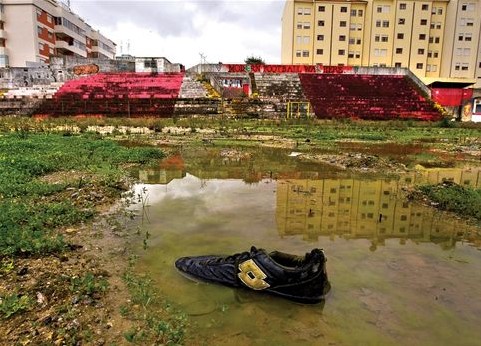
It’s one of the saddest sights you can come across. Walk the stairs from the Vidal Pinheiro metro station in the city of Porto, and you find yourself exactly at a place where football heritage was made. The ruins that surround the tram station tell the story of a place, of a club. Of a group of passionate football supporters who are no longer there. Nor ever will be.
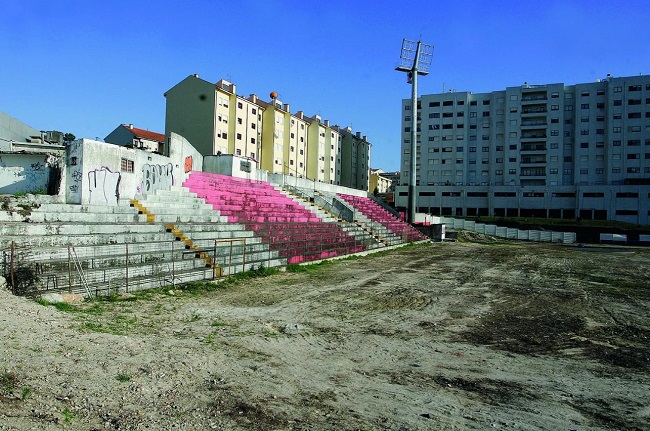
The Vidal Pinheiro ground was Sport Comercio and Salgueiros’ soul. Not just their longstanding home but their very essence. When the stadium gave way to a new metro stop, not only were the sounds of the heaving stands, the ball bouncing on the turf and the chants silenced. It was the club itself that disappeared almost into oblivion. Never has the closure of a football stadium meant so much for a club in the history of the game in Portugal.
***
Standing up to the dictatorship
Probably one of the greatest moments in the history of Vidal Pinheiro had nothing to do with football, and, in turn, that is why Salgueiros was never just an ordinary club. Back in 1948, Portugal was hoping that the Allies’ triumph in World War II meant the end of a fifteen-year-long dictatorship led by António de Oliveira Salazar. The regime was afraid too. Pressed by the British, they released some political prisoners – including the famous player, national manager and sportswriter Cândido de Oliveira – and made some minor adjustments to their secret services and political police force.
Salazar was also obliged to convene open elections for the President of Portugal. Even though everyone took for granted that Oscar Carmona would win, one of the generals who supported the military coup and had been in office for a fourth term, for the first time another military officer came forward to represent those who wanted a change. Norton de Matos took the bold step of defying the almighty Salazar, but he quickly found out that few were ready to publicly throw their support behind his cause. Fear was still the dominant currency in Portugal at the time.
Salazar exacts revenge
One organisation that didn’t cower, though, was Salgueiros. When Matos found it impossible to find a decent venue to stage a rally in the city of Porto, it was the club that allowed him to use their facilities to gather one of the biggest crowds against the regime that Salazar had ever had to witness. It was a defining moment in the fight against fascism in Portugal and showed what Salgueiros was all about as an institution. Weeks before the elections, though, Norton de Mattos renounced, stating he didn’t trust how the ballot count would be done, giving Carmona his last win before he died, two years later, in mid-term.
Salgueiros suffered as a consequence. For the following decades, the club was bullied by the authorities at every chance they got, and despite their huge popular appeal in the city, they were never granted the same conditions as other city rivals. They would have to wait, like so many, for the Carnation Revolution in 1974 to blossom. A time when the Vidal Pinheiro became an iconic landmark of a different country. A different football culture.
Bullied out of their ground by FC Porto
Salgueiros was a club born out of the passion of a group of youngsters who played regularly under street lamps after a hard day of work in the local industries and plots of fields that surrounded Paranhos, a slum, mainly working-class neighbourhood, north of Porto. The club came to be in 1911 and adopted the red and white of Benfica after many of its founders saw the Eagles face FC Porto, the big name in town. Salgueiros quickly rose to become one of Porto’s fiercest opponents, alongside Boavista and Académico, winning the regional league in 1918. Their menacing status soon raised eyebrows in the FC Porto boardroom, and the power the Dragons yielded in the city was used to keep Salgueiros in check. The club disappeared when they couldn’t find a place to play, after being thrown out of the famous and popular Covelo ground, mostly because of the influence of businessmen with ties to Porto.
They eventually joined forces with Sport Club Comércio, changing their official name to Sport Comércio e Salgueiros, and eventually found in Alexandre Vidal Pinheiro, a military engineer who had served in World War I, an unexpected patron. Pinheiro gifted the club some land that belonged to him on the northern side of Paranhos and even helped with the construction works alongside many members who put their efforts into making the ground suitable for the enthusiastic local crowd.
Anti-fascist patron
What many Salgueiros supporters already knew was that Vidal Pinheiro was a hardcore anti-fascist military officer who had opposed the military coup back in 1926 and was even arrested for belonging to the opposition forces, serving time in Africa and the Azores, where he was finally stationed. It was then that he was finally kicked out of the army for insubordination and returned to his native Porto, where he learned what Salgueiros was all about.
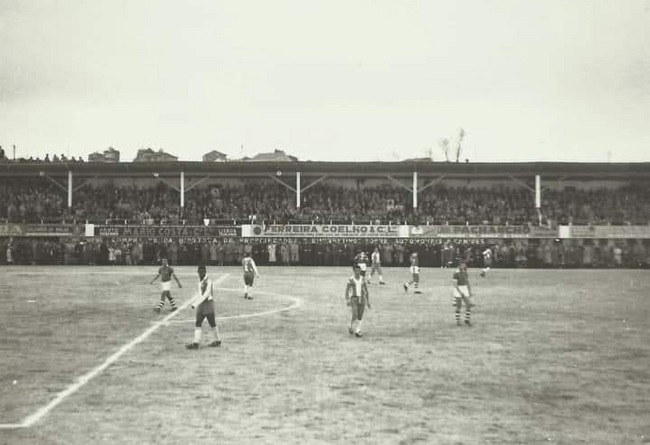
It was a working-class club that included not only factory and countryside workers but also opposers to the political regime who didn’t see their values reflected in the likes of FC Porto, Boavista or Académico. It became his life’s mission to help out the club in every way he could, and it began with the construction of the new ground. It was opened in 1932, a dirt ground with wooden stands in all but one end, at a time when there were still no buildings around it. Vidal Pinheiro then became chairman and member of several boards during the following years, helping the club open different sporting sections – they would become one of Portugal’s greats in water polo – and eventually the stadium was named after him after being originally known as Campo Augusto Lessa, the street where it was built.
In 1949, it was he, once again, who opened the doors of the ground to Norton de Matos, ending with the club losing all economic support from the city hall and with Salazar subsequently forbidding any political event from taking place at a football ground in the future. Pinheiro died a year later, and without him, Salgueiros suffered in consequence.
Revamp and sporting success
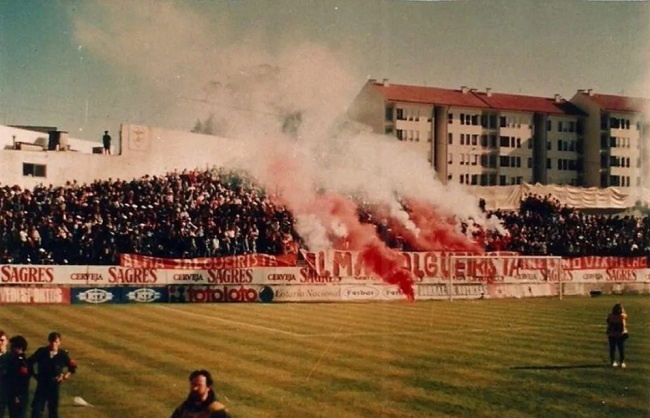
The first upgrades at the ground took place in the 1970s, almost forty years after it had been inaugurated. The wooden stands were replaced by concrete at a time when the neighbourhood was expanding fast, and several housing blocks were also being built in the areas surrounding it. A longstanding tree, where some kids used to climb to get a better view of the events, was also chopped down. The main stand, the only one that was covered, was reserved for the board and the oldest club members, while the opposite stand was opened to away supporters. The ultras, who flourished in the 1980s but had always been noisy, sat behind the east end where the famous Alma Salgueirista (Salgueiros soul) was brewed.
Men and women alike, all representatives of the working-class nature peculiar to the area, would scream and shout for the entirety of the match, creating an atmosphere unlike any other in Portuguese football at the time. To enter the east gate, one had to cross a small, rudimentary pass that seemed to take you into another dimension, a symbol of the poor and forgotten Paranhos neighbourhood that lasted for decades. By then, Salgueiros had become a regular of the second tier after a brief spell in the first division at the turn of the 1960s, but throughout the ups and downs it remained an extremely popular club.
Players, club staff and fans foster closeknit community
Players, staff and board members would visit the cafes and restaurants in the streets surrounding the ground, even on match days, and had a close relationship with supporters. It was a family club, something that deeply impressed those who came from other parts of Portugal, initially, and then the first foreign signings that came when the club finally climbed back to the first tier in 1984. Salgueiros was the last professional football club in the top leagues to host matches on a dirt pitch. The Portuguese Football Federation had banned clubs from playing on dirt pitches at the beginning of the decade, but they granted an exception for those who got promoted from the second tier for the length of a season before they modernised their facilities.
While Portugal were showing their brilliance in the European Championship in France, and Liverpool were beating AS Roma to claim the European Cup, those who visited the Vidal Pinheiro still had to change their boots to play in dirt, often muddy conditions. The chalk lines were a whisker away from the stands, and players would often feel the abuse and pressure of the home fans “in their faces” as they went to take a throw-in or tried to dribble close to the sidelines. Players like Paulo Futre, Fernando Gomes, Manuel Fernandes, Diamantino and Fernando Chalana, artisans of the game, were forced to turn into working men for a day.
The Vidal Pinheiro misses out on Zidane
Eventually, the grass pitch was inaugurated in 1985, and the ground underwent more refurbishments as Salgueiros turned into a household name for the following seasons. Floodlights were installed but it wasn’t enough to host televised matches, so, when in 1991 Salgueiros famously clinched a place in European competition for the following season, the club was informed by UEFA that they had to change venue. When Zinedine Zidane and his AS Cannes side came to town, they faced the Alma Salgueirista not in Vidal Pinheiro but at Boavista’s Bessa stadium instead.
The same happened with many of the matches against the Big Three in the 1990s. With television running the game, most matches were scheduled to be played at night, and Salgueiros were forced to move to the neighbouring Maia ground instead of making good use of their stronghold as they had done for the previous decades. Vidal Pinheiro became a trademark sanctuary of Portuguese football during the 1990s, a survivor of the afternoon kick-offs, hosting some of the most epic and enthralling matches played during those years.
Heyday followed by sudden end
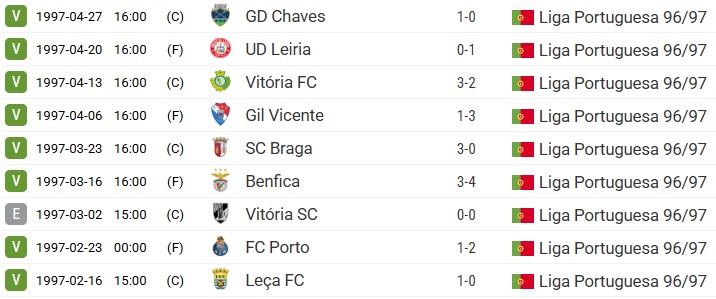
The club never again reached as high as during that 1990/91 season, but they often finished midtable as they became home to some of the most talented players in the league for the span of a decade, including the likes of Ricardo Sá Pinto, Edmilson and Deco. They joined the usual no-nonsense local players like captain Pedro or Basílio, and it was the mix of youth talent and raw-neck enthusiasm that made the sides coached by men like Zoran Filipovic, Carlos Manuel or Mário Reis, some of the most exciting in those years. In 1997, they almost sealed a ticket to play in Europe once again, but failed at the last hour in an away match in Faro with a missed penalty in the dying seconds. For some, that remains the greatest side Salgueiros ever had, able to beat both Porto and Benfica away.
Then, it all ended, with a silent bang. Despite on-pitch success, the club, like many, was in financial trouble and when the board, led by José Linhares, was approached by the Porto city hall with the prospect of selling the land where the ground stood so that the metro line could pass by on its way north, they didn’t even blink. There was a promise, never fulfilled, that they would be helped out to build a new, more modern ground in Arca d’Agua, a neighbouring site that was actually closer to where the club had been founded.
What Linhares had failed to grasp was that it wasn’t about facilities or money. It was about the very soul of the football club and its home ground. Salgueiros and the Vidal Pinheiro had become one and the same, and by selling the land, he condemned the club to oblivion.
The ground was sold in 2001, with the club first moving to Maia, and demolition works began in 2006. By then, Salgueiros had already been relegated to the second tier in their first season away from Vidal Pinheiro, in 2001/02, before declaring bankruptcy in 2004. The stadium of Arca d’Agua remained an empty promise.
Attempts to keep the club alive
A group of faithful supporters refused to let the club die, and in 2008 they began the Salgueiros 08 project, which reestablished the club as a landmark of popular football in the city, but they were never able to climb back to the professional tiers, even if, in the process, they regained the rights of the club’s crest and official name. Salgueiros have been a homeless club ever since, moving around different small grounds in the northern neighbourhoods of Porto, recently relocating itself in the Contumil area, just outside FC Porto’s Estádio do Dragão.
For those who take the metro and get out at the Vidal Pinheiro station, they can still find the remains of what was once one of the proudest and most beloved football stadiums in the land. A reflection of an era that is no more, and also of the fate of those popular football clubs that couldn’t cope with the more commercial mindset of the modern game. Salgueiros remain alive and, with it, the memory of the old Vidal Pinheiro. A place where football and politics were indelibly intertwined, perhaps like no other in Portugal.
By Miguel Lourenço Pereira, author of “Bring Me That Horizon – A Journey to the Soul of Portuguese Football”.
