
Portugal landed in Russia looking to the stars. That dreadful dead weight on their backs had been released two years prior when, against all the odds, the national side conquered Paris through a lone goal by none other than Éder to claim the first piece of silverware for the Seleção.
The European Championship win broadened the horizon for the Portuguese, who truly believed they were in with a shout of lifting the World Cup like never before. Cristiano Ronaldo had enjoyed two memorable seasons for Real Madrid – winning the Champions League and the Spanish league in 2017 and then the big one in 2018 all over again – and, for once, qualifying had been a smooth affair.
Also, a new generation of huge talents was knocking on the door, so few could doubt that the Portuguese should be considered among the favourites. Things didn’t turn out as well as expected, though, but for ninety minutes, Portuguese supporters enjoyed Ronaldo’s most brilliant World Cup match in the Portuguese shirt in an unforgettable tie against their historical rivals and neighbours, Spain.
***
Rerun of a modern classic
For the third time in a decade, Portugal and Spain would meet once again in tournament play. Add the last group match at Euro 2004 and that would be four crunch matches in less than two decades, more than in the previous century combined. It was starting to become a cult classic for the new era of international football but this time, for once, it seemed it was Portugal who had the upper hand. The Spain that dominated world football between 2008 and 2013 was long gone. Only Sergio Busquets, Andrés Iniesta, Gerard Piqué, David Silva and Sérgio Ramos remained in the squad from the golden era of Spanish football and they were also preparing to say their goodbyes to international football.
Worst still, Vicente del Bosque, who had left after a poor display at Euro 2016, had been replaced by the former FC Porto manager Julen Lopetegui, who had made himself known for guiding the Spanish under 21 side during those glorious years. He actually brought a new flair and intensity to the Spanish side, something Argentina tasted sourly when they were hammered 6-1 three months before the World Cup in Russia began.
Lopetegui sensationally sacked
The Spanish were again seen as heavy contenders but then, Lopetegui was shockingly fired by the recently appointed Luis Rubiales, once it became known that he would take the Real Madrid job after the tournament ended. Rubiales, who became notorious after forcing himself on a Spanish player from the World Champions’ women’s side years later, caused mayhem within a squad that was already training in Russia when the news broke. Fernando Hierro, the federation sports director, was appointed in haste as the manager for the competition, completely destroying Spain’s dream of winning the World Cup for the second time in a decade.
In the Portuguese camp the news seemed to reinforce a sense of superiority that came not only after the unlikely Euro 2016 win but also because the qualifying campaign had been surprisingly tasty for once. Portugal’s World Cup qualifying group included Switzerland, Hungary, Latvia, Andorra and the Faroe Islands. With only the first placed side automatically qualified, Fernando Santos made it clear that the new European crown brought a sense of responsibility with it and the squad needed to be at their best from day one. However, it was the Swiss who won the first official match played after the Paris final, a 2-0 defeat for the Portuguese that hurt the nation’s pride.
Impressive qualification raises expectations further
Portugal answered back with thrashings of Andorra, the Faroe Islands and Latvia, netting 16 goals in the three matches – Ronaldo scoring seven, an improvement from past qualifying campaigns – as Santos smoothly introduced into the squad the likes of André Silva, Bernardo Silva, Bruno Fernandes, Rúben Dias and João Cancelo. Come the last match against the Swiss at the Estádio da Luz, Portugal had managed to win every game in the group stage bar the opening trip to Basel, but the Helvetic side had a faultless 100% record. A win was needed and a win was what Portugal got, thanks to a Djourou own goal and an André Silva strike on the hour. Portugal’s ticket to Russia never seemed in doubt and now it was finally officially. The Portuguese were travelling to make good on the win at the Euros.
***
The only notable absence in the squad that travelled to Russia was Éder. The goalscorer of the winning goal in Paris played in the host country, for Lokomotiv Moscow, but still could not find his way in the final list that included a mix of seasoned veterans such as Cristiano Ronaldo, João Moutinho, Pepe, Bruno Alves and Ricardo Quaresma alongside many of the Euro 2016 champions in Rui Patrício, Raphael Guerreiro, José Fonte, João Mario, William Carvalho, Adrien Silva and Cédric with newcomers Gonçalo Guedes, Bernardo Silva, Bruno Fernandes, Ricardo Pereira, André Silva, Rúben Dias, Gelson Martins and Mário Rui also called up.
João Cancelo, injured, was also missing as was Nani, a decisive player at the Euros, with Santos surprisingly calling up Manuel Fernandes, a former Benfica graduate who played in Russia. It was a sound squad with a mix of talent, experience and a world-class superstar in Ronaldo leading the pack.
Off-pitch issues for Portugal
Sadly, weeks before the event, the shocking Alcochete attack and then the Portuguese Cup final at Jamor, brought a deeply emotional toll on the Sporting players, particularly Patrício, who was the undisputed starting goalkeeper for Portugal, with Beto and Anthony Lopes serving as subs, and that sense of doom somehow transposed from what had happened at club level into the national side.
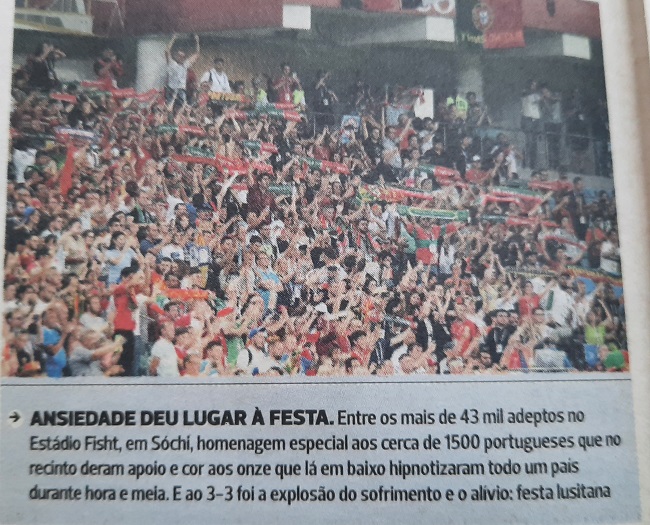
Also, Ronaldo, decided to announce at the end of the Champions League final that Real Madrid won against Liverpool for a European crown in a row, that he was leaving Los Blancos after nine years at the club, letting it slip that he didn’t feel cherished enough by the board. With speculation regarding his future rife, and knowing the first game would be precisely against the Spanish, every minute before the clash between the two rivals nations fuelled news on both sides of the border that turned a group stage match almost into a title decider. Much more than three points seemed to be at stake with a lot of players having something to prove, it seemed.
Santos picks attacking lineup
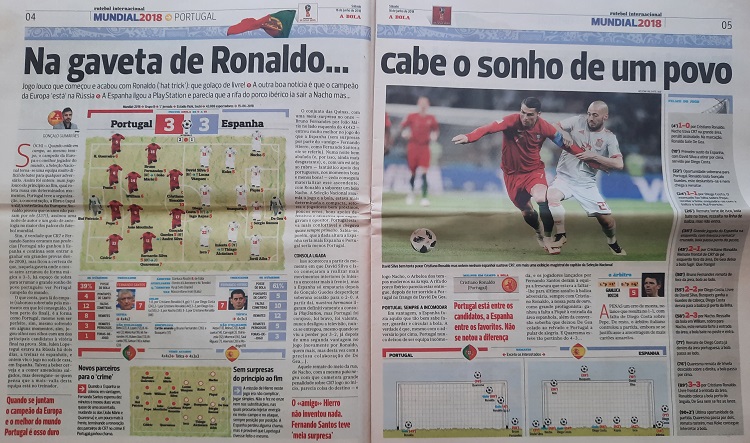
The match was to be played in Sochi, on 15 June, just two days after Lopetegui had been sacked. That meant Santos’ preparation for the match was surrounded with doubts of about whether Hierro would follow Lopetegui´s early plan or not and how the players would react to such a strange series of events. In the end the former Real Madrid legend went with a practically the same eleven as his predecessor had been selecting, with David de Gea in goal, in front of a defence consisting of Sérgio Ramos, Gerard Piqué, Jordi Alba and Nacho. Nach at right-back was a surprise choice, covering for the suspended Dani Carvajal ahead of his traditional replacement, Alvaro Odriozola. Busquets, Koke, Andrés Iniesta and David Silva backed up Isco Alarcón with Diego Costa as the lone striker.
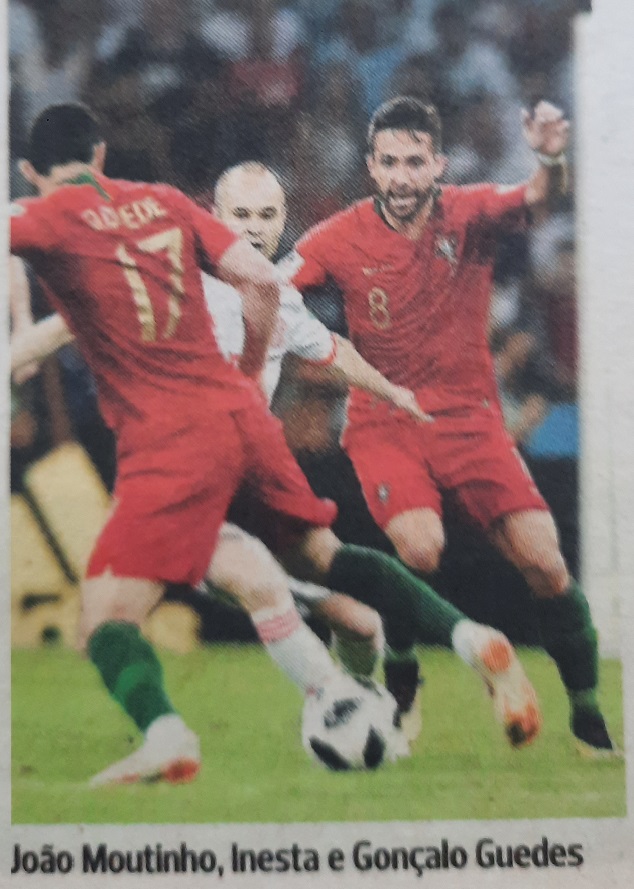
Santos decided to go with a side that held nothing back. Cédric would play in right-back, alongside the veteran pairing of Pepe and José Fonte, who had worked wonders during the Euros but were now two years older, and Guerreiro on the left, ahead of Rui Patrício who remained in goal. William Carvalho and José Moutinho would patrol the midfield, where Spain had superiority. Bernardo Silva and Bruno Fernandes were placed as false wingers, in support of Gonçalo Guedes and Ronaldo up front. It was one of the most offensive starting elevens Santos could have come up with, perhaps in response to regular criticism for being a defensive manager. It also meant he finally let go of the 4-4-2 model he had used to win the Euros, embracing a more talented squad who provided less grit but more flair in the creative areas.
Bright start, early breakthrough for Portugal
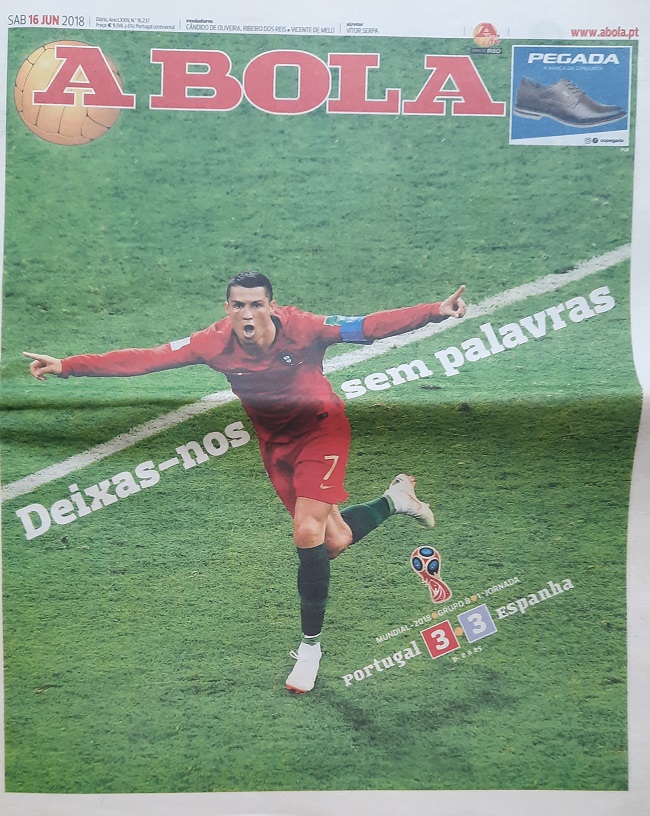
Portugal started the match with the upper hand, dominating procedures and enjoying more of the ball. Ronaldo seemed to have been extra motivated by the tonne of harsh criticism directed his way from the Spanish press after he announced his departure. In the third minute, Ronaldo galloped through the Spanish defence as if he was in his own backyard and ended up being fouled by his team-mate Nacho inside the box. Coolly, he picked up the ball, smashed it into de Gea’s net and celebrated with his new trademark celebration like a man possessed. It was the fourth World Cup for Cristiano and he had scored in all four tournaments, joining the likes of Pelé, Miroslav Klose and Uwe Seeler as the only players ever to do it.
Joy didn´t last long though. Fifteen minutes later, with Spain already enjoying more of the ball, a long pass by Iniesta reached Diego Costa who sat alone, surrounded by Pepe and Fonte. The then Chelsea forward beat Pepe in the air, who decided it was better to pretend he had been fouled than to follow the action, and then the powerful forward beat Fonte before sliding the ball past Patrício with ease.
Portugal retake lead thanks to David de Gea howler
For the remainder of the first half, both sides had decent chances to score, but it was Portugal, right before the break, who took the lead once again. Cédric crossed into the box, and as Gonçalo Guedes tried to control the ball he let it slip from his feet only to find its way to Ronaldo’s boots. From the top of the box, the Portuguese captain blasted a shot with his left that seemingly wasn’t going anywhere until de Gea failed to clutch the ball and it squirmed under his body and into the net. It was a lucky moment, if there ever was one, but Portugal had deserved it.
During the interval something clicked in the Spanish camp and La Roja came back much more determined to get even. Portugal started to watch how the quick flowing passing the Spanish were known for actually worked and progressively they were cornered into their own half. Just ten minutes into the second period, a David Silva freekick into the box caused mayhem and found Busquet’s head who carefully teed up Diego Costa for a tap-in to make it 2-2. It was soft defending from the Portuguese back four, with Pepe particularly coming late to the party once again.
Nacho rocket puts Spain in charge
Three minutes later, Spain got their third of the night. Silva, who by then was becoming decisive in manoeuvring the Portuguese defence at his will, moved from the left and tried to assist Isco before Fonte blasted the ball against the Spanish midfielder in despair. The deflection surprised everyone as the ball flew to the right of the Spanish attack where Nacho, the villain of the penalty, appeared unmarked. The defender was never known for his ability to score but against all odds he decided to shot from a distance and the superb connection sent the ball skidding at speed through Portuguese box and into the net via the inside of the post with Patrício hapless. It was a screamer and turned things around.
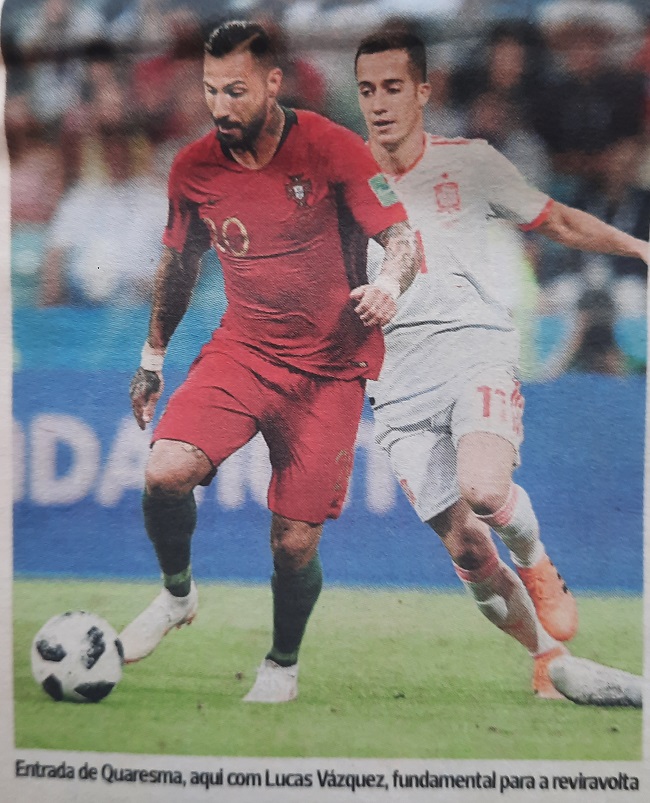
Spain were leading and deservedly so. They were playing better football and somehow nderstood where to hurt the Portuguese. Santos had to make changes. He decided to bring on Ricardo Quaresma and João Mário, two Euro 2016 winners, for newcomers Bruno Fernandes and Bernardo Silva. Minutes later it was André Silva, the top scorer in qualifying, who replaced Guedes as Spain began to drop deep, allowing Portugal to have most of the ball. By then Hierro had decided to send on Iago Aspas and Thiago Alcântara for Diego Costa and Andrés Iniesta but it was when he subbed David Silva for Lucas Vasquez that the Portuguese began to believe they still had a shot in the game.
Majestic free kick seals Ronaldo’s hat-trick
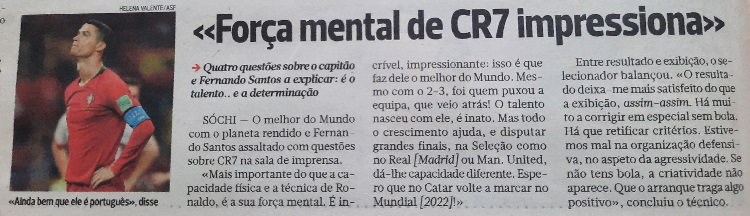
And they did. With just two minutes left to play for, Ronaldo was fouled outside of the box. As expected, the Portuguese captain, who had never scored from a free-kick for Portugal in a big tournament, picked up the ball decided that this was going to be his night. He coolly stepped back and then applied his trademark spin and dip to the ball, leaving De Gea unable to react. The ball rocked over the wall and flew into the net but by then Ronaldo was already running to the touchline to celebrate his first and only hat-trick with Portugal in a summer tournament. It was the first time since Pauleta against Poland that a Portuguese player had scored three goals in a World Cup match.
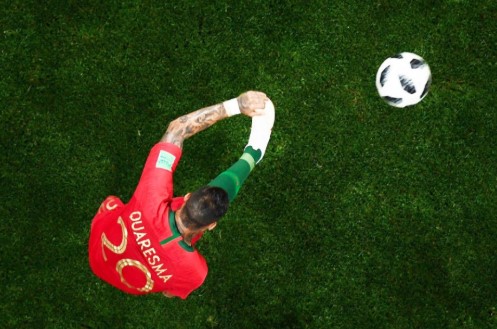
The match was one of the most memorable games of the tournament but it was also the high point for both sides. Touted as favourites to go all the way, Portugal and Spain suffered until the very last day to qualify. Ronaldo scored again against Morrocco in a tight match as did Spain against Iran, with Diego Costa again on the score sheet. That meant the Iran’s win against Morocco still gave them a chance to qualify if they beat Portugal. The side coached by none other than Carlos Queiroz also had an eye on what Spain were doing against the Africans. In the match played at Saransk – with a starting eleven that included nine players who had been at the Euros, Santos took no chances on newcomers – Quaresma opened the scoring and in the 90th minute Portugal were topping the group with Spain losing against Morrocco.
Then Iran scored to make it 1-1 and suddenly they were a goal away from qualifying, which made the closing minutes emotionally intense. A goal by Aspas in the other game sealed Queiroz´s fate with Portugal coming second because they had scored a goal less than the Spanish.
Cavani puts Portugal to the sword
That meant Portugal had to face the Uruguay of Luis Suarez and Edison Cavani in the last sixteen while the Spanish met the hosts Russia. While the Russians managed to overcome the Spanish in a tense penalty shootout, Portugal were beaten by the South Americans with Cavani netting twice to cancel out Pepe’s goal. It was a devastating blow as the 2018 World Cup was the last hurrah for many players. Few believed then that both Pepe and Ronaldo would be back in 2022.
For a while, there was a genuine feeling that Portugal could have become a title contender at last. The Uruguay defeat prevented a match down against the French who would end up winning the competition in Moscow weeks later. For Portugal it seemed another lost opportunity but it also planted the seed for a promising generation to take their first steps with the national side. A year later, winning the first edition of the Nations League returned some lost pride to the squad and made Portugal once again prime contenders for the Euros in 2020. Then COVID-19 came and the world was forced to a halt. The momentum was lost and nothing would ever be the same for the world or for Fernando Santos’s Portugal side.
By Miguel Lourenço Pereira, author of “Bring Me That Horizon – A Journey to the Soul of Portuguese Football”.
