
How could Portugal make amends for past mistakes and look to the first World Cup played in December as a unique opportunity to take home their first world crown?
The performance at the Euros in 2021 – the competition was postponed because of the COVID-19 pandemic – had been demoralising. Cristiano Ronaldo’s club football career was backtracking fast, first at Juventus and then by returning to Old Trafford. A lot of squad players were now part of some of Europe’s best sides, but they never seemed to find the best way to coexist within the national camp.
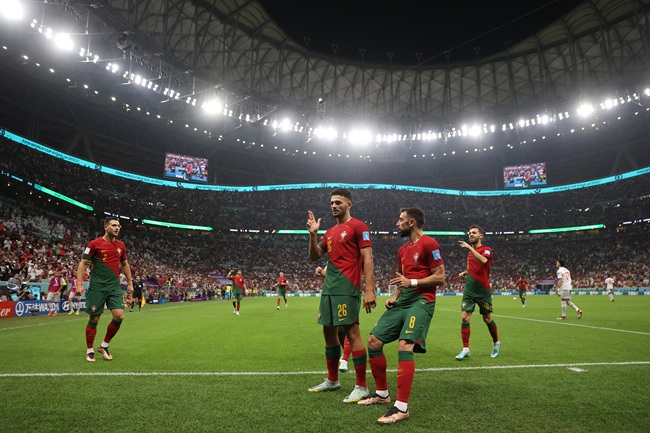
Come the last sixteen tie against Switzerland, for almost two hours, it seemed they had finally found their soul just in time to put a claim for the throne. Only to be a glimpse quickly lost in the following round.
***
Portugal arrived at Qatar as one of the strongest sides and at the same time one of the most indecisive squads in the competition. After the Russia debacle, the 2019 triumph in the inaugural Nations League tournament, played at home, brought back a sense of positivity. It was Portugal’s second trophy win in three years, and many started to expect more from them in the years to come. The likes of Bernardo Silva, Rúben Dias and Bruno Fernandes were approaching the peak of their club careers, while promising young players such as João Cancelo, Rúben Neves, Rafael Leão and Diogo Jota were making a name for themselves.
Ronaldo was still there, as was Pepe, the stalwarts of the previous generation, even if it became clear that they were past their peak. Still, Fernando Santos felt unsure about dropping either. Pepe, because Portugal didn’t have a decent centre-back partner for Rúben Dias, now of Manchester City. Ronaldo, because he was the greatest football icon in the world, a player bigger than his home nation, and who was still scoring for fun in Italy despite his physical limitations, forcing him to change the way he played. To fit Ronaldo into a more coherent attacking side became Santos’ biggest nightmare, but the lack of a world-class number nine, after the promising career of André Silva went sideways due to persistent injuries, helped.
Question marks after poor Euro and stumbling World Cup qualification
Still, the 2020 European Championship was a shambles, Portugal played poorly in the group stage, qualified miraculously, and then were out in the first knockout round against a poor Belgium side. Some started to doubt whether Ronaldo should keep on playing. It became clear that Bernardo Silva and Bruno Fernandes often stepped over each other on the pitch, and by playing the three of them Portugal usually lacked width. All those warning signs became clear during the qualifying stage for the 2022 World Cup. Away draws in Belgrade and Dublin hurt, but it was the home defeat against the Serbians, despite a first-minute goal by Renato Sanches, himself a player who after the 2016 Euros saw his career go downhill due to injuries and poor decisions.
Portugal finished second in their qualifying group, and had to battle past Turkey and North Macedonia to book their place in Qatar. They were no longer seen as such a formidable side as they probably should have been. They were still seeded, though, and that helped them have a seemingly favourable draw, albeit having to face teams they did not have great memories of playing against. Uruguay, who had beaten them in 2018; Ghana, whom they faced in 2014 when they got knocked out in the group stage; and South Korea, responsible for their demise in 2002. The omens weren’t particularly good.
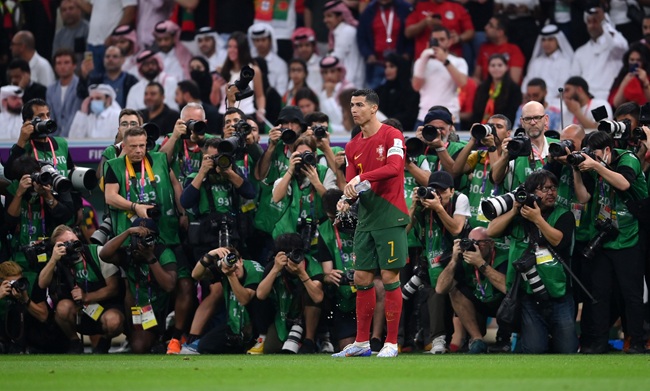
Before travelling to the Middle East, rumours started to spread about the possibility of Fernando Santos finishing his tenure after the tournament. It was widely believed that the likes of Pepe and even Cristiano Ronaldo would follow. The Portuguese superstar actually arrived at Qatar without a football club, having been released by Manchester United once his relationship with Dutch manager Teen Haag collapsed. Ronaldo went on strike, expecting the club to support him, and was surprised to see the board backing the manager. Still, he was leading the side as Santos decided to bring also Rui Patrício, Pepe, Raphael Guerreiro and William Carvalho as the sole survivors of the 2016 Euro winning squad.
Only six years had passed by, but the changing of the guard was clear. With the possibility of calling up 26 players due to COVID-19 restrictions, the names called by Santos included goalkeepers José Sá and Diogo Costa, defenders António Silva, Nuno Mendes, João Cancelo, Danilo Pereira, Diogo Dalot and Rúben Dias, as well as midfielders João Palhinha, Bruno Fernandes, Bernardo Silva, Vitinha, Rúben Neves, Matheus Nunes and Otávio. Alongside Ronaldo in the attacking line there was room for André Silva, Gonçalo Ramos, João Felix, Rafael Leão and Ricardo Horta. It was, undoubtedly, the most talented squad Portugal had ever taken to a World Cup finals, but there were doubts if talent would suffice.
Portugal open with edgy win over Ghana and Uruguay victory
As Uruguay drew against South Korea, Portugal’s win against Ghana proved decisive. Ronaldo scored from a penalty kick well into the second half, and João Felix netted a second before André Ayew got one back for the Ghanaians. Rafael Leão was brought on for Rúben Neves and scored a third, and Bukari benefited from a rare Diogo Costa mistake to make it 3-2 in the end. It was a precious win, but there were signs of defensive frailty with Danilo Pereira playing alongside Rúben Dias and Cancelo and Guerreiro operating from the wings.
Ronaldo’s goal meant he became the first player to score in five different World Cups, another record to add to his long list, but once again it became clear he was out of shape, after failing Manchester United’s pre-season due to his row with Teen Haag. Against Uruguay, Portugal played a more clinical game and won 2-0, with Bruno Fernandes scoring twice. His second goal came from the spot, as Ronaldo had already been subbed for the second time, a novelty in his career. Already qualified for the last sixteen, Santos decided to rotate most of the squad for the last match against South Korea, but while many expected Gonçalo Ramos or André Silva to play up front, Ronaldo was once again called up, and rumours started to spread that Santos had been pressured to keep the skipper on due to his World Cup goalscoring record.
Ronaldo played terribly and failed several goal-scoring opportunities. This time, he was subbed on the hour and put on an ugly face as he saw his number on the board, with André Silva coming on in his place. Portugal, who were drawing 1-1, lost after conceding a goal in the final seconds, but all the focus had been put on the fact that Ronaldo and Santos, once so close, seemed more distant than ever.
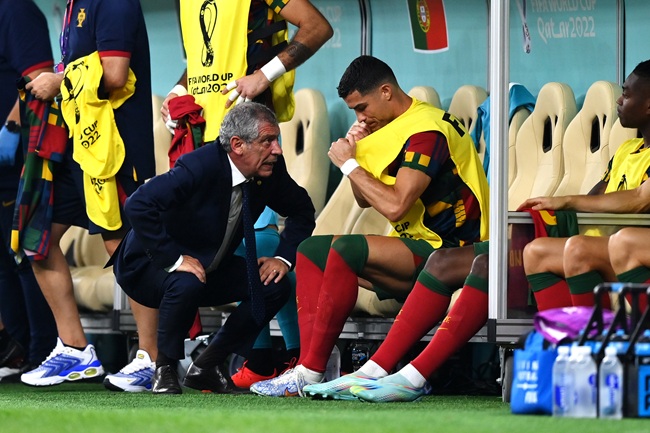
Bombshell! Ronaldo is dropped
Knowing they would be playing Switzerland, who had finished second behind Brazil in a group that comprised Cameroon and Serbia, but who had only lost with a late goal by Casemiro, many expected Santos to keep trust in his usual starting eleven. That meant playing Ronaldo up front even if it seemed wiser to have a more dynamic attacking line as the Swiss were known to sit deep. An hour before the match, to be played at the Lusail Arena, news broke that Santos had benched Ronaldo. It was the first time since a match precisely against the Swiss, in the last group game of Euro 2008, that the No7 was starting a competitive match for Portugal at an international tournament on the bench.
Cancelo was also dropped for Diogo Dalot. Gonçalo Ramos, who hadn’t played one minute yet, was drafted in to be the lone striker. He was supported by Bruno Fernandes and João Felix, with Bernardo Silva, Otávio and William playing behind. Dalot played with Guerreiro, Dias and Pepe, now team captain, in front of Diogo Costa.
Swiss unprepared for Ronaldo-less Portugal
Murat Yakin, who had played against Portugal on that night in 2008, called his usual lineup of Yann Sommer, Manuel Akanji, Fabian Schar, Ricardo Rodriguez, Granit Xhaka, Fernandes, Sow, Freuler, Vargas, Embolo and Shaquiri, but he too seemed dismayed by the prospect of facing a different attacking line than expected. It seemed the Helvetic side had a plan to stop Ronaldo, but couldn’t fathom any other option, and it quickly showed.
While Switzerland moved in their usual 3-5-2, despite noting Ronaldo’s absence, Portugal remained faithful to their 4-2-3-1. Santos, who was coaching his eighth World Cup match with Portugal, a new record, asked the players to exploit the space between the back three and the wings. For the first fifteen minutes, both sides seemed too respectful of the opponent, but then, in the 17th minute, Portugal scored first. Bernardo Silva had seen Ramos moving well and tried to pass, but the ball went sideways, but a few seconds later it was João Felix who managed to assist the debuting forward. Ramos began an exhibition that would vindicate Santos’s decision more and more by the minute. A thunderous shot that took everyone by surprise fizzed into Sommer’s net at his near post for one of the goals of the tournament.
Portugal kept on pressing and fifteen minutes later came the second, with Pepe taking advantage with a powerful header, from a beautifully measured cross by Bruno Fernandes from a corner kick. The centre-back became the second-oldest player to score in a World Cup, surpassing Roger Milla from Cameroon. At halftime, Portugal looked comfortable, controlling their lead, in the knowledge that the Swiss would have to push forward eventually, meaning more space would become available for the quick transitions powered by Bruno and Bernardo’s through balls.
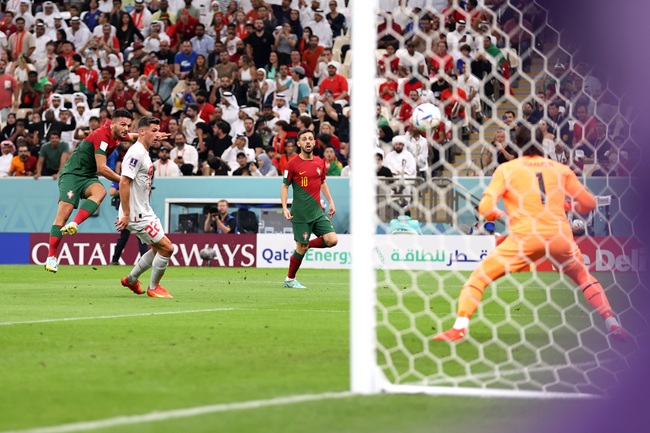
As Ronaldo prepared to warm up, Ramos started the second half by scoring his second, taking advantage of a beautiful pass by Diogo Dalot, passing his marker and then deflecting the ball past Sommer nonchalantly. Zakaria and Seferovic came on for the Swiss as Murat Yakin desperately tried to stay in the game, only for Raphaël Guerreiro to appear out of nowhere and take advantage of a nice assist from Ramos to score Portugal’s fourth. The forward’s ability to link with the players around him was making it clearer that he offered more to the collective play than Ronaldo, who usually holds on to the ball to try to shoot at any moment.
Minutes later, Akanji scored after a well-placed corner kick by Shaquiri had been deflected by Pepe, once again showing Portugal’s defensive frailties. It wasn’t to be for the Helvetics, though. Ramos finished the night by netting a hat-trick, once again finishing beautifully from a Félix assist. Minutes later, Ronaldo finally came in, looking grim, alongside Ricardo Horta and Vitinha. Ramos, Felix and Otávio came off under thunderous applause.
Leão the smiling assassin
The Portuguese captain still had twenty minutes to add his name to the scoresheet, he who had netted 118 goals in 195 caps, but it wasn’t to be. Rafael Leão, who later came on for Bruno Fernandes, eventually scored the sixth goal for the Seleção with a trademark curled shot and smiling face. Seconds later, the match ended, confirming what was probably the most perfect match by any Portuguese side in a World Cup since the demolition of North Korea in 1966. It was the first time since 2006 that Portugal managed to qualify for the last eight. Funnily enough, they did so with Ronaldo as substitute, he who had played in the 2006 Nuremberg Battle against the Dutch, but during his football prime career was never able to guide his teammates as far as the last sixteen.
It seemed ironic if it wasn’t for the paranoia that quickly spread in the Portuguese camp. In the hours following the match, the country seemed divided. On one hand, Ronaldo’s family, journalists who were close to him, and some supporters made themselves heard and publicly attacked Santos and his decision, while others, ecstatic after the collective display of the Portuguese, fully supported the manager. At the same time, Messi was guiding Argentina to what was going to be his first win in the tournament, adding rubbing into the wound in Ronaldo’s camp.
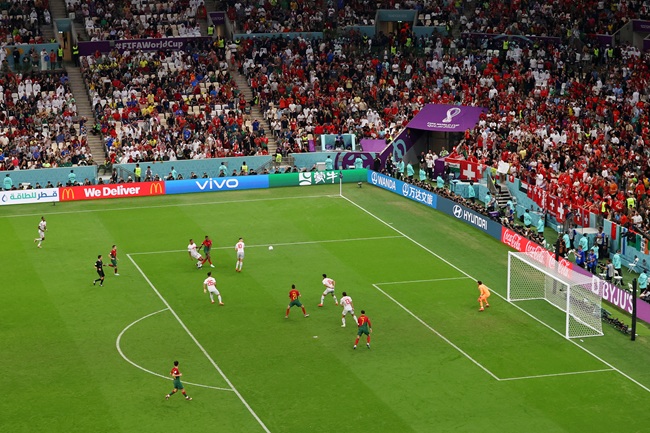
It was a bittersweet win. Even Ramos, who became the first player since Thomas Skuravhy in 1990 to score a hat-trick in the knock-out stages, didn’t get the credit he deserved as his place in the starting lineup for the following match against Morocco immediately came under attack. Ronaldo, it was said, would be a better option, and what happened versus Switzerland was a one-off and unlikely to happen again. Santos, however, acknowledging that by sidelining Ronaldo his time with the national side was effectively over, decided to stay true to himself and once again picked Ramos over Ronaldo for the Morocco match in the last eight.
The North Africans had proven themselves to be as competitive as any other side in the tournament, disposing of Spain in the previous round, and took advantage of Portugal’s sole mistake. They also prepared themselves to play against Ramos, not Ronaldo, and knew how to neutralise the offensive threat of the Benfica forward better than the Swiss. When Ronaldo finally came on, he too was unable to tie the match, and Portugal became the victim of the first African nation ever to reach a World Cup semifinal. It was one of the most painful defeats in the history of the Seleção because, for the first time, it seemed possible to actually win the competition as Santos had shown the courage many claimed he didn’t have.
It was the end of the line for him, but not Ronaldo, who was quickly back at the starting lineup under Roberto Martínez, the new national team manager, while Ramos was progressively sidelined once again, despite having earned a high-profile move to PSG months after. Beating the Swiss – only the third time Portugal actually managed to win three matches at a World Cup after 1966 and 2006 – showed how good Portugal could actually be if they played as a collective unit, while the display against Morocco showed they needed more than just that. And that is a doubt that remains whenever Portugal kicks off another international competition. The 2026 World Cup is around the corner, and once again, people will be waiting to see which version of the Seleção will unfold.
