
Few football clubs define the 1990s in Portugal like Sport Comércio e Salgueiros do. They were almost everyone’s second or third team, a side everybody liked because it represented the true essence of the game: a small ground, passionate supporters, a community club that tried to survive in a city dominated by a giant, but aspiring to be a top side all the same.
Everything was against them, and year after year they defied the odds. In 1998/99, Salgueiros lived through what, in retrospect, became the last season when it really felt like something magical might happen. A season of celebration for the city of Porto, and which for Salgueiristas will always be remembered for the sheer aesthetics of a final partnership with Hummel.
***
In the summer of 1998, Salgueiros were still trying to find their way. The club had seen their former manager Carlos Manuel leave mid-season for Sporting, after he had almost managed to put the club back in Europe in the previous campaign. Dito, a former international, was called up to for a rescue mission and managed to calm the waters. The side, which was expecting to build on the extraordinary result of the previous campaign, finished in a very respectable 8th in the league standings, six points behind Marítimo, who clinched the last ticket to Europe.
Growing from there was the expected next step as Dito was confirmed head coach for the season but, strangely, few signings arrived to reinforce an ageing squad. Toninho Cruz was brought in from Desportivo Chaves, Filipe Cândido arrived from Setúbal and Celso was signed from América Minas Gerais. Under the radar, however, came the player that defined the season, for good and bad. Deco, who would become one of Portugal’s greatest midfielders of all time, had arrived in Portugal with a promise to sign for Benfica. He never did. He first went to Alverca, where he started to excel, and then moved north to Salgueiros, always expecting to find his way back to the original plan that was to play for the Lisbon giants. Few people knew about him when he first landed at Vidal Pinheiro, but the first training seasons made it clear that he was someone truly special. Someone Dito could build a team around.
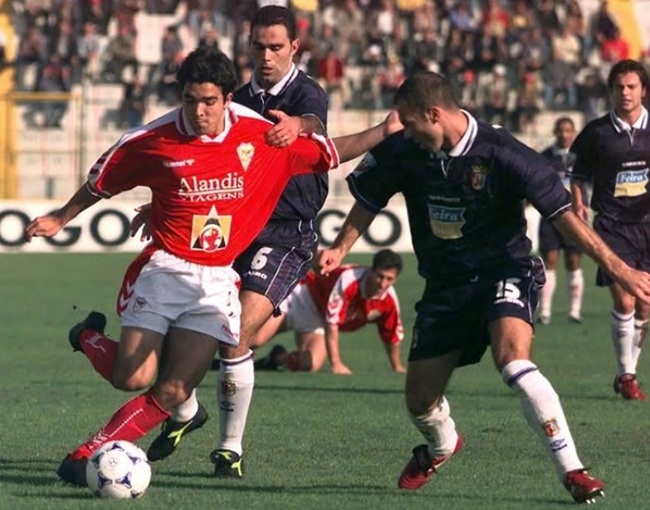
When the season started, the club presented the new kits. After several years working with Le Coq Sportif, Hummel and then Adidas, the previous campaign had been a strange one as the side signed a one-year deal with Reusch, an Italian sports manufacturer who became known for making some of the most popular goalkeeper gloves on the market. Made famous by German international Sepp Meier in the 1970s, they expanded their portfolio in the following years and started to design football kits as well. The deal only included goalkeepers’ kits, though, as they opted for a return to Hummel, who had dressed the squad in the early nineties. The famous German brand’s logo was back on the shoulders and sleeves of the home red kit.
Hummel back with a new design
In 1998/99, Hummel presented a new, more dashing model. Instead of playing in their customary totally red shirt, Salgueiros would sport a thick white dash on the shoulders, populated with Hummel’s logo in red. The rest of the shirt would sport the same usual reddish tone with the brand logo in white, the usual and iconic club crest and the sponsorship of Alandis, a travel agency that had taken the mantle the season before, from the celebrated Fermar industrial company, the sponsor which most people still associate with the club’s shirt.
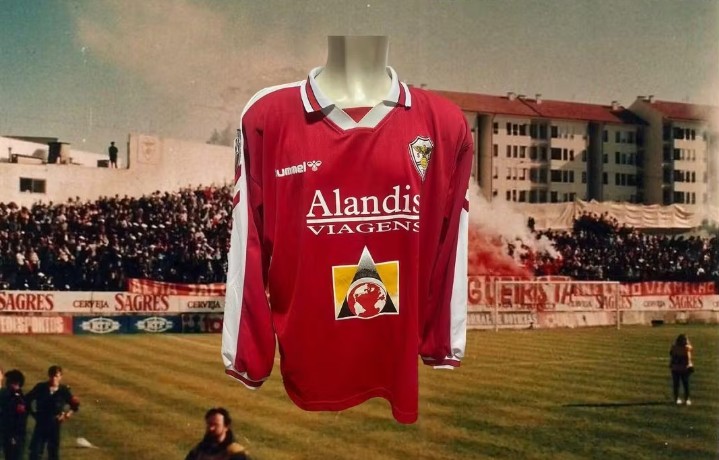
As usual, the shorts would be white, and there was a red version as well for some matches, and the white shirt would reverse the design, an all-white model with the shoulders and collar in red, as well as the brand logo on the right side of the chest. Tradition was upheld. Salgueiros rarely ever wore any other colour than the red and white they became famous for. Goalkeepers would use a Hummel kit, after the short-lived Reusch experience, with a mainly all-green design with different shades in vertical stripes, and black shorts. To avoid kit clashing against sides wearing the goalkeeper’s colours, the alternative kit was grey and purple.
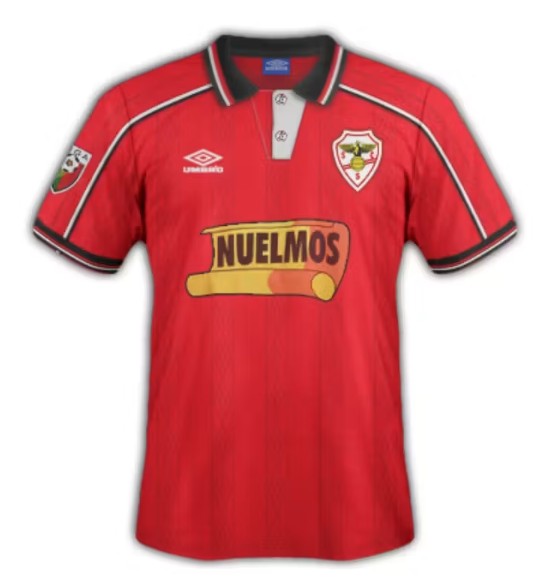
In mid-season, Salgueiros changed the sponsorship on their shirt, ending the association with Alandis and signing a new deal with Nuelmos, a transport trading company that became their preferred shirt sponsor for the seasons to come. It wasn’t the first time a side changed sponsorship mid-season, a common sight in Portuguese football during the 1990s as short-term contracts were signed with nobody really knowing how long they would last.
Salgueiros’ season started well. For the first five fixtures, Dito’s men managed to score two wins, against tough opponents in Farense and Vitória SC at Vidal Pinheiro and two away draws versus Marítimo and Alverca. A goalless draw against Boavista at home was seen as a good result – the fact Boavista finished the season only behind Porto shows how important those two points were – but then came the first defeat against Leiria. Wins against Académica, Chaves, Sporting and Rio Ave and draws versus Campomaiorense, Braga, Estrela da Amadora and, crucially, Benfica, meant only their visit to their city neighbours Porto counted as a defeat until the end of the year. Deco was playing brilliantly alongside the veteran midfielder Abílio and the likes of Cao, Carlos Ferreira, Ademir and Fernando Almeida. Pedro Reis and Chico Fonseca titanic leadership in defence and a surprising campaign by goalkeeper Jorge Silva meant Salgueiros finished 1998 riding seventh, four points behind Estrela da Amadora, who were fifth and two from União de Leiria, sixth.
Deco’s departure precipitates downturn in form
It was the Salgueiros people had come to love. A no-nonsense side who were terribly tough to beat at home, and who knew how to grab important results away, as they oscillated between mid-table and that last European place. Then, everything went sideways. Porto approached the club to sign Deco in January, as they saw him as the perfect replacement for Zlatko Zahovic, their star creative midfielder of the previous seasons, who was now forcing a move to Spain.
The first match without the Brazilian who would later turn Portuguese was a devastating 4-1 defeat in Aveiro against Beira-Mar. It was all downhill after that as Salgueiros went twelve consecutive matches without a win. Five more defeats and six draws including a defeat against Marítimo in the Cup, took them closer to the relegation fight than some might have expected. Crucially, they managed to beat Vitória FC, a result followed by draws against Chaves and Académica. With four matches to go, they were now ninth, eight points ahead of the drop zone and eight points behind Leiria, who were occupying the last UEFA spot. The season was essentially over by then and while defeats against Sporting and Rio Ave didn’t help, draws versus Estrela and Beira-Mar meant they managed to secure a 12th-place finish with only a single win in the second half of the season. Without Deco, that is.
Many at Vidal Pinheiro tried to imagine what could have been if Porto – who celebrated their fifth league championship in a row in a season where Boavista finished runners-up, making it the first and only time neither of the top two places was taken by clubs from the capital –hadn’t signed the playmaker in January. Salgueiros was in a decent position to challenge for fifth place and for the second season running, those dreams of European nights were destroyed by one of the Big Three. First it was Sporting, when they poached away coach Carlos Manuel, then it was Porto when they whisked away Deco.
Still homeless but still alive
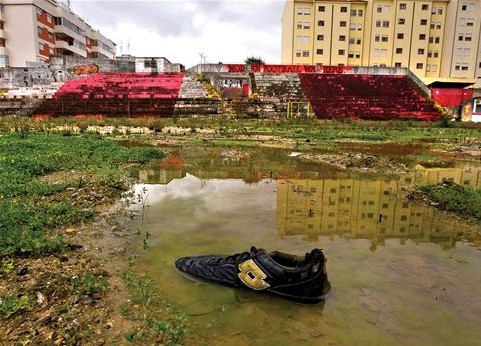
The following year Salgueiros were almost relegated, saved by the bell on the very last day, and even though they finished 10th in 2000/01, there were signs the club was starting to diverge from the strong-minded side they had been throughout the previous decade. News that the stadium was going to be sold to the Porto Metro company to expand one of its lines marked the end of the club as people knew it. By 2001/02 Salgueiros got themselves relegated and never again set foot in the first division since. Four years later, the club, which had been promised a new modern ground in Arca d’Agua, closer to where they had first started to play, declared bankruptcy and folded. Only the passion of a few supporters kept them alive, through the Salgueiros 08 project. They were eventually able to buy back the club’s name and identity, the SC Salgueiros of old, who now play in the Campeonato de Portugal, despite remaining homeless.
The 1998/99 season also marked the end of the second period of collaboration between the club and Hummel. For the following season, Salgueiros signed a deal with Umbro, using an almost identical template to what the British company had prepared for Manchester United during their celebrated Treble season the year before. The greatest difference was that the repeated brand logo on the shoulders was replaced by an all-red stripe, as the colour was, for the first time, not red or white but black. It was a beautiful kit, but the painful season never allowed it to enter the supporters’ hearts.
The partnership lasted until 2003, when the club were already playing in the second tier, and before they moved to Lacatoni for their last campaign in professional football. Without their Vidal Pinheiro home, Salgueiros’ soul emptied and the club were never able to replicate the same die-hard spirit of old, and perhaps that is why, for many surviving club supporters, that 1998/99 shirt still resonates so powerfully.
 |
Sign of the times
It was the final what-if moment in the history of a club that touched the skies once and who came so close to glorious achievements time and time again, only to fall like a shooting star in the end. It was a sad ending for a formidable sporting institution. The demise of Salgueiros not only made Portuguese football poorer, but also explained how the game was evolving fast and moving away from community-based clubs to more efficiently run small corporations powered by major local or foreign investors. But, as the saying goes, that’s another story.
