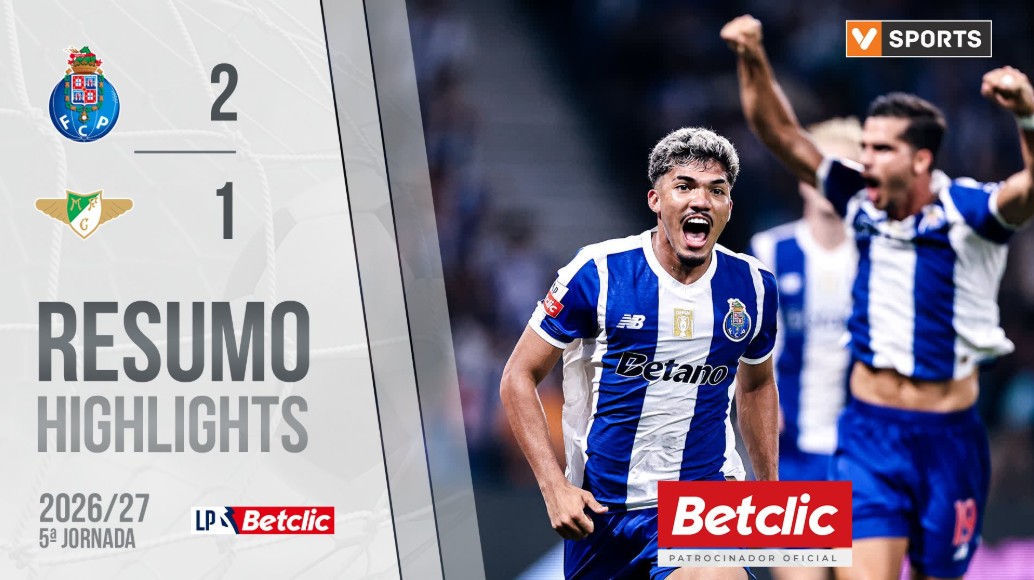
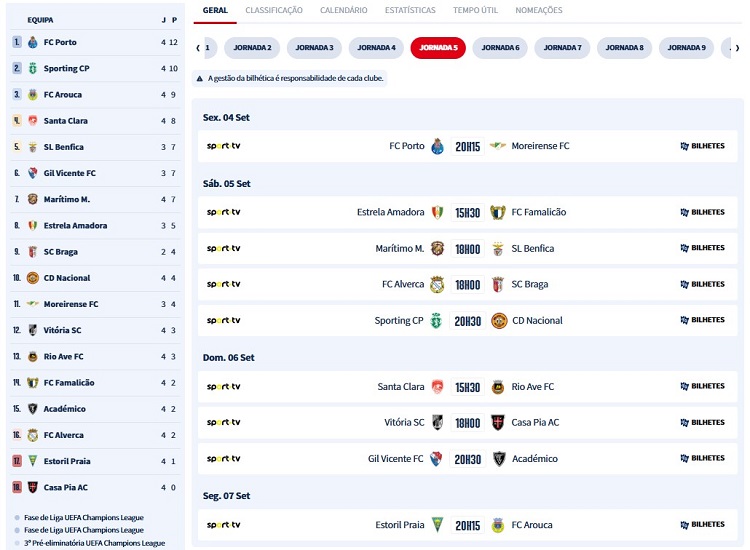
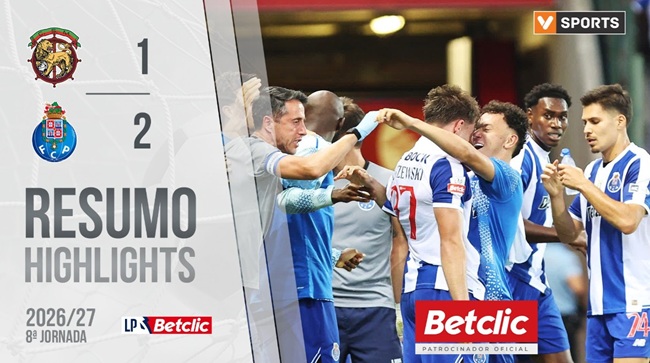
Porto were made to work hard but maintained their perfect record in the Liga Portugal, coming from behind to beat Marítimo 2-1 in Madeira.
Polish teenager Oskar Pietuszewski was the hero of the hour, scoring a brilliant individual goal shortly after coming on as substitute to complete the comeback. The 18-year-old winger controlled a long ball over the top of the Marítimo defence by compatriot Jakub Kiwior, cut back away from goal before twisting and firing an unstoppable shot into the opposite top corner of the net past impressive Marítimo goalkeeper Fran Vieites. There was an anxious wait for Porto’s players and fans as VAR checked for offside before confirming what turned out to be the winning goal.
It was no more than the visitors deserved after dominating the match, outshooting the islanders 19-7 with expected goals 2.32-0.20 in Porto’s favour.
Rare Diogo Costa blunder
Yet it was the hosts who took the lead, Gábor Szalai’s speculative shot from range leading to a collector’s item, a mistake by Portugal goalkeeper Diogo Costa, who misjudged the effort and let it skid into the corner of the net without diving.
Porto equalised shortly before the break through Victor Froholdt, the Dane following up after Francisco Moura’s header had been well saved by Vieites.
The Spanish goalkeeper was having a fine game and a series of excellent saves in the second half seemed likely to earn his team a point.
The Polish connection had other ideas though, Pietuszewiski’s moment of magic keeping up Porto’s 100% winning start to the season as the reigning champions make it eight wins in eight Primeira Liga matches.
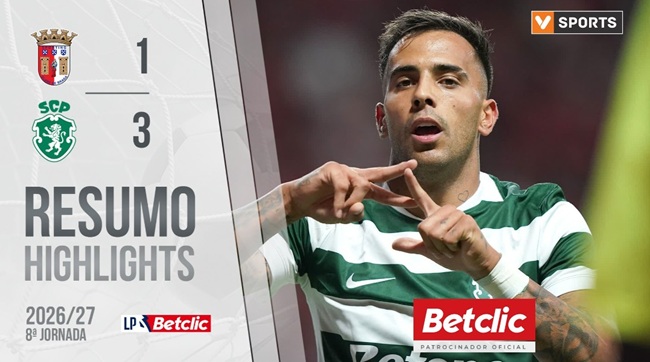
Primeira Liga football returned with a bang after the long international break as Sporting beat Braga 3-1 in a highly entertaining clash at the Quarry tonight.
Sporting coach Rui Borges left first-team regulars Rodrigo Zalazar, Luis Suárez and Maxi Araújo on the bench after their long journeys from South America, while Braga were at full strength and looking to extend their perfect home record this season – five games, five wins.
Just as a tight first half of few chances seemed to be drifting towards a goalless conclusion, Braga midfielder Denis Huseinbasic found himself in space 25 yards out, tried his luck and his powerful shot rebounded off the post, hit Sporting goalkeeper Rui Silva and rolled into the net.
The hosts were buoyed by the goal and came out strongly after the break, Pau Vitor and Gabriel Silva close to doubling their lead, the latter’s shot only kept out by a miraculous interception by Sporting defender Iván Fresneda.
Substitutions make all the difference
At the other end of the pitch, Geny Catamo went close, but the game turned when Sporting coach Rui Borges looked to his bench and brought on the big guns Araújo, Zalazar and Suárez.
Suárez was immediately denied by the alert Braga goalkeeper Bernardo Fontes, but soon after the Colombian was in the right place to power a header into the net from an Irankunda cross. It was Suárez’s 7th consecutive match for Sporting in which he has found the net.
Sporting completed their comeback in the 71st minute. It was an own goal by goalkeeper Fontes, but all the spadework had been done by former Braga player Zalazar with a brilliant driving run into the box and low cross that ended up in the net.
Zalazar was not done yet, the Uruguayan winning the ball deep in his own half, running the length of the pitch and smashing a shot that bulged the net with the aid of a deflection. Again, the ex-Braga midfielder was contained in his celebrations, and his brief but eventful night was then over as he was taken off with a muscle injury.
Sporting saw out the final minutes without undue alarm to move to within three points of leaders Porto, who play in Madeira against Marítimo tomorrow.
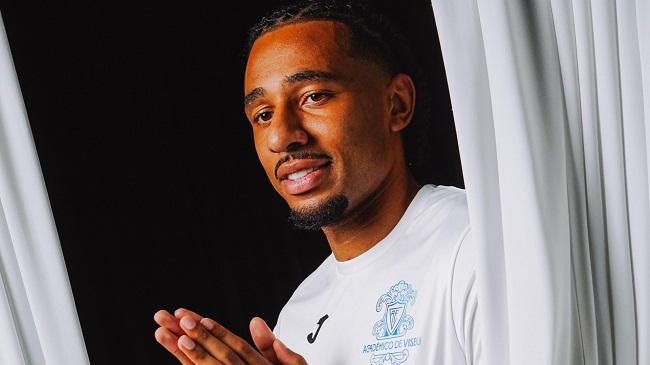
French centre-back Hugo Gambor was signed by Académico in September (Image: www.academicodeviseu.pt)
Hugo Gambor was born on 30 December 2002 in Blois, France, where his football journey also began. He spent most of his youth development at Blois Football 41, remaining at the club for 12 seasons before joining US Orléans in 2019 at the age of 17.
A year later, he caught the attention of Paris FC, where he signed his first professional contract. Despite joining a Ligue 2 club, Gambor featured mainly for the reserve side in National 3, occasionally operating as a defensive midfielder.
His first major opportunity came in 2022. With limited first-team opportunities in Paris, Gambor joined Dunkerque, then competing in France’s third tier, and quickly established himself in the side. His first season ended with promotion to Ligue 2. At the higher level, Gambor later admitted that rather than the physical demands, it was the reduced margin for error that surprised him most.
His performances at Dunkerque eventually earned him a move abroad. In January 2024, he joined Gent, his first experience outside France. After a gradual introduction, he earned more playing time the following season, although injuries interrupted periods of regular involvement.
In August 2025, Gambor returned to France on loan at Troyes, with his 2025/26 Ligue 2 campaign forming the statistical basis of this analysis.
Although born in France and previously involved with the French U18 setup, Gambor later chose to represent the Central African Republic, his father’s country of origin, making his senior international debut in September 2024.
A new chapter followed in September 2026, when the 23-year-old completed a permanent move to Académico de Viseu, adding Portuguese football to a career already spanning France, Belgium and international football.
The recruitment question
Following his 2025/26 season at Troyes, what type of centre-back is Hugo Gambor, and how could his profile fit the current demands of Académico de Viseu?
Methodology — from data to game context
The analysis focuses on Gambor’s 2025/26 season at Troyes. He made 20 appearances across all competitions, while the statistical sample used in this study is restricted to his 16 Ligue 2 appearances and 1,098 minutes played.
Data collected from SofaScore was benchmarked against 65 Ligue 2 centre-backs with at least 1,000 minutes played, using nine metrics covering defensive actions, duels and distribution. Gambor’s performance was converted into percentiles to contextualise his position within the cohort.
His profile was then compared with Académico de Viseu’s current centre-backs, using 2025/26 data to maintain consistency between samples. His potential fit, however, was assessed against Académico’s current 2026/27 context, supported by match observation.
Finally, five full Gambor matches were analysed, using the data to identify questions for video investigation rather than assuming the footage should confirm the numbers.
Data identifies signals and raises questions; video helps explain how and why those signals emerge, and can reveal behaviours the numbers do not capture.
What does the data tell us?
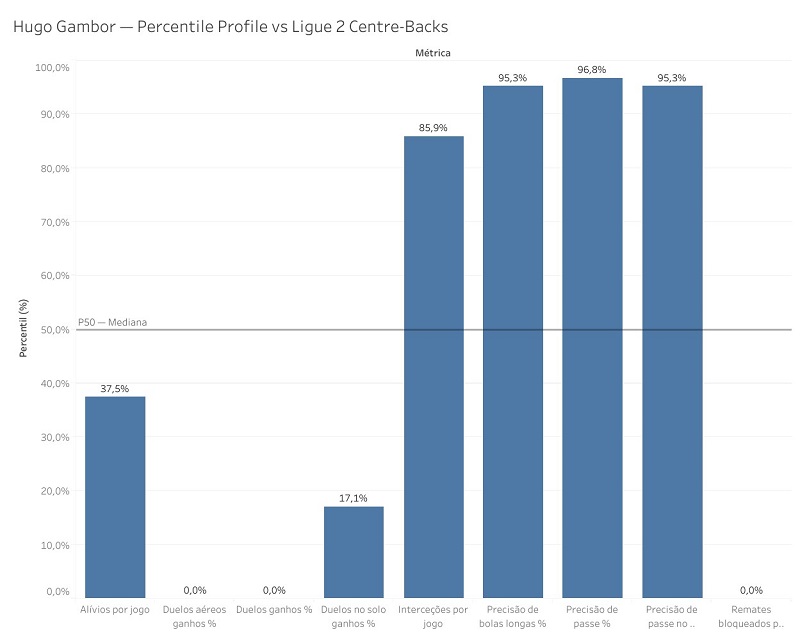
Gambor’s statistical profile shows a clear contrast: he ranks among Ligue 2’s most efficient centre-backs in possession, while recording significantly lower numbers across several duel metrics.
In possession, Gambor recorded 93.02% pass accuracy (P97), 85.88% accuracy in the opposition half (P95) and 62.69% long-ball accuracy (P95). These numbers point to a highly efficient distributor, although accuracy alone does not reveal pass difficulty, risk or progression.
Out of possession, his 1.25 interceptions per game (P86) provide another strong signal, raising questions around his ability to read passing lanes and anticipate play.
The picture changes significantly in the duels. Gambor won 44.33% of his overall duels (P0), 51.11% of his ground duels (P17) and 38.46% of his aerial duels (P0). These numbers warrant attention, but do not explain the underlying causes: positioning, timing, opposition, duel difficulty and tactical context may all influence the outcome.
The same caution applies to his zero blocked shots (P0). Rather than treating this as evidence of poor box defending, the more relevant question is broader: how does Gambor actually defend his own penalty area?
The data therefore provides an initial hypothesis: a highly efficient distributor with strong interception output, but significant questions around his duel performance.
How does he compare with Académico’s centre-backs?
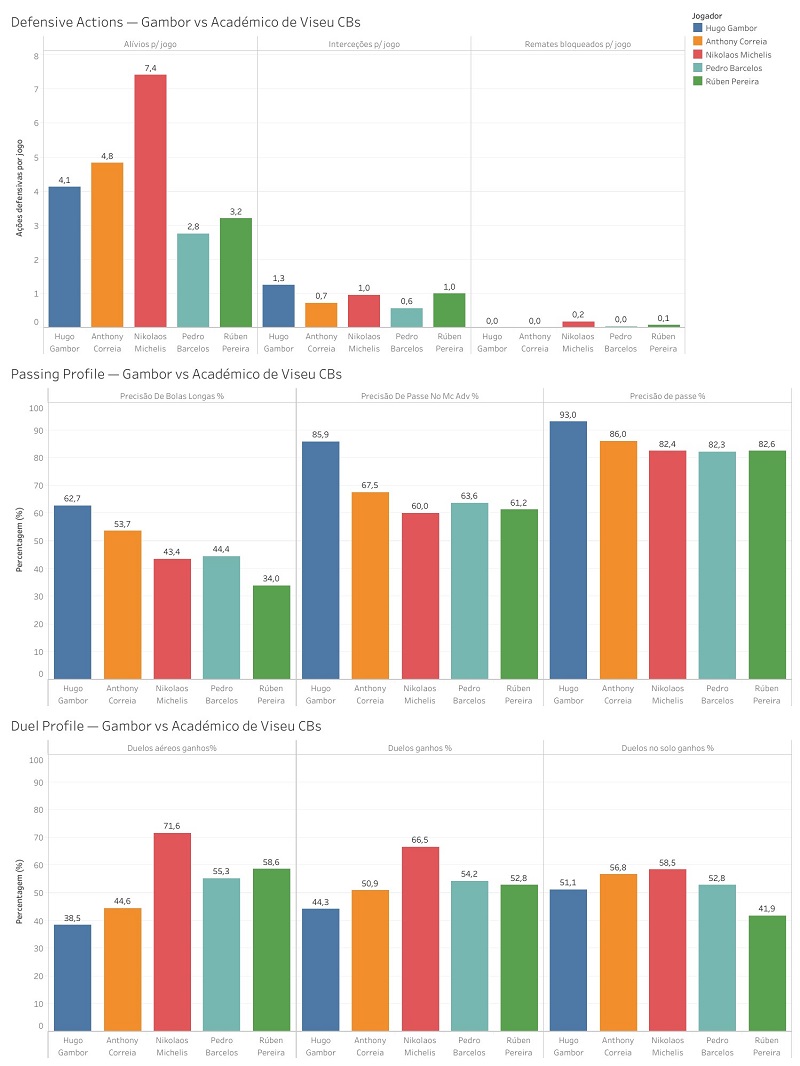
To understand what Gambor could add to the squad, his profile was compared with Académico’s current centre-backs — Nikolaos Michelis, Anthony Correia, Pedro Barcelos and Rúben Pereira — using 2025/26 data.
The clearest difference again comes in possession. Gambor leads the internal comparison across all three distribution metrics: 93.02% pass accuracy, 85.88% opposition-half pass accuracy and 62.69% long-ball accuracy. He also records the highest interception rate at 1.25 per game.
The contrast remains in the duels. His 44.33% overall duel success and 38.46% aerial duel success are the lowest figures in the comparison, while his 51.11% ground-duel success places him above Rúben Pereira but below the other three centre-backs.
This comparison is not intended as a ranking. The players competed in different contexts, while Pedro Barcelos and Rúben Pereira recorded fewer than the 1,000 minutes required for the Ligue 2 benchmark. Instead, the aim is to identify what Gambor could add to the group and which aspects of his profile require further investigation.
The internal comparison therefore reinforces the initial picture: distribution and interceptions differentiate Gambor positively, while his duel performance remains the main area of uncertainty.
6. From data to video
Five full matches were analysed to provide context to the statistical signals — and the data and video did not always tell exactly the same story.
For interceptions, the video supported the data. Gambor’s 1.25 per game (P86) were reflected in his recurring ability to anticipate trajectories, recognise opposition movements and occupy space before the receiver.
In possession, the footage also supported his strong statistical efficiency. Gambor generally looked secure in build-up, capable of reading pressure and finding both inside and longer options. However, he tended to favour lower-risk solutions and showed occasional issues with body orientation against blind-side pressure and with his final decision after longer carries.
The main discrepancy appeared in the duels. Despite ranking at P17 for ground duels and P0 aerially, Gambor won 8 of the 12 clear ground duels and all 4 clear aerial duels identified across the five matches.
The video sample is too small to override the season data, but it also does not support treating these areas as confirmed weaknesses. Three of the four ground duels he lost resulted in fouls, making his approach and management of contact worth monitoring. Aerially, the gap between the season numbers and the observed sample would justify further assessment.
Video also provided greater context to his box defending. Despite recording zero blocked shots, Gambor produced several positive actions through cross clearances, anticipation and tackles in dangerous areas. However, two goals from crosses highlighted issues with tracking and controlling opposition references inside the box.
Overall, the footage supported some statistical signals, challenged others and revealed behaviours the data could not capture.
7. Profile and fit at Académico de Viseu
Combining data and video, Gambor profiles as a quick, technically secure centre-back suited to playing in build-up, with distribution, long passing, anticipation and depth control among his most notable qualities.
There are also areas of uncertainty. He can be conservative in possession, while his scanning and body orientation under pressure showed some inconsistency. His decision-making after longer carries and his control of opposition references against crosses also require attention, while the season-level duel numbers remain an open question.
To assess how those characteristics could translate to his new environment, four full Académico matches of this season were observed. Recurring patterns included short build-up from the goalkeeper, strong involvement from the centre-backs and the deepest midfielder regularly dropping alongside or between them. Centre-backs were also able to carry forward when space became available.
This context appears compatible with Gambor’s security in possession and passing quality. His speed and anticipation could also be valuable when Académico defend higher, particularly when controlling space in behind or when a centre-back steps out to engage an opponent.
However, those same demands make some of his uncertainties particularly relevant. Short build-up increases the importance of scanning, body orientation and decision-making under pressure, while his occasional issues tracking opponents from crosses and the uncertainty surrounding his duel performance remain areas to monitor.
Overall, Gambor appears to offer Académico a differentiated profile through his distribution, anticipation and ability to defend space in behind, with several characteristics aligned with the patterns observed in the team.
Recruitment conclusion
Gambor presents a potentially interesting profile for Académico de Viseu, particularly through his distribution quality, anticipation, speed and depth control.
Questions remain around his duel performance — particularly aerially — as well as his tracking of opposition references from crosses and decision-making under pressure. Based on the evidence collected, he would warrant progression to a further stage of assessment, focused specifically on these areas of uncertainty.
The purpose of that next stage would not be to confirm a predetermined conclusion, but to reduce uncertainty before a final recruitment decision.
For the first time in club history, Académico de Viseu have won three consecutive Liga Portugal matches (Gil Vicente, Vitória SC and most recently, Estrela da Amadora).
‘Os Viriatos’ (A reference to Viriathus, the leader of the Lusitanians, assumed to have lived for a significant period in the vicinity) have carried that momentum to (at least) the end of September as Viseu match Arouca and Braga for points in a battle for fifth (which would guarantee a 2027/28 UEFA Conference League qualification campaign).
André Clóvis has been the focal point of the campaign, a common theme over the last few seasons.
86 goal contributions speak for themselves, produced in 155 appearances across five seasons.
This composed effort was he second against Estrela, but four in seven overall to commence a long overdue season in the first tier of Portuguese football.
Kevin Fernandes reports as the latest PortuGOAL Figure of the Week finally hits the heights he seemed destined for.
Filho feito em Viseu (Son made in Viseu)
André Clóvis Silva Filho was born in the city of São Paulo in Brazil, initiating his youth career at Atlético Sorocaba – a local side notorious for friendlies played against the North Korean national team.
Representing Guaratinguetá, Clóvis played his first season of senior football alongside his brother (Anderson Silva, former Famalicão and Vitória SC forward).
13 Série C goals were enough to entice the interests of Internacional and eventually Algarvian side Portimonense, but neither these spells nor subsequent passages through Leixões and Estoril would be as fruitful as Clóvis’ time in the city of Viseu.
Only Póvoas (86), Ramiro (108) and Pipa (119) have scored more goals for Académico de Viseu than the 28-year-old forward. In fact, 38.6 percent of all Viseu goals have been directly influenced by André Clóvis since his arrival.
A modern-day Viseense legend.
Sound investment
A fee totalling over a million euros was hardly insignificant for Viseu, backed by German investor Dietmar Hopp, who is also owner of German side Hoffenheim and Brazilian outfit Barra. Clóvis has certainly paid dividends.
The bulky, imposing forward is far from a mere goalscorer, although few have been as prolific in recent years.
Clóvis makes intelligence runs behind opposition defences as often as he offers an outlet to play off of. He is an incredibly complete forward for the level and a springboard that allows Viseu to escape pressure and build attacks of their own.
The goal catalogue of the latest PortuGOAL Figure of the Week is vast and destined to grow.
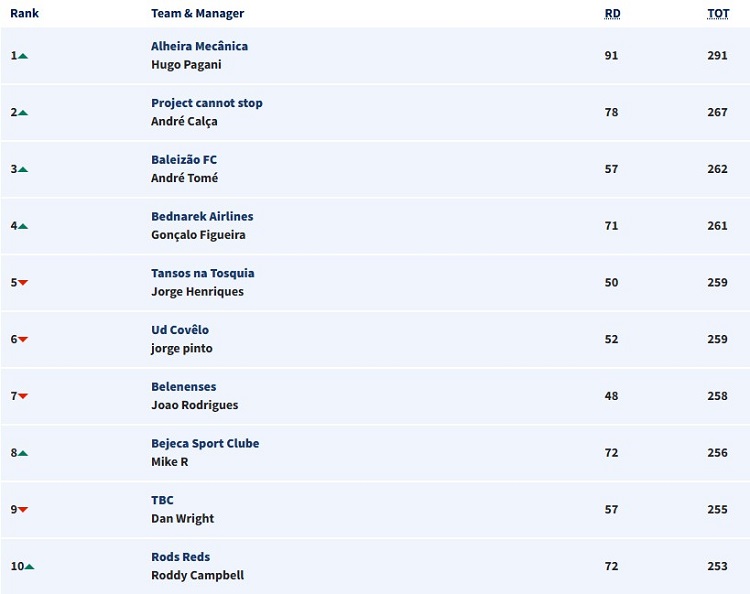
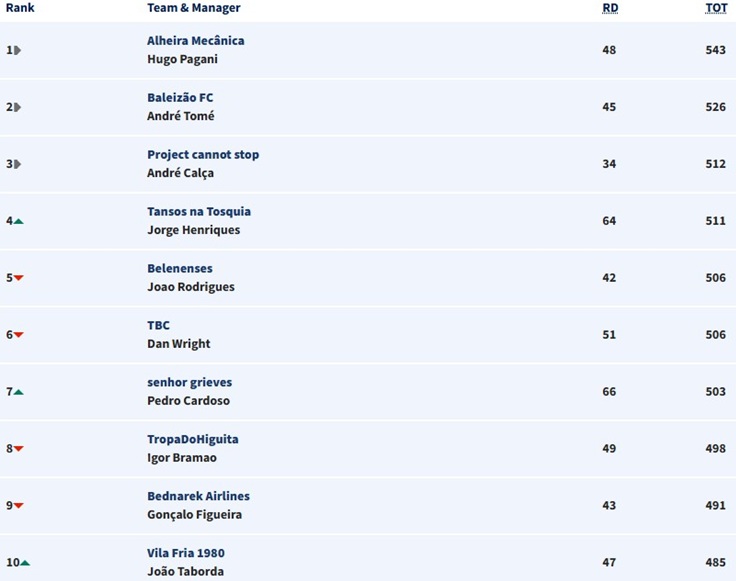
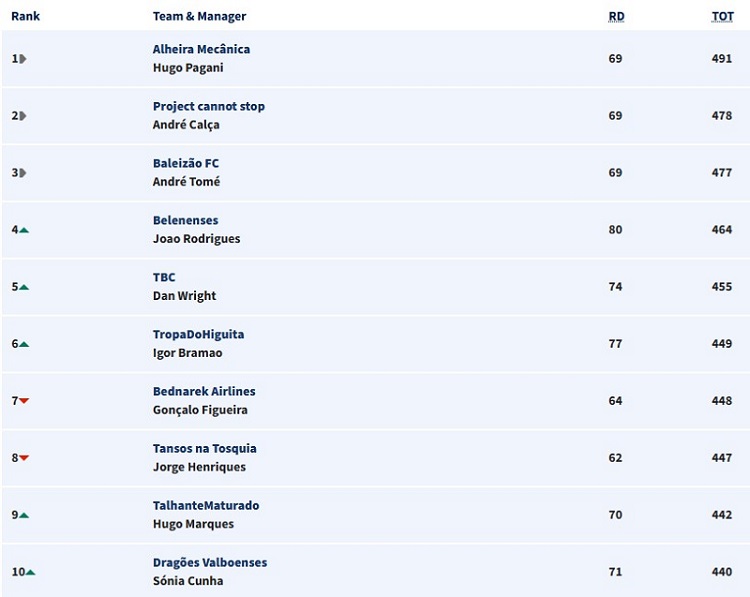
Congratulations to Pedro Cardoso and his “senhor grieves” team who scored the most points in gameweek 7 of the PortuGOAL Fantasy Football league.
Académico de Viseu striker André Clóvis and Porto midfielder Victor Froholdt were the star performers, both hitting double figures in what was a low-scoring gameweek.
Young Gil Vicente midfielder Gil Martins continues to enjoy a highly productive start to his budding career. The 20-year-old clocked up another assist to score 7 points and he is proving an interesting pick in the Fantasy Football game at a cost of just €4.5 million.
Thanks to a total haul of 66 points, “senhor grieves” moves up to 7th place in the PortuGOAL FF league, which now contains a total of 95 teams.
PortuGOAL Fantasy Football 2026/27 Gameweek 7 Leaderboard (top ten)
“Alheira Mecânica” remains top of the table but there is a change right behind.
“Baleizão FC” is up to second after leapfrogging and swapping places with “Project cannot stop” who is now in third place.
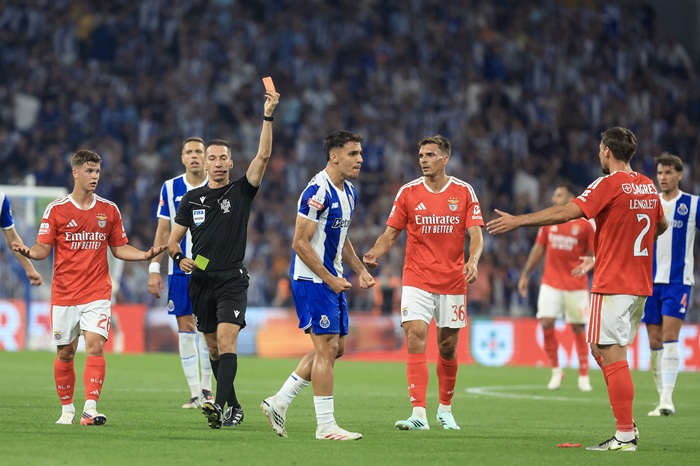
Porto extended their lead at the top of Liga Portugal to five points after defeating Benfica 3-1 at Estádio do Dragão.
It was a high octane start with the visitors getting on top early on. Georgiy Sudakov had been looking shaky before his shot was deflected wide by Jan Bednarek.
Gianluca Prestianni headed Alexander Bah’s cross over the bar and the right-back was involved again, his left footed effort headed away from danger by Pablo Rosario.
Clément Lenglet was booked for taking out Victor Froholdt as Porto started to string some passes together. Veiga fired into Bah from close range but the Spaniard got another chance in the 31st minute and made no mistake.
Bednarek’s long pass found Pepê who caught Tomás Araújo out of position, Veiga running onto the ball, taking a touch and steering it past Samuel Soares.
The game got heated when Prestianni, whose face was bleeding following an earlier altercation, won a foul and got himself booked for abusing referee Miguel Nogueira.
A minute later Benfica were reduced to 10 men.
A heavy touch from Lenglet allowed André Silva to close in and disrupt the centre-back who then slapped the back of Silva’s head. Silva’s theatrical reaction was pathetic, but Lenglet should have known better and had no excuses as Nogueira showed the Frenchman a second yellow card.
Sudakov made way for Alessandro Circati and Hwang In-Beom replaced Veiga who aggravated a leg injury that he carried into the game.
Circati’s first involvement was dodging a huge bullet when his weak backpass was intercepted by Pepê. Soares came off his line to deny the Brazilian twice and prevent the Dragons from doubling their lead.
Benfica proved that they would remain a threat however, Pavlidis firing wide and William Gomes fortunate to avoid a yellow card for a foul on Prestianni.
Porto tried to kill the contest at the start of the second half but Benfica equalised in the 51st minute.
Prestianni did well to drift inside and when most expected him to shoot, he played a perfect pass over Porto’s defence where Bah did enough to head the ball past Diogo Costa.
The joy was short lived as Francesco Farioli’s side scored twice inside ten minutes.
The first came when Silva lost control of Rosario’s pass but did enough to steer the ball into the path of Froholdt who found the bottom corner.
Silva turned provider again on the hour mark when he did well against Araújo, holding the ball up and getting it into the danger area where In-Beom fired over Soares and into the roof of the net.
Marco Silva introduced Leandro Barreiro, Dodi Lukébakio and Andreas Schjelderup but the chances continued to fall Porto’s way. Soares denied Silva, Rosario fired wide and Bednarek couldn’t head Im-Beom’s corner on target.
Pavlidis tested Costa in the 83rd minute but there was no way back for Benfica, Farioli bringing on Oskar Pietuszewski and Samu Aghehowa who made their first appearances of the season.
Porto strike the first blow
Benfica came into the Clássico undefeated in 56 Liga Portugal matches and in tremedous form, winning eight straight games with 27 goals scored.
It appeared the unbeaten record would be extended before a brutal four minute spell saw Gabri Veiga break the deadlock and Clément Lenglet sent off.
We will never know what would have happened had Lenglet restrained himself and stayed on the pitch.
Regardless, his moment of madness alongside Tomás Araújo’s performance proved that Porto possess the strongest central defence in the competition. Diogo Costa vs Samuel Soares is not a contest worth discussing.
Not only did Porto claim a vital three points against their main title rivals, the introduction of Oskar Pietuszewski and Samu Aghehowa means they are finally get back to full strength.
The Dragons have not lost at home under Francesco Farioli and with Sporting CP appearing unlikely to be able to sustain a serious challenge, the title is Porto’s to lose.
Get ready for the drama
Expect the Portuguese media to go into overdrive with the conspiracy theories coming to the fore once again. The fact is that what Clément Lenglet did to get sent off was just dumb.
Farioli, predictablty, had nothing negative to say when asked about the refereeing: “Nothing strange today, so everything’s fine.”
Porto then decided to add fuel to the fire on social media:
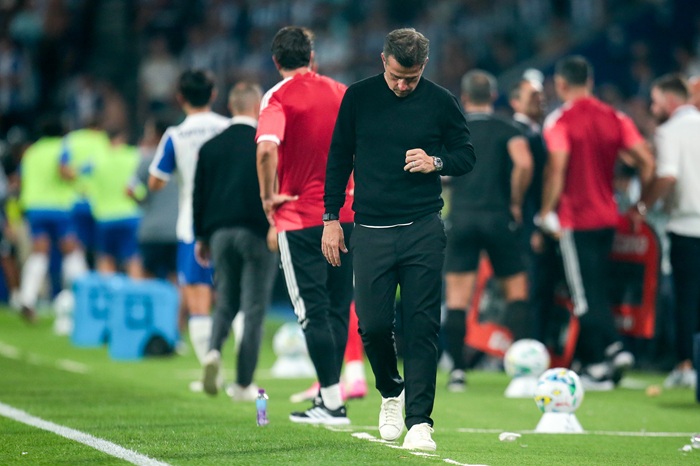
Marco Silva offered his thoughts about the officiating: “Regarding the sending-off, I’m not going to comment. If the club has something to say about the game, I think they should say it.
“I don’t know if I’ll be able to continue like this until the end of the season. I come from a different culture. Here, unfortunately, it’s possible to influence referees before games, after games, during the week, in every way imaginable, and sometimes it works.
“I’m not going to go there. I think coach Farioli will come here next, take the opportunity and ask him the question. That’s not for me to answer.
“He spoke yesterday, he spoke last week about strange things, so you guys join in the conversation with him, because you also like it. We’re going to promote Portuguese football well, and we’re going to have very good shows.”
Silva also acknowledged that there was more to the result than dubious decisions: "I have to say that we lost the game and we were the ones who lost it. We don’t want to disrespect anyone: we lost the game tonight and that’s what we have to focus on.
“There were some aspects that we talked about a lot and that were important for us. We had to have emotional balance, regardless of provocations, regardless of the atmosphere. We have to have emotional balance and, therefore, I say, we lost three points and we lost the game.”
Rui Costa was not going to miss an opportunity to defend his club but admitted that Lenglet didn’t help himself. “Playing here with 10 men isn’t the same as playing 11 against 11, and I believe that with 11 against 11 the result would have been different based on what we were doing.
“I’m not going to discuss Lenglet ’s sending off , although, if you analyse it, André Silva complains about his face when it’s just a slight tap on the back of the neck, not even on the face. I’m not going to discuss the incident because, having a yellow card, he can’t risk an action like that.”
The Benfica president then moved onto the officials: “Regarding the double standards, especially in disciplinary matters, there is a tremendous double standard, in which Benfica was punished. The number of fouls that Porto commits, in addition to the normal foul that is not punished with a yellow card, gives strength to one team and weakens the other.
“This is what everyone saw. There are a series of fouls by Porto players that must be punished. Before Lenglet ’s expulsion , I see Prestianni receiving a yellow card for showing his bloodied face to the referee after a tackle he received almost off the ball, which wasn’t even sanctioned. It is in this sense that, without eliminating the errors we made, the double standard was far too exaggerated.”
(Photos: José Coelho & Manuel Fernando Araújo/Lusa)
For the second time in a week and the third time this season Sporting failed to hold onto a lead and dropped costly points in the Liga Portugal.
Goals from Gonçalo Inácio and Luis Suárez put the Lions in control against Arouca. But a senseless challenge leading to a straight red card for Zeno Debast in the 54th minute changed the complexion of the game.
Arouca began to dominate possession and when substitute Eduardo Quaresma gave away a penalty, converted by Jose Fontán, alarm bells were ringing all around Alvalade.
Sure enough, Vasco Seabra’s side got their equaliser, Dylan Nandín turning in a Pedro Santos cross in the 87th minute.
It is the 17th time Sporting have failed to close out a game when leading under Rui Borges, and the second time this season they have let two points slip from a position of having a two-goal advantage.
After the international break Sporting travel to Braga. A poor result at the Quarry could render Borges’ position as head coach of the Lisbon club untenable.
Torreense celebrated their first ever game in European competition tonight in style, beating Lillestrom in Norway 2-1 thanks to goals by Spanish duo Alejandro Alfaro and Manuel Pozo. The hosts rallied late on, Thomas Olsen halved the deficit, and when Nuha Jatta was sent off the local fans sensed they could still get at least a draw.
But the ten men of Torreense held on for a deserved victory to get their Europa League campaign off to a dream start.
Following a creditable showing and a narrow Super Cup loss to Porto in the season curtain raiser, the Liga II campaign has not begun well. Only one win in six matches sees the club from Torres Vedras sitting in 14th place in what is supposed to be a renewed promotion charge.
But tonight’s debut in the Europa League has the club and their supporters smiling again.
Shining on the big stage
The biggest complement that can be paid to coach Luís Tralhão and his team is that they did not look out of place against a side with years of European experience behind it.
The Portuguese outfit more than matched their opponents for the first 70 minutes. Alejandro headed Torreense into the lead midway through the first half, nodding in an excellent David Bruno cross.
At this stage Torreense were taking the game to the Norwegians, Malik Abubakari forcing Lillestrom goalkeeper Dahlberg into a brilliant reflex save.
After a wobble before the break, Torreense got back on top early in the second half and doubled their lead in the 49th with another fine goal. The club’s Spanish connection was again in evidence as impressive left-back Javi Vázquez crossed to his compatriot Manu Pozo, who rifled a hard low shot into the net.
Lillestrom storm back
Whether it was tiredness, nerves or a series of Lillestrom substitutions, the home team gradually began to get a firm grip on proceedings, putting increasing pressure on Torreense.
On 79 minutes the Portuguese team’s resistance finally broke as a swift move ended with Olsen tapping in from close range.
Spurred on by the noisy home crowd, Lillestrom threw everything at Torreense, who were reduced to ten men when Jatta picked up a careless second yellow card, but at the final whistle it was the small pocket of visiting fans who were making the noise as they wildly celebrated another historic night for the club.
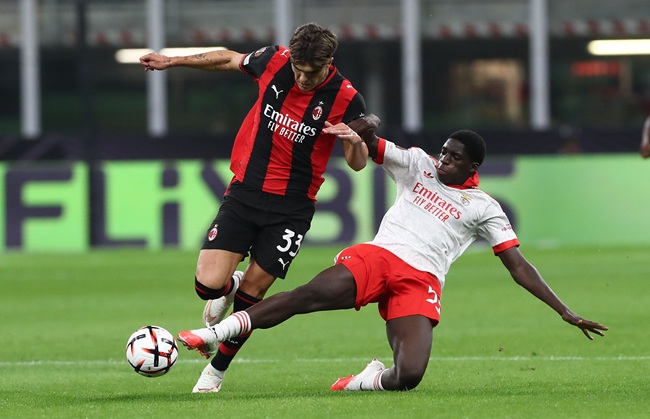
Benfica’s Daniel Banjaqui competes for the ball with Milan’s Davide Bartesaghi. (Photo: Marco Luzzani/Getty Images)
The feel-good factor at Benfica continues after a 2-0 victory against AC Milan in the UEFA Europa League.
Marco Silva made nine changes to his starting side at San Siro in relation to the weekend win over Gil Vicente, Dodi Lukebakio starting and opening the scoring in the 16th minute. The winger had already cut inside and fired a weak shot at Mike Maignan, he drifted infield again and found the bottom corner.
Georgiy Sudakov pounced on a mistake from the hosts and hit the post before Milan got into the contest.
Samuel Chukwueze was looking dangerous but it was Filippo Terracciano who would test Anatoly Trubin first, his long-range strike turned wide by the goalkeeper.
Benfica continued to defend well with Fredrik Aursnes and João Palhinha dropping deep. They took their lead into the break after Ardon Jashari and Omari Hutchinson missed the target followed by Alphadjo Cissé firing at Trubin.
Ruben Amorim made two changes at half-time, Mario Gila and Christian Pulisic replacing Terracciano and Hutchinson.
Koni De Winter fired wide from close range but Benfica withstood the onslaught and extended their lead in the 54th minute. The new left side connection got it done, Souffian El Karouani sending a cross into the box where Jakub Kaminski was left wide open to volley past Maignan.
Ruben Amorim introduced Diego Moreira and Alexis Saelemaekers in an attempt to break through down the left wing. Trubin denied Pulisic before Adrien Rabiot came off the bench and couldn’t keep his effort down.
The signs were clear that Benfica were going to register their first win against the Italian club when Pulisic’s low drive was tipped wide by Trubin.
Daniel Banjaqui made two crucial challenges late on and Palhinha produced another important interception, Marco Silva’s side registering their eighth straight victory.
Eagles flying high
Benfica are on fire under Marco Silva, winning eight straight games with 27 goals scored. Just four have been conceded in that run.
Eagles supporters are loving life under the new manager. The victory in Milan was Benfica’s first in seven attempts against the Italian club.
“The players perfectly understood what we had to do differently, defensively, compared to the game against Gil Vicente. We won without conceding a goal on a difficult pitch, which is important for us, against an opponent Benfica had never beaten before.”
“These kinds of records exist to be broken, and it was an opportunity for us to do it. When I entered the stadium, I felt something different, something speical in the fans’ reception of the players.”
Silva rotated his squad heavily with one eye on Sunday’s Clássico in Porto. Alessandro Circati, Souffian El Karouani and Fredrik Aursnes made their first starts of the season and made it count.
Enzo Barrenechea and Leandro Barreiro will be hoping to return to the starting side at Estádio do Dragão, but Silva will be reluctant to break up the Palhinha and Aursnes partnership.
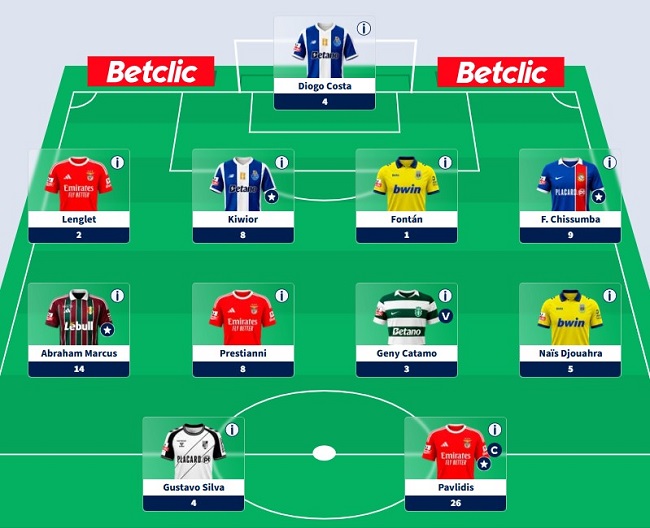
Congratulations to Salvador Silva and his “Salvidotti” team who scored the most points in gameweek 6.
His 84 points was the highest team score in the PortuGOAL Fantasy Football league after this weekend’s Liga Portugal matches.
Captain Vangelis Pavlidis continues his extremely productive season, contributing 26 points to the team.
The Greek striker is not the highest individual scorer in the game though. That accolade falls to his teammate Gianluca Prestianni (60 points in 6 gameweeks!), who was also in the Salvidotti lineup.
Other inspired picks were Estrela da Amadora’s Abraham Marcus, who returned 14 points, and Alverca left-back Francisco Chissumba who got on the scoresheet and finished on 9 points.
Salvador jumped up the PortuGOAL FF standings to 42nd place in the 93-team league.
PortuGOAL Fantasy Football 2026/27 Gameweek 6 Leaderboard (top ten)
The top three all scored exactly the same number of points this round, 69, leaving the podium unchanged.
“Alheira Mecânica” remains top of the table with a 13-point lead over “Project cannot stop” who in turn is one point ahead of “Baleizão FC” in third place.
A hard-fought match of few chances had a dramatic twist in the tail in Famalicão tonight.
Sporting had taken the lead in the 81st minute through a Luis Suárez penalty and the points seemed certain to be heading back to Lisbon when Roméo Beney was sent off soon afterwards.
But the hosts were rewarded for their efforts and organisation that blocked Sporting’s route to goal most of the night when Gonçalo Inácio turned Umar Abubakar’s header into his own net in stoppage time. It was the hapless Sporting captain’s second own goal in successive matches.
Sporting poured forward in the remaining minutes, Suárez and Ioannidis both with chances to restore the Lions’ lead, but it wasn’t to be.
Rui Borges’ team fall four points behind leaders Porto and two behind second-place Benfica one week ahead of the Porto-Benfica Clássico.
Famalicão remain in the bottom half of the table but this performance and result will give Carlos Carvalhal’s side a boost in their quest to get on track and try to replicate last season’s excellent showing.
With three minutes remaining of the 90, Benfica were drawing 1-1 with Gil Vicente at Estádio da Luz despite dominating possession and a growing avalanche of attacking football.
Gil Vicente finally buckled. A Vangelis Pavlidis penalty and the now regulation golaço by the red-hot Gianluca Prestianni resulted in a 3-1 victory for Benfica.
The strong finish made up for a lukewarm first half by the hosts. Héctor Hernández gave Gil a shock lead in the 7th minute, with the Liga Portugal’s top scorer Pavlidis equalising on 29 minutes.
It was Benfica’s seventh successive victory and Marco Silva’s team will prepare for two tough away matches in the coming week with confidence sky high. The Eagles take on AC Milan in Italy on Wednesday in the Europa League before heading north for the Clássico against Porto next Sunday.
Porto came from behind to beat Casa Pia 4-1 and make it 6 wins out of 6 in the Liga Portugal (Photo: Miguel Carmo)
Porto earned a sixth straight win in Liga Portugal, beating Casa Pia 4-1 in Rio Maior. The Dragons fell behind for the first time this season but responded in convincing fashion.
It was ominous early on, Jan Bednarek heading Gabri Veiga’s corner over the bar and Veiga hitting the post after build up play from Jakub Kiwior and André Silva.
Casa Pia fought back, Henrique Araújo doing well to tee up Mohammed Salah who forced a save from Diogo Costa. The hosts maintained the pressure and should have taken the lead, Araújo pouncing on a loose pass from William Gomes, outmuscling Alberto Costa and firing over from close range.
Filipe Coelho’s side capitalised on some luck to take the lead before the break, Pablo Rosario kicking Selvi Clua in an attempt to clear a corner. Referee José Bessa pointed to the spot where Araújo sent Costa the wrong way, Casa Pia's first goal of the campaign.
Porto didn't have to wait long to responded, keeping a corner alive which resulted in Rosario rolling to ball to Silva who scored from close range.
Khaly had avoided punishment after slapping Silva in the face but was booked after cynically dragging the striker to the ground. Costa retreated to tip Clua’s long range effort over the bar but it wasn't long before the contest was over.
Jan Bednarek headed Veiga's corner into the net on the hour mark and it was 3-1 six minutes later, Khaly diverting Kiwior’s long ball into the box where substitute Borja Sainz volleyed past Ivan Mandić.
Costa saved a sharp header from Evans Maurin but Porto shut up shop, closed it out in style and scored a fourth goal in added time. Mandić came off his line and took out Santiago Giménez, the Mexican stepping up and converting from the penalty spot.
The victory saw Porto remain perfect in Liga Portugal, the penalty in Rio Maior just their second goal conceded. Giménez’s late penalty was his first goal since moving on loan from AC Milan.
Farioli already has his eyes on the Clássico against Benfica: “We will start preparing for the game from tomorrow morning, with the correct analysis. We will play an important match and, from tomorrow, our focus will be entirely on next weekend's Clássico."
Victor Froholdt could return to action after a concussion with Zaidu Sanusi, Oskar Pietuszewski and Samu Aghehowa on their way back from injury. The match will be played at Estádio do Dragão on Sunday, 20 September at 20:30 BST.
Congratulations to Rui Freitas and his “Teikirize OK” team that accumulated an incredible 153 points in gameweek 5. It was the highest team score in the PortuGOAL Fantasy Football league after this week’s Liga Portugal matches.
Rui did it by making judicious use of the Loan Rangers chip and packing his team with Benfica players, with a couple of wisely chosen Estrela da Amadora players making up his eleven.
Captaining Gianluca Prestianni proved a masterstroke, the in-form Argentine earning a massive 52 points for Teikirize OK. Benfica centre-back Lenglet (20 points) and Estrela’s Romanian midfielder Ianis Stoica (15 points) were two other standout performers.
Rui jumped up the PortuGOAL FF standings to 11th place in the 91-team league.
PortuGOAL Fantasy Football 2026/27 Gameweek 5 Leaderboard (top ten)
Alheira Mecânica remains top of the table after another positive week (131 points, also using the Loan Rangers chip), but his lead has been cut to 13 points with “Project cannot stop” remaining in hot pursuit in second place.
Rodrigo Zalazar celebrates scoring a stunning free kick against Galatasaray (Photo: Carlos Rodrigues/Getty Images)
Sporting came from behind to beat Galatasaray 3-1 in Lisbon tonight to begin their 2026/27 Champions League campaign on the right foot.
An early own goal by captain Gonçalo Inácio put the visitors ahead, but strikes from Geny Catamo, Luis Suárez (penalty) and Rodrigo Zalazar had the Sporting fans celebrating at the end of the night.
Rui Borges orchestrated Sporting’s best ever run in the Champions League last season as the Portuguese team made it to the quarter-finals before being narrowly beaten by eventual runners-up Arsenal.
The successful campaign was initiated by a superb league phase with the Lisbon outfit accumulating 16 points from their 8 matches. But this is a very different Sporting team with a host of new recruits, and the lack of cohesiveness was again in evidence in a disjointed first-half display.
Galatasaray got off to a dream start when a long throw-in the 5th minute ended up being deflected into his own net by Gonçalo Inácio. The Turkish champions looked like the home team in the opening 45 minutes as they were camped in Sporting’s defensive half of the pitch.
At this stage Borges’ decision to relegate three in-form regulars to the bench – Iván Fresneda, Zeno Debast and Flávio Gonçalves were replaced by Georgios Vagiannidis, Eduardo Quaresma and Luís Guilherme respectively – seemed to have backfired.
Doumbia and Zalazar lost
Sporting rarely managed to play through Galatasaray’s high press, with expensive new signings Doumbia and Zalazar looking lost in terms of their positioning.
The home fans began to show their frustration, especially as on the rare occasions when Sporting mounted an attack, the Turkish defence showed evidence of being extremely porous. On 18 minutes a quick passing combination involving Maxi Araújo, Doumbia and Luis Suárez ended with the Colombian scoring, but the goal was ruled out for a Maxi offside at the start of the move.
Sporting equalised in the 27th minute from a counter-attack instigated by the excellent Quaresma, the ball eventually bouncing around the box and Geny Catamo pouncing to volley home.
However, the goal did not shift the momentum, with Galatasaray, spurred on by their noisy travelling fans, continuing to boss the game. In the 37th minute the Turks seemed certain retake the lead as Leroy Sané cut through the Sporting defence, but he smashed his shot over the bar with the goal at his mercy.
As the half-time whistle blew, the only good news for Sporting was that they were not losing, the visitors peppering 7 shots at goal compared to just 2 from the home side.
All change in the second half
The second half was a different story, especially once Sporting got their noses in front shortly before the hour.
Goalkeeper Rui Silva found Doumbia with an accurate vertical pass, the Italian setting Suárez racing towards goal with a through ball. The striker rounded goalkeeper Çakir but fell under the challenge of Jakobs and the referee pointed to the penalty spot. Suárez himself took responsibility, rifling in a low hard shot for his fifth goal in four games.
Sporting at last began to stamp their authority on the match, Suárez going close to another goal but shooting narrowly wide.
The moment of the night came in the 63rd minute when Zalazar curled a beautiful 25-yarder into the top corner direct from a free kick to make it 3-1.
Galatasaray all but disappeared as an attacking force, even after bringing on ex-Sporting winger Rafael Leão who was roundly booed every time he touched the ball. Sportinguistas have never forgiven him for abandoning the club in the wake of the infamous Alcochete attack in 2018.
Guilherme and Sergi Altimira went close to scoring a fourth for Sporting.
“Important win for a young team” – Borges
“It was important to start off with a win. We have a young team and a lot of our players were playing in the Champions League for the first time,” said Sporting coach Rui Borges post-match.
“In the first half Galatasaray pressed us high up the pitch and we found it difficult to get our game going.
“We were better in the second half, more intense and more competitive, stronger in the duels. We ended up scoring our goals and we didn’t let Galatasaray create danger. I’m happy with the collective capacity of the team.”
André Ferreira was busy early on in Moreira de Cónegos, the goalkeeper doing well to deny Gianluca Prestianni and Rafa Silva.
Maracás was having a hard time against the Eagles’ attack but he did well to block Rafa’s shot, Ferreira then called into action to stop Tomás Araújo.
Moreirense created their best chance in the 40th minute, Samuel Soares coming off his line to deny Alexandre Duville-Parsemain before Landerson sent the follow up wide.
The breakthrough came in added time, Clément Lenglet heading a corner over the bar and being hit high by Duville-Parsemain.
The Benfica bench blew up before referee Fábio Verissimo went to the touchline, watched replays and awarded a penalty. Vangelis Pavlidis stroked the ball down the middle.
Marco Silva’s side extended their lead 10 minutes after the restart. Prestianni drove to the byline and cut the ball back to Schelderup who squeezed it through Ferreira.
The result was confirmed four minutes later when Prestianni did it all himself. He raced raced past Gilberto Batista, got into the box, stayed on his feet and curled the ball into the bottom corner.
Fredrick Aursnes came off the bench and added a fourth goal. Schelderup sent a hopeful ball into the box where the Dane was left wide open to pass the ball under Ferreira and into the net.
The victory sees Benfica climb to second on the table, two points behind Porto. They have the most prolific attack, scoring 18 goals in five matches.
Porto’s UEFA Champions League campaign began with a 2-0 loss to Manchester City at Estádio do Dragão.
City’s class was evident for all to see and the visitors went close to taking the lead in the 20th minute. Phil Foden’s cross picked out Erling Haaland who looked certain to score before Diogo Costa slapped his header away from goal.
Haaland headed Antoine Semenyo’s cross over the bar and Foden’s shot was saved by Costa, the goalkeeper continuing to keep Porto in the game after denying Haaland and Rayan Cherki in quick succession.
Marc Guehi caught Gabri Veiga with a forearm to the head before the break, the Spaniard bleeding badly and requiring treatment but no foul awarded by referee Szymon Marciniak.
Man City took the lead three minutes after the restart and it was no surprise who found the net. A counter attack ended in Enzo Fernandez sending a cross into the box where Haaland rose above Jakub Kiwior and headed the ball off the post and over the line.
Porto enjoyed their best spell of the game with Alan Varela going close, Enzo Maresca recognising his side had lost control by bringing on Elliot Anderson and Iliman Ndiaye for Cherki and Semenyo.
William Gomes went close after charging down Gigi Donnarumma’s clearance, Francesco Farioli introducing Hwang In-Beom, Borja Sainz, Francisco Moura and Santiago Giménez in the space of five minutes.
The managers continued to trade blows from the bench, Maresca bringing on Rayan Aït-Nouri and Mateo Kovacic.
Haaland headed Ndiaye’s cross over the bar, Aït-Nouri fired wide, Rúben Dias headed Enzo Fernández’s free kick over the bar and Anderson saw his effort tipped wide by Costa as City tried to land the killer blow.
It came in added time when Porto couldn’t clear a corner, Aït-Nouri finding Haaland who fired through traffic to give Costa no chance.
Haaland reacted to a cheap shot from Pablo Rosario which saw both players booked, Fernández going close on two occasions as the English club closed it out in style.
Porto Outclassed
Porto have become used to bossing games and hardly giving their opponents a chance.
The gulf in class was too much to overcome however, Manchester City ending the contest with 64% possession and 20-5 shots including 10-0 on target.
Diogo Costa’s reputation and value continues to increase but there was no stopping Erling Haaland, the Norweigan hitman too much to handle for Nehuén Pérez and Jakub Kiwior.
Porto came up short on the few occasiosn they created goalscoring opportunities and Haaland took six shots, one more than the Dragons combined.
“We defended very well, but we can’t give space to the best striker in the world. He had eight or nine touches on the ball, seven shots and two goals. His finishing ability is unbelievable.”
Gabri Veiga commented on the difference in competitions: “The Portuguese league is undervalued, it always creates difficulties for us, but this is the highest level. We played against one of the best teams in the world.
“Now we have to think about Casa Pia, we know it will be very difficult, we have learned our lesson from last year [Porto lost the corresponding fixture last season]. Our priority will always be the championship.”
The humbling defeat could prove to be a worthwhile exercise for Farioli who was missing Jan Bednarek, Victor Froholdt and Oskar Pietuszewski. He will surely make changes, the first to ease Santiago Giménez into the starting side for André Silva, Samu back in training and soon to be another option up front.
Gil Nunes is a football commentator based in Gaia, Portugal. He is a resident commentator of “O Jogo” Sunday edition. Gil is also a well-known voice of Portuguese football in Russia and the Middle East. You can read his work on his substack.
Dinis Pinto’s shot looked destined for the back of the net, but Diogo Costa, once again and as naturally as breathing, saved FC Porto and secured another three points for the Dragons. It was far from the high point of his career. But what is impressive is the sheer naturalness with which such an episode unfolded. So much so that few people even comment on it.
Many still remember a time when goalkeepers couldn’t play with their feet. And when they had no specific training. Goalkeeping coach? An utter utopia. Today, times have changed, and the goalkeeper, beyond his natural role as the “saviour of the nation,” is also a key reference point in building play from the back and the commencement of attacking movements. The paradigm has shifted: making impossible saves, in itself, is the hallmark of an average goalkeeper. It is no longer enough.
If the debate over who is the greatest of all time can never be a consensual one – and democratically speaking, that is a good thing – this particular debate has two clearly defined sides. On one hand are historic names such as Bento, Damas and Costa Pereira who, despite being outstanding in every aspect of agility and presence in goal, fall short when compared with the other side of the divide, where names such as Ricardo, Vítor Baía and Rui Patrício belong. Particularly the latter two.
Elegant even when conceding goals, Vítor Baía’s presence extended to an ability to read the game and a sense of timing when coming off his line that, even today, remains without equal. Then there is the fact that he is the most decorated player of all time. Ten national league titles, a UEFA Cup, a Champions League and an International Cup, and that little collection with the application of a filter to highlight the most prestigious trophies.
As for Rui Patrício, there is almost unanimous agreement that he belongs among the greats, largely because he provided stability in the Portuguese goalkeeping position in the post-Ricardo era and, above all, because he was the goalkeeper who emerged when the nation needed him most: an extraordinary performance in the Euro 2016 final, the one that brought such joy to Portugal. Which leads to a simple conclusion: his limitations, particularly when it came to playing with his feet, prevented him from going further in his career, but everyone should doff their cap to a goalkeeper who never faltered when it mattered most. He is part of history. 10 July 2016: Portugal had a great goalkeeper.
The 2022 World Cup qualifier against Serbia, in which the visitors’ high press ultimately condemned Portugal to defeat, exposed the decisive fault line: Portugal could no longer have as their first-choice goalkeeper someone who was so limited with his feet, particularly at a time when a youngster was already proving his undeniable credentials in a demanding club environment. FC Porto. And Diogo Costa.
Five years on, Diogo Costa has become a world-class reference point. Because he is so complete. In Portuguese terms, the most complete goalkeeper there has ever been and, logically, also the greatest. With no obvious weaknesses – perhaps he could be more aggressive when dealing with crosses to the far post, but that is hardly a deficiency – the young goalkeeper is the prototype of the modern goalkeeper: offensive-minded, capable of reading the game and fully involved in the team’s attacking dynamics.
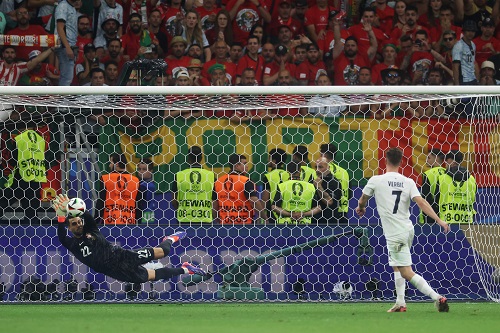
Diogo Costa, here saving Jure Balkovec’s spot kick during the EURO 2024 shootout against Slovenia, is a penalty saving specialist (Photo by Lars Baron/Getty Images)
Then there is his ability to make the difference consistently: whether against Moreirense (among others), Bayer Leverkusen, Slovenia at Euro 2024 or Spain in the 2025 Nations League final. The last three examples showcase his penalty-saving prowess. Diogo Costa has developed the mettle to remain calm in decisive moments, consigning perhaps the most difficult moment of his career to the dustbin of history – the goal conceded against Morocco at the 2022 World Cup. Because there is no doubt: the best Portuguese goalkeeper has to come from this second paradigm. And no one has commanded as much unanimous approval as the FC Porto goalkeeper. The greatest Portuguese goalkeeper of all time is the one playing today. Period.
Yes, perhaps Diogo Costa staying at the club was André Villas-Boas’s greatest victory in a transfer window that was otherwise highly productive for the Dragons. If the blue-and-whites can, at certain moments of a match, operate in very deep areas because they know their goalkeeper is a genuine outfield player and that, as a result, they are effectively always playing with eleven outfield players, then there is nothing better than preserving their most valuable asset. He will not remain at the Estádio do Dragão forever, but while he is there, there will be the certainty that the goal will not waver. And that is priceless: amid all the tactics, all the ideas about how to play, all the philosophies and all the mind games at press conferences, there is no greater treasure than the constant assurance that the goal is safe.
Sporting turned in a solid performance in a routine 2-0 home victory over Nacional at Alvalade tonight.
Luis Suárez was the star of the show with a goal and an assist and Sporting fans will be relieved the Colombian striker has remained at the club after a summer of speculation that he would be moving on.
The centre-forward slammed in from the penalty spot after Maxi Araújo had been upended in the box to give the Lions the advantage at the break. It was his 4th goal in his last three games.
Sporting doubled their lead shortly after half time through a perfectly executed counter-attack. Zeno Debast sent Suárez racing towards the box with a precise through ball, the striker looking up and placing a pinpoint pass into the path of Flávio Gonçalves who finished with aplomb.
The hosts could have scored plenty more goals, substitute Fotis Ioannidis unlucky to see his effort deflected onto the bar by Nacional goalkeeper Renato Marin after a great dribble.
Nacional, who were inoffensive throughout the 90 minutes, fall to their third straight defeat and new coach Alexandre Santos will have his work cut out to bang the islanders into shape.
Benfica made it five straight wins in all competitions after a comfortable 3-0 victory over Marítimo in Funchal.
The opening goal came in the 7th minute when Gianluca Prestianni’s shot was saved by Alfonso Pastor, the ball falling for Leandro Barreiro who slammed it past the goalkeeper.
João Palhinha went close before Alexander Bah went straight into the change rooms after a cheap shot from Paulo Henrique, the right-back replaced by Jakub Kamiński.
Vangelis Pavlidis’ deflected strike hit the post and Prestianni tested Pastor at his near post as Benfica went into the break well on top.
Marítimo made a positive start to the second half, Rafael Fernandes going close to converting Raphael Guzzo’s corner.
That was about as good as it got for the promoted club however, Pavlidis scoring from an offside position before turning provider in the 71st minute. He headed Andreas Schjelderup’s cross to the back post where Barreiro couldn’t miss.
Prestianni sealed the deal in the 82nd minute when he robbed Rodrigo Andrade inside Benfica’s half, raced clear and curled the ball into the bottom corner.
Porto conceded their first goal in six games this season but eventually overpowered Moreirense at Estádio do Dragão.
Francesco Farioli’s side wasted no time getting on top , Pablo Rosario's shot deflected wide but it was the visitors who should have taken the lead in the 12th minute.
A loose pass from Gabri Veiga was pounced on by Alexandre Parsemain who raced into the box and decided not to shoot, his weak pass to João Veloso easily defused by the Dragons’ defence.
Moreirense got another chance in the 20th minute and made no mistake. Veloso got forward and delivered a cross that was volleyed home by Dinis Pinto.
Porto bounced back, William Gomes’ shot turned wide by André Ferreira before the Brazilian won a free kick. He sent it into the danger área where Jan Bednarek rose highest and headed home.
The momentum was maintained after half-time as Porto took the lead in the 58th minute. They went straight through the midddle, Victor Froholdt releasing Pepê who saw his cross converted by Gomes.
Froholdt missed two opportunities from point blank range which kept the visitors believing. Yan Lincon went close before Diogo Costa made a fantastic save to deny Pinto.
The game was halted after a distressing incident involving Froholdt. He was hit in the head by Guilherme Liberato’s elbow and shoulder, the midfielder knocked out and stretchered off the pitch.
Santiago Gimenez tested Ferreira twice after coming off the bench, the new signing impressing after signing on loan from AC Milan.
Porto closed it out, ending the contest with a dominant 70% possession, 23-7 shots and 2.90-0.85 xG.
No elaborate introduction is needed for the Gameweek Four PortuGOAL Figure of the Week. Casa Pia were defeated by Moreirense via a special match-winning goal, courtesy of Francisco Domingues.
We sincerely hope that FIFA were watching as Sporting’s Nuno Santos was previously nominated for the prestigious Puskás award for an arguably less spectacular finish of the same vein.
The full-back who is often referred to as Kiko (a typical, affectionate diminutive of Francisco in Portugal) confessed post-match: “I couldn’t even believe it.” That incredulity was shared by several teammates who had their hands on their heads, in a similar state of shock, the moment his audacious shot hurtled into the net.
Portuguese newspaper Record rehashed a video of Kiko attempting the same technical gesture in previous training sessions, while Moreirense manager Vasco Botelho da Costa called it “a work of art.” The artist himself admitted that he does possess the ability and tendency to attempt it with some regularity.
The PortuGOAL Figure of the Week could only be awarded to the protagonist of an extremely strong candidate for goal of the season. Kevin Fernandes reports.
Southern soul, Moreirense magic
Born in Lisbon, Francisco Miguel Teixeira Domingues represented Benfica for 18 years of his life.
Kiko rapidly became a fan favourite, winning the 2022 Under-20 Intercontinental Cup, the U15 Portuguese Championship and leading Benfica B to their joint-highest ever finish (fourth in Portugal’s second division).
Unfortunately, Francisco Domingues would never get his opportunity to feature in Benfica’s first team despite value shown throughout his successful formative years. Kiko would find a home in Moreira de Cónegos, a town of less than ten thousand people to provide a distinct contrast to life in Lisbon.
Kiko settled well into senior football in his new surroundings, featuring in 27 of 34 Liga Portugal fixtures in his first season (2025/26), an irrefutable success for the Green and Whites as they finished seventh, two places above wealthier and more storied local rivals Vitória.
The 2026/27 season has so far been showcased by Kiko’s extraordinary moment of technical inspiration as Moreirense have been a mixed bag as a team, winning once, drawing once and losing once. It can be argued that the moment of the season (for Moreirense in Liga Portugal) came from Domingues.
Mental fortitude
Discurso do Francisco Domingues “Kiko”, capitão e lateral esquerdo da equipa B do Benfica.
Este ano a equipa B foi uma verdadeira equipa. Não houve grandes destaques individuais, saltos para a equipa A , mas formou-se um grupo coeso.
Initially a winger, Kiko transitioned into a full-back in his later years as a youth player. Without any overwhelmingly exceptional qualities, the attack-minded player offered value to Benfica’s B team as a solid all-round performer and a vocal, proactive attitude.
Despite his impressive technical ability, Kiko never quite showed the promise of the likes of fellow Benfica full-backs Daniel Banjaqui or José Neto, both winners of the U17 World Cup with Portugal, and his career stagnated in later years, in part due to a serious injury that doubtless stunted his development.
Kiko has stood out throughout his short career for his mature decision-making, somewhat ironic given the audacious and what could be perceived as a naive effort that has put him on the radar of millions as his goal went viral across the world.
The latest PortuGOAL Figure of the Week is perhaps more deserving of the title than any predecessor due to his suddenly gained reputation. Humble Moreirense will be hoping that this translates into repeated moments of magic.
Kevin Fernandes’ Liga Portugal Team of the Week (GW4)
A common complaint among groundhoppers attempting to plan a trip to take in Portuguese stadiums is the tardy announcement of the Primeira Liga match schedules. Protests from local fans and journalists have tended to fall on deaf ears, with the definitive dates and kick-off times of fixtures often announced less than two weeks in advance of the game in question.
It is an even bigger problem for foreign football tourists, who have to factor in flights and hotel bookings as they come to savour the unique atmosphere and experience that Portuguese football has to offer.
Depending on the schedule of European matches, Portugal’s biggest clubs – Benfica, Sporting, Porto and Braga – could play their domestic games on the Friday, Saturday, Sunday or Monday of any given weekend.
With Sporting playing some of their Champions League matches on a Tuesday, the Lions will play two of their next six Primeira Liga matches on a Friday: Braga v Sporting (9 October), and Casa Pia v Sporting (30 October), ahead of their UCL games away at Lens and Shakhtar Donetsk respectively.
Likewise, Benfica will play their domestic league matches three times on a Monday (versus Santa Clara (a) on 26 October; Alverca (h) on 2 November and Famalicão (h) on 30 November) owing to their Europa League schedule on Thursday nights.
Big clashes for the diary
Selected big clashes that take place in the opening third of the Liga Portugal championship.
Porto v Benfica, Sunday 20 September, 8.30 pm
Braga v Sporting, Friday 9 October, 8.15 pm
Porto v Sporting, Sunday 29 November, 8.30 pm
Rearranged matches
More immediately, Benfica and Braga will play their matches in the coming week that were postponed due to their playoff ties in the Europa League and Conference League respectively. Moreirense v Benfica will take place on Wednesday 9 September, while Estrela da Amadora v Braga will be played the day after, on Thursday 10 September.
To find out the official times of top-flight league matches in Portugal, click on this page of the official Liga Portugal website and then click on the Jornada (Round of Matches) along the top menu.
Mexican striker Santiago Giménez signs for FC Porto from AC Milan for a fee of around €20 million (Photo: fcporto.pt)
It was a busy last few days of the transfer market in Portugal, with Primeira Liga teams making final adjustments to their squads for the 2026/27 season.
PortuGOAL rounds up the late moves involving Portugal’s major clubs.
FC Porto
The standout late signing of the window was Mexican striker Santiago Giménez, bought by Porto for a fee of €18 million + €2m in add-ons from AC Milan. The 25-year-old scored prolifically when first arriving in Europe, hitting the net 65 times in 105 games for Feyenoord. That goal-scoring rate earned him a big move to AC Milan, but he was unable to replicate his form in Série A (7 goals in 37 matches), and missed most of last season through injury.
Another boost to Porto’s forward line comes in the form of highly rated Brazilian forward Gabriel Mec. The Blue and Whites paid Grêmio de Porto Alegre €11 million for the 18-year-old who is a Brazil youth international.
Porto have also brought back midfielder Seko Fofana for another loan spell from French club Rennes. The Ivory Coast international was a big hit last season, scoring important goals in the Dragons’ Liga Portugal triumph.
Two young full-backs have also been acquired. Right-back Emanuel Benjamín, 19 years old, has been signed from Real Madrid, while 20-year-old left-back João Souza has been brought in on loan from Tottenham Hotspur.
Striker Deniz Gul has left the club, signing for Galatasaray for a €10 million fee.
Sporting
Sporting continued their reset by saying goodbye to two stalwarts of their recent success, Pedro Gonçalves and Daniel Bragança. Pote was sold to Fiorentina for €22.5 million plus €2.5m in add-ons, while Bragança is also off to Italy, Torino signing the midfielder for €4 million.
Georgian midfielder Giorgi Kochorashvili has also been offloaded, joining Sevilla in exchange for a reported fee of €4 million.
The Lions have made changes in the goalkeeper position too, signing giant Brazilian Kaique Pereira from Palmeiras and selling João Virgínia to Wolves.
Sporting also brought in 17-year-old Moroccan left-back Moncef Zekri, signed from Belgian club Mechelen.
Pedro Gonçalves and Daniel Bragança both won three championship titles for Sporting
Benfica
Another Moroccan left-back arriving in Lisbon is Souffian El Karouani. Benfica have signed the 25-year-old on loan from Al-Qadsiah with an option to buy the defender at the end of the season for a fee of €10 million.
A similar deal is in the final stages of negotiation for Argentinian attacking midfielder Claudio Echeverri. The 20-year-old will sign for Benfica on loan from Manchester City, with an option to make the move permanent for a fee of between 10 and 15 million euros.
Meanwhile Colombian midfielder Richard Ríos does not fit into Marco Silva’s plans for this campaign at least. One year after being signed from Palmeiras for €27 million, the 26-year-old has agreed to a season-long loan at Saudi club Al Ittihad.
Braga
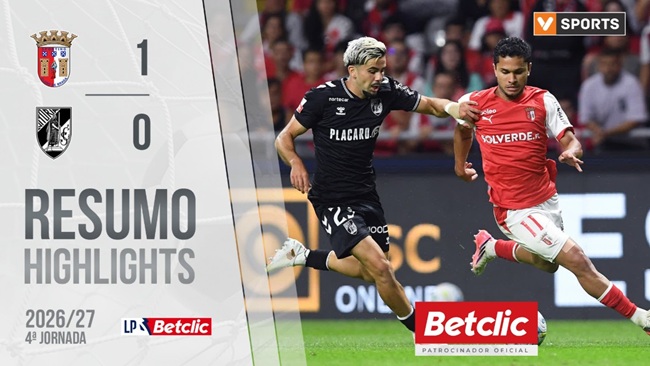
Braga made two late signings in the transfer window, both of whom saw minutes in Monday’s 1-0 victory over Vitória in the Minho derby. 21-year-old Serbian striker Jovan Milosevic has signed a 5-year contract at the Quarry, Braga paying Stuttgart for €8 million for the centre-forward who impressed on loan at Partizan Belgrade last season, scoring 16 goals in 23 games.
Young Barcelona prospect Tommy Marqués has also been snapped up for a fee of €11 million plus €1m in add-ons. The defensive midfielder played twice for Barcelona’s senior team last season.
Congratulations to Hugo Pagani and his “Alheira Mecânica” team that shot to the top of the PortuGOAL Fantasy Football league after this weekend’s matches thanks to a massive 91-point haul.
Benfica made it four wins on the bounce with a 2-1 victory over Estoril Praia at the Estádio da Luz tonight.
Much of the talk pre-match was whether new signing João Palhinha would feature, and the defensive midfielder entered the fray earlier than expected when Enzo Barrenechea was forced off injured in the 31st minute.
Given a rousing reception by the near capacity crowd of over 60,000, Palhinha soon endeared himself to the Benfica faithful with a trademark sliding tackle on the run to halt a dangerous André Lacximicant run, followed by a clenched-fist celebration.
One-way traffic
That was a rare Estoril attack. Benfica dominated the whole match as reflected in the final game statistics heavily skewed in the favour of the home team: possession (66%-34%), shots (25-4) and corners (9-0).
The hosts took the lead five minutes before the break when Pavlidis turned smartly in the box and shot low into the corner of the net. We are still in August and it was the Greek striker’s 11th goal of the season!
Clément Lenglet doubled Benfica’s lead shortly after half time with a thunderbolt of a shot from 30 yards out.
Another superb finish, this time by Estoril striker Begraoui in the 82nd minute, made it a nervy last few minutes for the home supporters but Benfica saw out the remainder of the match without undue alarm.
Testing schedule
Marco Silva’s team are enjoying an impressive run of form but they will be put to the test in the coming weeks with tough away trips to Marítimo, Moreirense, Milan and Porto in September.
Braga beat Vitória de Guimarães 1-0 in a dull Minho derby at the Quarry.
Victor Gomez hit the post in the 34th minute and Pau Victor's shot was saved by Oliwier Zych on the stroke of half-time.
Referee André Narciso awarded the hosts a penalty after Óscar Rivas was ruled to have fouled Victor, the decision eventually overturned.
The contest was heading to a bore draw before the deadlock was broken in the 79th minute. Diego Rodrigues got past Rivas and slammed a low drive that deflected off Zych and into the roof of the net.
It was far from a classic, Braga doing their best to dissuade anyone from watching them play. They haven’t been helped by an injury to Ricardo Horta who has missed the previous three games.
Their defence can’t be questioned however, Carlos Vicens’ side condeding just two goals in eight matches this season. Guimarães hardly looked like scoring, registering just 0.28 xG and two shots on target.
Portugal’s ability to produce world-class footballers who have prospered in Europe’s biggest clubs, along with the national team’s strong showing in tournaments this century, are well-documented and widely known aspects of Portuguese football.
What is less well-known is the league structure that provides players of outstanding ability with a route to eventually reach the pinnacle of the game.
The likes of Cristiano Ronaldo, Bruno Fernandes and Vitinha are just the very elite tip of the iceberg. But the country’s best players and the sport in general in Portugal is sustained by a huge network of clubs that provide a platform for the game to be played with equal passion in every corner of this football-obsessed country.
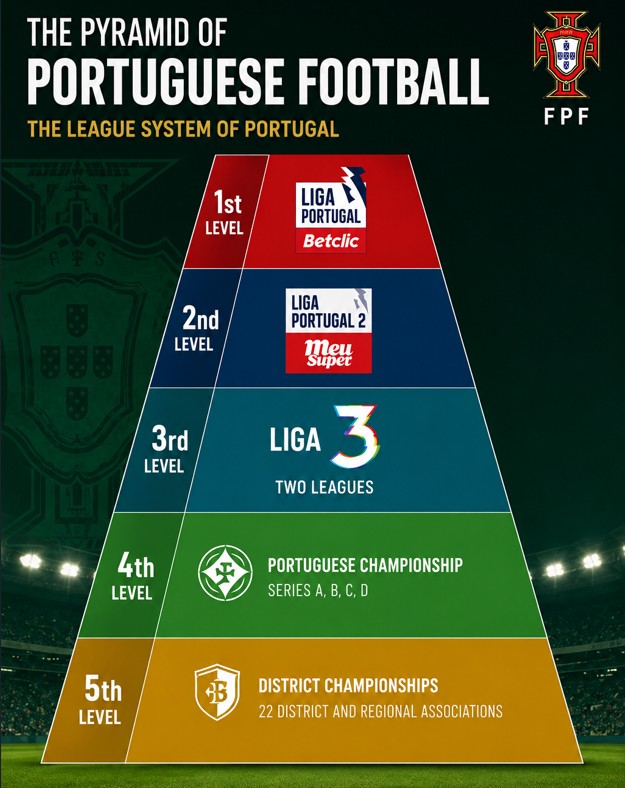
The Portuguese football pyramid explained
The information below is correct as of the start of the 2026/27 season. The football authorities in Portugal often make structural changes to the way the game at club level is organised in the country, with another shake-up rumoured to be on the cards for next year. Over the past five seasons the pyramid has been set up as follows.
Top Tier
At the top is the Primeira Liga, which is currently an 18-team league. It was first played in a similar format to its current form in 1934/35, with each team playing each other home and away and the winners earning the right to call themselves national champions.
At the end of the season, the bottom two clubs are relegated to the second division, while the team finishing 3rd from last faces a play-off with the team that finished third in Liga II for the last available place in the following season’s top flight.
Second Tier
Portugal’s only other fully professional league is Liga II, also an 18-team division. The teams who finish in the top two places are promoted to the top flight, with the third-placed club having a chance of promotion too, via the playoff. It should be noted that the B-teams of some of Portugal’s major clubs compete in this league but cannot be promoted.
Relegation is the same as in the top flight, whereby the teams who finish in the bottom two positions go down, and the club that finishes third from bottom goes into a playoff to try and preserve their Liga II status.
Third Tier
Liga III is where football in Portugal shifts to semi-professional level and geography comes into play. The season includes two distinct phases. In the first half of the season, the third tier is split into two 10-team regional divisions, Série A (north) and Série B (south).
Clubs finishing in the top four places in each division then form a new nationwide league, where everybody plays each other home and away. The top two teams get promoted to Liga II, and the side finishing third has a chance to join them via a playoff with the club that finished third from bottom in the second division.
Also in the second half of the season, the teams that finished the initial two leagues in positions 5-10 form two new divisions, with the clubs finishing in the last two positions in each league relegated to the Campeonato de Portugal.
Fourth Tier
The Campeonato de Portugal is currently split into four 14-team leagues, on a regional basis (this season clubs from the Azores are in Série 4; clubs from Madeira in Série 2). As with Liga III, the season takes place in two different phases. The top two teams in each of the four leagues qualify for the promotion phase, which comprises two 4-team leagues. The winners and runners-up of each of these leagues are promoted to Liga III.
The bottom five clubs of each of the four initial divisions are relegated into the district leagues.
Fifth Tier
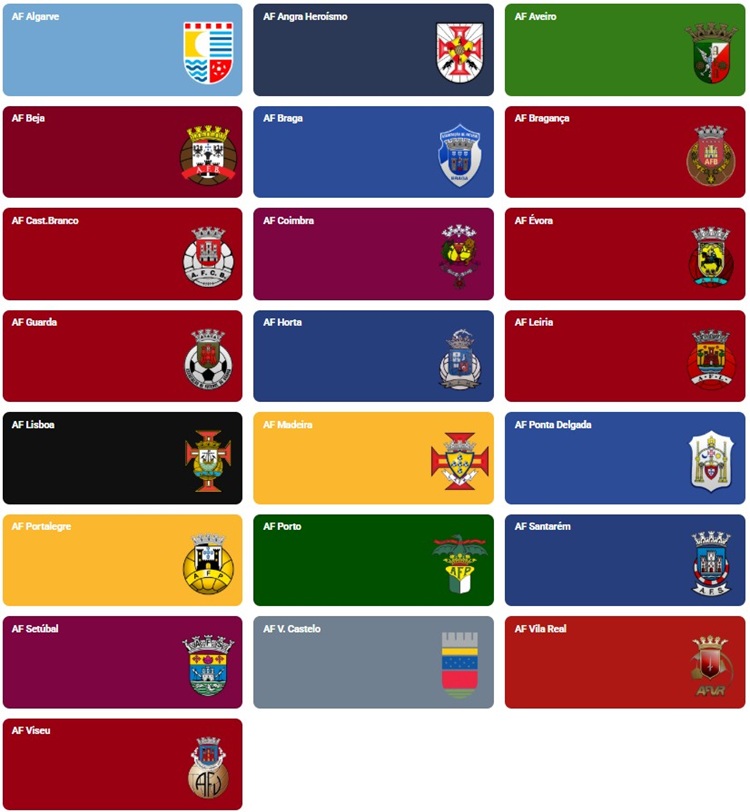
The fifth tier of the Portuguese football pyramid comprises district leagues. Portugal has 22 regional football associations, corresponding to the country’s 18 mainland administrative districts, plus four more covering the islands of Madeira and the Azores.
Each association organises its own leagues, differing greatly in number depending on the size and population of the region in question. For example, the Lisbon FA has 765 registered teams in it, while the Football Association of the Azorean Island of Horta has 38 clubs.
Twenty clubs from the district leagues are promoted each season to the Campeonato de Portugal.
Grass roots. The 22 district Football Associations in mainland Portugal and the Islands of Madeira and the Azores
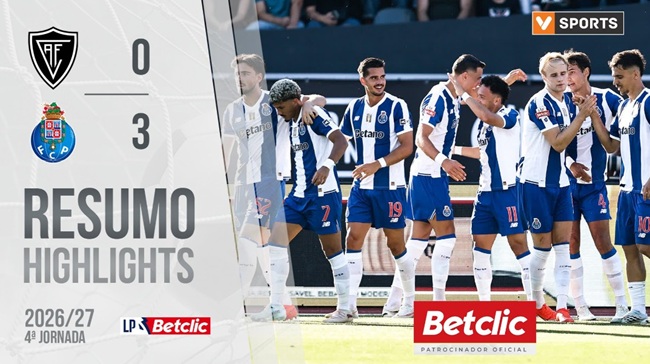
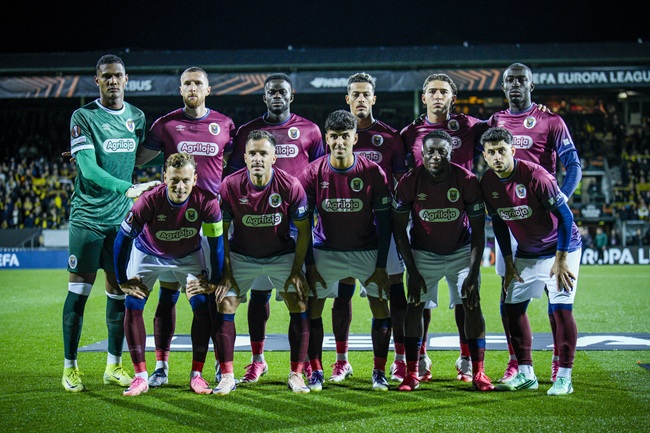
Portuguese champions FC Porto continued their perfect start to 2026/27 by clocking up their fourth successive win in the league (on top of the Super Cup victory in the season curtain raiser) to remain top of the table.
What is the connection between all five wins? Remarkably, Porto have yet to concede a single goal in any of their five matches played in the new campaign.
Striker André Silva was in the right place at the right time to score a typical poacher’s goal in the 5th minute.
In-form Veiga shines
Midfield lynchpin Gabri Veiga then took centre stage, scoring with a fine 20-yard finish before brilliantly setting up William Gomes who made it 3-0 after 38 minutes.
Despite two injuries necessitating substitutions in defence – Zaidu Sanusi and Jan Bednarek replaced by Martim Fernandes and Nehuén Pérez respectively – the Dragons remained impregnable as they easily played out the remainder of the match.
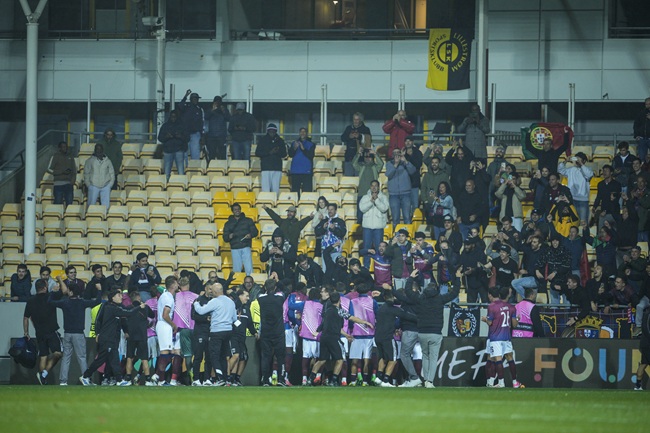
Académico could not lay a feather on Porto, but the newly promoted club will not feel too dispirited about their return of two points from their opening four games given they have already played Benfica and Porto.
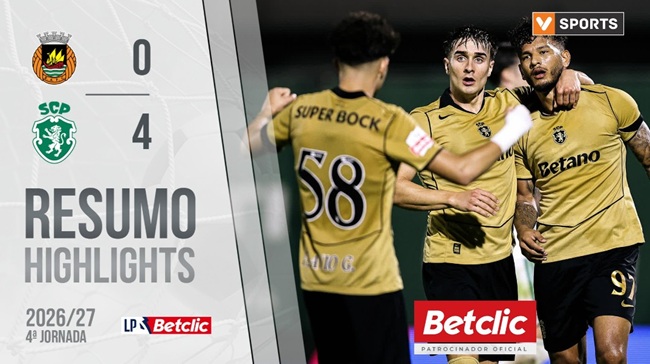
A clinical first-half display powered Sporting to a 4-0 victory against Rio Ave to make it three wins in a row for Rui Borges’ men.
Four shots on target by the visitors in the opening 45 minutes resulted in four goals, rendering the second half a non-event, although Sporting will be pleased to keep their first clean sheet of the season.
Flávio Gonçalves got the ball rolling in the 5th minute, slotting past Ennio van der Gouw after a fine pass from Issa Doumbia.
The young attacker then turned provider, passing across the box to Geny Catamo who fired an unstoppable shot into the top corner.
Striker Luis Suárez decided to join in the fun, firing in with his right foot then his left foot to elevate the score to 4-0 by the 37th minute, and Sporting could have scored more in what proved a complete mismatch.
The Lions go top of the table, at least until previous leaders Porto play Académico tomorrow.



 Porto extended their lead at the top of Liga Portugal to five points after defeating Benfica 3-1 at Estádio do Dragão.
 “He spoke yesterday, he spoke last week about strange things, so you guys join in the conversation with him, because you also like it. We’re going to promote Portuguese football well, and we’re going to have very good shows.”
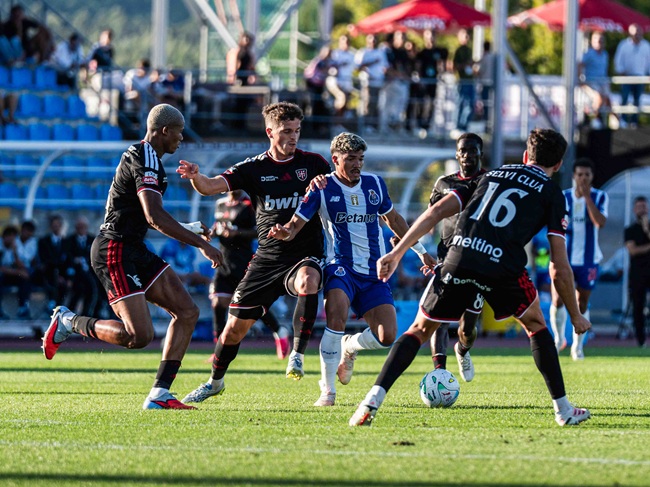


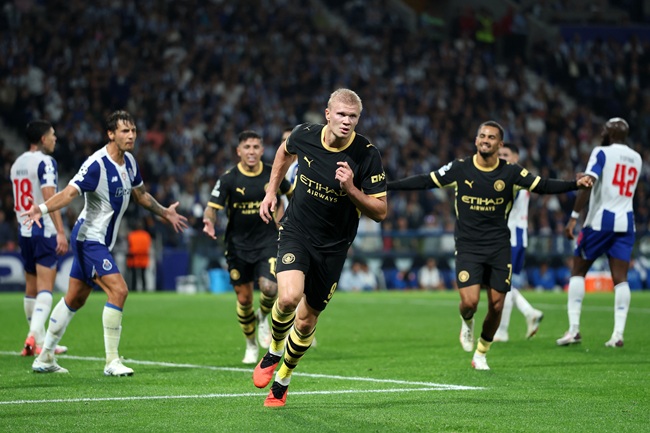
 Porto’s UEFA Champions League campaign began with a 2-0 loss to Manchester City at Estádio do Dragão.
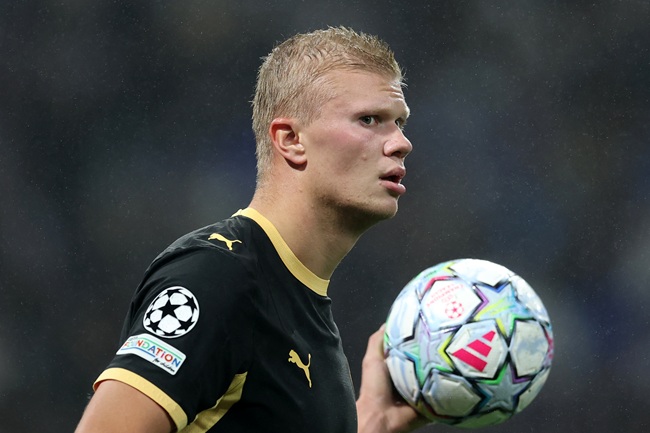 The gulf in class was too much to overcome however, Manchester City ending the contest with 64% possession and 20-5 shots including 10-0 on target.