
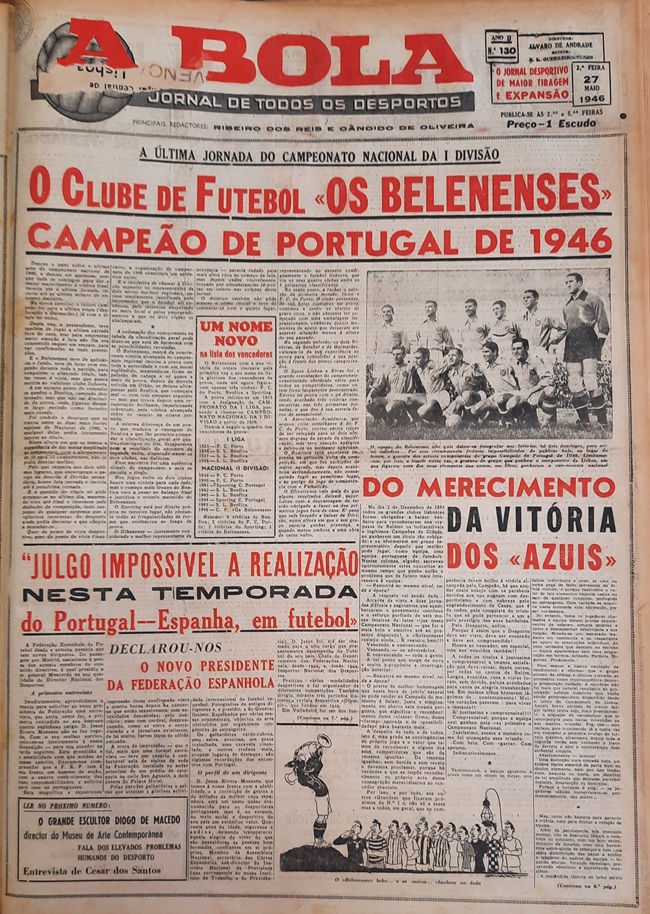
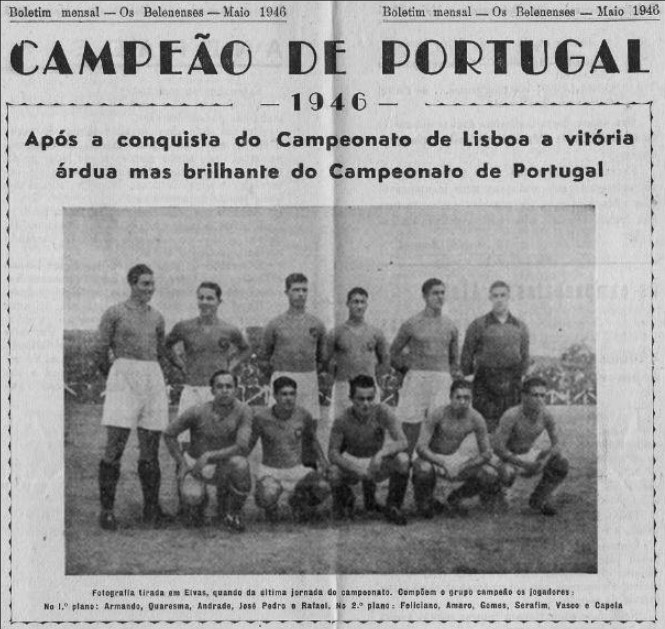
There was a time when the Big Three wasn’t actually a thing. The celebrated Club Futebol “Os Belenenses” were considered by everyone in the game as part of Portuguese football royalty, like any of the other well-known title contenders. They only lacked a Portuguese league title to show for it, having won both the Portuguese Cup and the previous version of the national league, the Campeonato de Portugal.
The coronation came in the 1945/46 campaign, the golden hour for the Azuis who couldn’t possibly imagine, then, that the season that made them kings of Portugal would never be repeated.
***
Two’s company, three’s a crowd and room for one more!
When CF Belenenses came to be, many believed there was no room for more clubs in Lisbon to thrive. The early success of Sporting and Benfica seemed to create the feeling that both sides were bound to dominate football in the capital. Yet, come the 1920s, everything changed. Casa Pia came to life as a group of former Benfica players connected to the educational institution, who decided to turn one of the city’s best football academies into a respectable top-tier side. As did Belenenses.
The club came from the same area as both Casa Pia and Benfica in north Lisbon, in its earliest form, which was seen by then as the place where the most talented and skilful players in the land were bound to appear. The Restelo and Alcantara neighbourhood was still partly free of urban infrastructure, so there was a lot of ground available to play on, football talent and ambition blossoming on the winds of the Atlantic.
In 1919, Portugal’s greatest football player of the day decided it was time to go back and play on his home turf. Artur José Pereira was a skilful winger who knew how to play and how to be a leader of men. He had been a Benfica footballer when Cosme Damião’s side came to life in the same area and then moved to Sporting to become one of the Lions’ first footballing icons. Yet, by then he was tired of playing for institutions that did not represent either his neighbourhood or his way of seeing the game. He called upon a group of footballers from the zone, first of all his younger brother Francisco, to discuss the establishment of a new football power in Restelo. After several meetings, the group expanded and by 1919 the club became a reality. Sporting’s captain Francisco Stromp publicly criticised Pereira after he left the Lions by saying, “Artur can fuck off and start that sort of club in Belém. He will not be missed”. But he was.
Proud to be Portuguese, a superpower is born
Belenenses quickly persuaded the best players from the local borough who played for either Sporting or Benfica to move back home. They incorporated “Club de Futebol” into their name instead of the English “Football Club” or “Sporting Club”, which was usual at the time, to emphasise their connection with their Portuguese roots.
Over the following decade, they became a superpower in their own right, claiming three Campeonato de Portugal trophies, the only national football competition at the time, played in the form of a cup competition. By the end of the 1920s, they were joint-top winners alongside Porto of the competition that preceded the Primeira Liga as we know it today. CF Belenenses also won the Lisbon league on four occasions, proving that Lisbon was more than just Benfica and Sporting.
Nobody doubted there was football royalty, as their Salésias ground also became the most famed football pitch in the land, the first with grass turf and the venue where the national side usually played their home games. They were fashionable, well-supported and played fantastic football. They outlived Artur José Pereira, survived the drama that followed the young Pepe’s tragic death, made famous the so-called “15 minutes like Belenenses” – later copied by Benfica – and claimed their first Portuguese Cup in the 1941/42 season after defeats in the final in the previous two years.
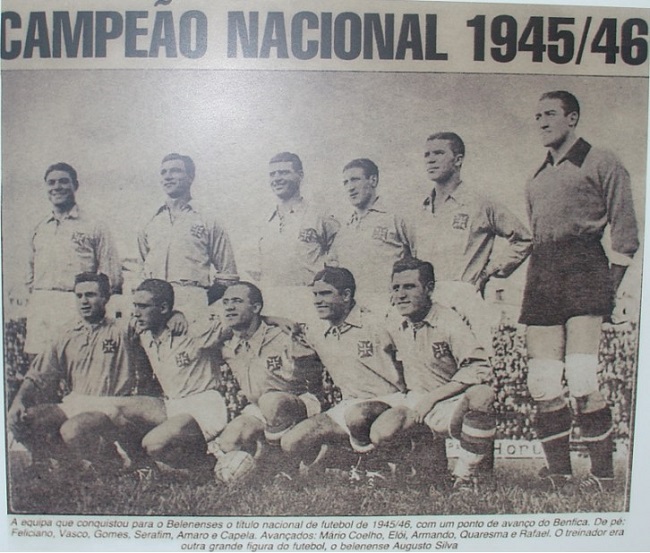
But the league title always seemed to elude them. Artur Augusto, known as Batatinha, one of Portugal’s earliest internationals, was by then the side’s manager after the popular spells of Cândido de Oliveira and Alejandro Scopelli. With a squad mustered with seasoned veterans, the club of Christ’s Cross were finally ready to challenge for the biggest trophy of them all once the 1945/46 season kicked off.
Among the favourites in newly expanded league
As always, Belenenses were considered among the favourites at the beginning of the campaign after finishing second to Benfica the year before. The league was expanded to 12 sides, to include the winners of the Aveiro and Portalegre regional leagues. Qualifying for the national league still depended exclusively on regional results rather than a promotion system that would only be made official in the 1947/48 campaign. Twenty-two matches would decide the new champion and fate dictated that only on the very last day would fans find out who would follow on from Benfica’s success.
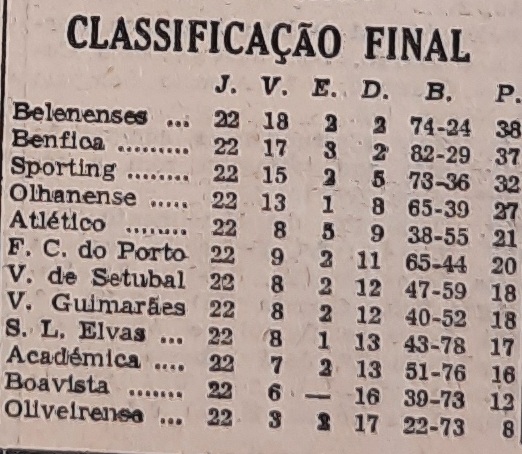
Champions Benfica were joined by Belenenses, Sporting and Atlético from Lisbon, while FC Porto and Boavista represented the city of Porto. Académica de Coimbra, who had taken part in every league edition, Vitória FC (Setúbal), Olhanense (Algarve), Vitória SC (Guimarães), Elvas (Alentejo) and Oliveirense (district of Aveiro) were the remaining sides who took to the field in December 1945, once the regional leagues were over. Belenenses, who won the Lisbon tournament, made their debut against local rivals Sporting and were held to a draw, followed by expected wins against Académica, Boavista, Oliveirense and both Vitórias.
All to play for at the halfway stage
A surprise draw against close neighbours Atlético hurt their campaign, but they were still leading the league when Benfica knocked them back with a clear 2-0 win that reduced the gap to just one point with a third of the campaign played. An important 3-2 win against Porto, who were having another poor spell after dominating with an iron fist at the turn of the decade, seemed to secure their position, but then a surprise came when Olhanense, who were also in the title running, won 2-0 at home against the Belém squad.
The result made it a bunched-up table at the halfway stage as Belenenses dropped to third, behind Sporting and Benfica, and Olhanense were close behind in fourth, with just two points separating all four sides. Belenenses would need a perfect second round to claim the league trophy, and that was exactly what they got.
Defence marshalled by the “Belém Towers”
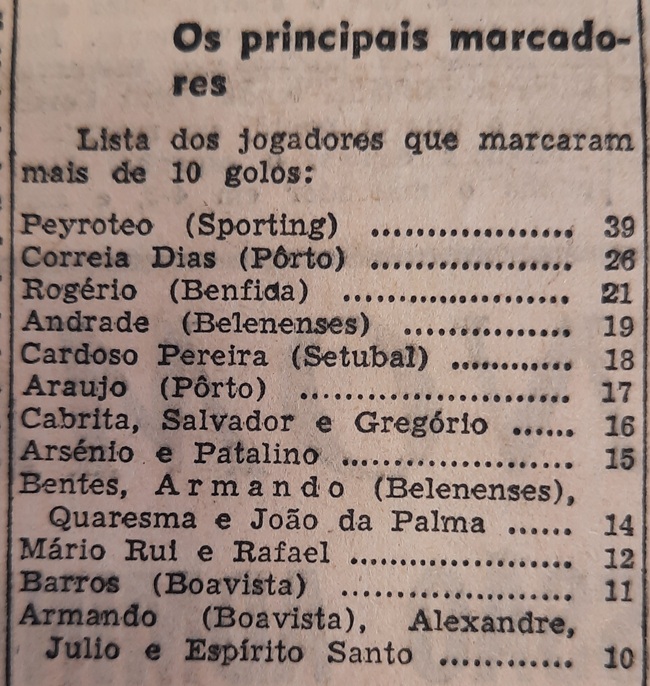
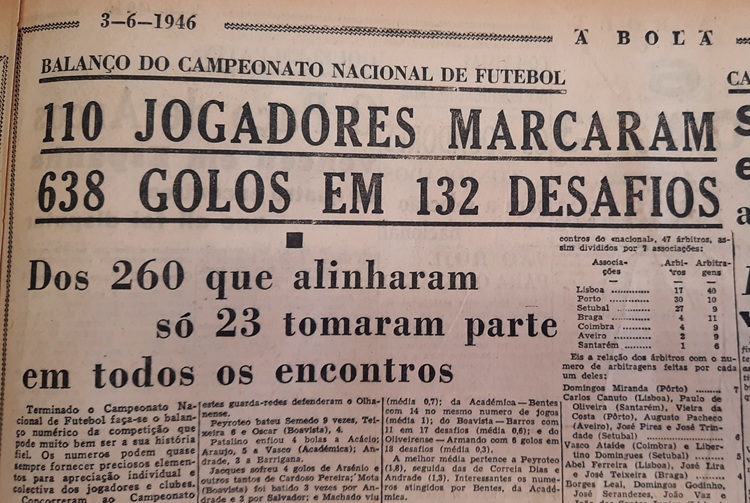
Augusto Silva’s side played impeccable football, built on the defensive genius of centre-backs Serafim, Vasco and Feliciano, the so-called Belém Towers, who played in front of goalkeeper António Capela. The nickname of the imposing defenders alluded to the nearby Torre de Belém (Belém Tower), one of Lisbon’s most historical buildings. Amaro and Gomes were the midfielders usually picked by Silva, while Artur Quaresma (no relation to Ricardo) led the attacking line that also included the likes of Manuel Andrade, José Pedro, Armando Correia and his genial brother Rafael, perhaps the most talented player in the squad.
With a defence that rarely conceded and an attack that knew how to hurt opponents, Belenenses went on a 12-match winning-streak to turn the league table upside down. They first beat Elvas at home and then retook second place by beating Sporting away. It became clear that the trophy would be a showdown between Benfica and Belenenses. Who would fumble first? Wins against Académica, Boavista and a record 10-0 triumph at home against Oliveirense should have been enough.
Title showdown
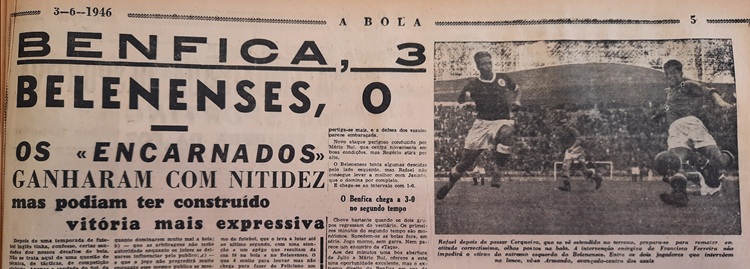
But the Eagles were not ready to relinquish their title yet and kept on winning themselves, so everything was set to be decided at the Salésias in a duel between the two contenders. Belenenses claimed a vital home win thanks to an Andrade goal, and climbed to first place with three matches to go. Now they only needed to equal Benfica’s results to claim the title. The Eagles hammered Boavista, but Belenenses managed a late win in Porto to stay ahead. Then Benfica travelled to Oliveira de Azeméis were they thrashed the home side, forcing Belenenses to do the same at home to Olhanense, who were enjoying their best ever season and sitting fourth in the table.
Everything was ready for a final showdown. Benfica would play at home against Vitória SC, while Belenenses had to travel to the Spanish border to face Sport Lisboa and Elvas, a side with strong Benfica associations, who were striving to do a favour to the club with whom they shared a common name, crest and passion.
All roads lead to the Alentejo
The day was May 26th, and history was about to be made. While Benfica offered tactical support to Elvas, with a member of their staff travelling to the town to share some tips on how to stop Belenenses, a huge contingent of supporters crossed the Tagus River by boat and then travelled all the way to Elvas to support their side on the brink of glory. Benfica coolly won their home game and waited for a favourable outcome from Elvas, and it seemed luck would be on their side when Patalino, Elvas’ greatest ever footballer, opened the scoring early on, the 1-0 remaining unchanged at half-time.
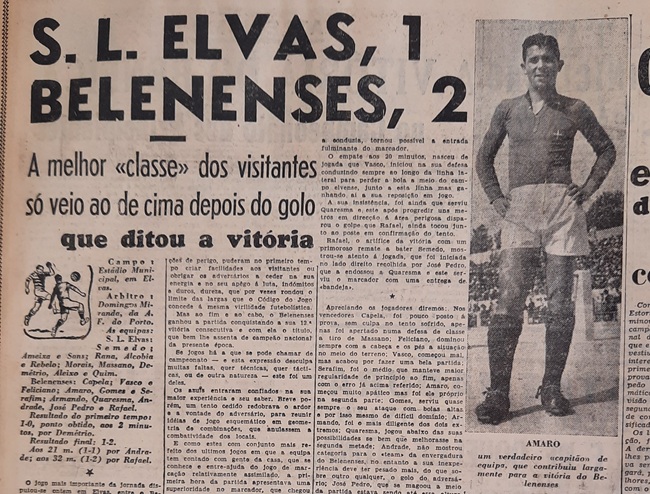
Augusto Silva rallied the players with a motivational speech for the ages, and they came out for the second half much more prepared. Andrade netted the equaliser on the hour from a free-kick following one of Vasco’s famous forward runs into the opponents’ box. The defender was at it again minutes later and, after sliding past several rivals, he assisted Quaresma for a shot. The ball rebounded and found Rafael, who only had to tap it in. It would become Belenenses’ most famous goal ever. With just ten minutes on the clock to play, Elvas found neither the strength nor the will to fight back, and the early celebrations from enthusiastic Benfica supporters from the region were shut down by the passionate chants of the Belém fans who had crossed the breadth of Portugal to witness history be made.
Party time in Belém
The team returned that same afternoon to Lisbon, followed by a huge crowd and then crossed the river to party all night long on their home soil, finally bringing the national league trophy to the Belém quarter, one of the most important locations in the identity of Portuguese football. They almost made it three out of three trophies for the season but were well beaten by Benfica in the Portuguese Cup competition that followed. Nonetheless, 1946 would forever become their year.
The following season, Belenenses were invited by Real Madrid to take part in the inauguration of the Chamartín stadium, now called the Santiago Bernabéu, and in the 1950s they twice came close to repeating a championship triumph thanks to the goals and the genius of their new striker, Matateu. But Belenenses never again became league champions, and by the 1960s it was clear they didn’t rank at the same level as Benfica or Sporting.
The 1970s were even harsher, and in the following decade the club were relegated for the first time in their history. It was the end of an era, and worse was to follow, the club ripped apart by a power struggle and messy split in the second decade of the 21st century.
Never again did Belenenses fight for a league win, and only in 2001 did another team, Boavista, break the Big Three’s iron grip on the Primeira Liga by joining the Restelo side as champions of Portugal. Despite have hit desperately hard times and playing in the lower leagues, still today Belenenses are a well-supported club and famous old name. But of all the celebrated individuals and teams that came before and after in the great history of Belenenses, no side is more beloved than the one that made them champions of Portugal in 1946.
Related: For the bigger picture, see our at-a-glance history of Portuguese football.
