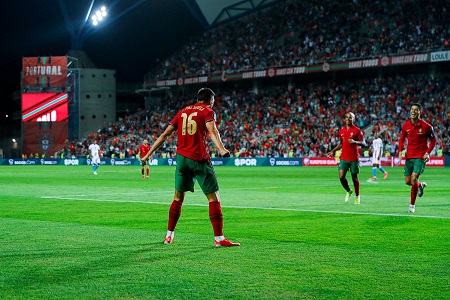
Vítor Baía at the 2002 World Cup. (Photo: Shaun Botterill/Getty Images)
We honour men.
Who sacrifice themselves.
Who change and shape destinies.
But sometimes, football gives us something else.
Not a warrior.
Not a poet.
But a thief.
He did not come to be adored.
He came to take.
He stole certainty from strikers,
snatched futures from crowds,
slipped into the heartbeat of nations and left with their breath.
You never saw him arrive.
He was there, suddenly—
a hand outstretched, a body suspended,
a silence heavier than applause.
He was not thunder. He was the pause before it.
He was not spectacle. He was inevitability.
And inevitability is the most ruthless seduction of all.
For his club, he became cathedral and custodian,
a monument built from reflex and faith.
For his country, he was the promise of belonging,
the man who held hope in his hands.
And for the rest of us,
he was the spell we did not choose to fall under—
the spell we never wanted to end.
Even now, you remember him not in goals scored,
but in goals denied.
Not in the noise of triumph,
but in the silence that followed his touch.
Who was he?
The phantom who guarded glory.
The thief who walked away with your heart.
The myth who made destiny his accomplice.
He was Vítor Baía.
The doctrine of faith
Goalkeeping, at its core, is faith disguised as science. You prepare, you position, you trust and then, you leap into uncertainty. Baía understood this better than most.
His belief was not in luck or fate, but in connection between eyes and instinct, body and intention, thought and motion. It was as if he trusted the game itself to reveal its secret one second before it did.
He often said that a goalkeeper’s greatest gift is conviction. Because doubt is death. The moment hesitation enters, the ball is already past you. Baía’s faith was visible in his stillness.
While others bounced on their toes, he stood serene, a man listening for something deeper than movement.
He believed that football had patterns, that every striker left a trail, that every pass carried the whisper of its destination. And so he waited. Not passively, but with purpose. He did not fight the game; he heard it.
In that faith lay his divinity. The calm that made chaos hesitate. The composure that made even destiny blink.
The keeper who knew tomorrow
There is anticipation, and then there is Baía’s anticipation. That eerie ability to sense danger before it takes form.
He studied body language like scripture. The drop of a shoulder, the twitch of a knee, the glance to the far post. All became hieroglyphs in his private language of probability. While most goalkeepers reacted to the ball’s movement, Baía reacted to the movement before the movement.
His saves often looked easy because he had already erased difficulty from the equation. He turned the extraordinary into the expected.
In an era before analytical departments and heat maps, Baía was his own analytics. He remembered every striker’s habits: the delay before a shot, the favourite angle, the disguise that wasn’t disguise at all. To watch him was to witness someone reading football’s subconscious.
And yet, there was nothing robotic about him. His intelligence was not mechanical; it was human, intuitive, deeply sensory. He knew tomorrow because he listened to today.
Barcelona: between crown and cross
Vítor Baía in action for Barcelona in 1997. (Photo: Ruediger Fessel/Getty Images)
When Vítor Baía left Porto for Barcelona in 1996, he did not just cross a border; he crossed a philosophy. At Porto, he was adored. At Barca, he was examined. There, every movement was data, every mistake, doctrine.
The Catalan ideal demanded that even goalkeepers become philosophers of possession. To play for Barcelona was to play for an idea, one that sought to control the uncontrollable. For Baía, it was both seduction and trial.
He had the elegance for it, the poise, the intelligence, but fate demanded a cruel symmetry: his body, once an instrument of intuition, began to betray him. Injuries blurred his rhythm. The thief of time found time turning on him.
Yet even in that imperfect chapter, he absorbed lessons that would echo through his later years. The concept of positional anticipation, the goalkeeper as first playmaker, took root there. His feet became extensions of his foresight.
When he returned to Porto, he brought Barcelona’s schooling home, not as imitation but as evolution. He fused Iberian precision with Portuguese spirit. From that synthesis emerged the Baía who would lift the Champions League under Mourinho: wiser, calmer, more complete.
His Barcelona story was not failure; it was apprenticeship. A crown he wore only to understand the weight.
The apprentice and the master
The relationship between Vítor Baía and José Mourinho was not one of convenience; it was one of recognition. Both men saw the game as a chessboard of minds rather than muscles.
Mourinho, once an interpreter under Robson at Porto and Barca, shared Baía’s obsession with control through anticipation. Where others chased the moment, they designed it. When Mourinho returned to Porto as manager, Baía was the anchor of his defensive prophecy. He became the silent strategist between the posts. The man who executed the manager’s theories in real time.
Every pressing trap, every counter-attacking pattern relied on him to foresee what came next. When Porto won the Champions League in 2004, much of the glory belonged to Deco and Carvalho, to the team’s organisation and defiance. But the secret heartbeat was always Baía.
He was Mourinho’s mirror, the calm in the storm, the unspoken assurance that strategy without serenity is just noise. Between them existed a mutual faith: Mourinho trusted that Baía could see the game as he did, two steps ahead, where tension becomes timing and timing becomes truth.
For Portugal, Baía was more than a goalkeeper. He was a vessel of identity during an age of emergence. Before Cristiano’s rise, before the golden generation fully announced itself, Baía was the emblem of Portuguese excellence. The bridge between modest past and modern belief.
His performances in Euro 2000 were a masterclass in psychological dominance. Against England, Romania, Germany, he did not merely stop shots; he dismantled confidence. You could see it in opponents’ eyes: the dawning realisation that scoring against him required something beyond talent. It required disobedience of fate.
He became the nation’s quiet mythology. Tthe man who stood still so Portugal could dream forward. His gloves were not armour; they were instruments of belonging.
For every Portuguese boy standing in the rain, Baía was proof that anticipation was not cowardice but courage refined. But even myths meet mirrors. In the semi-final against France, it was another prophet of calm, Zinedine Zidane, who ended Baía’s spell.
Extra time. Golden goal. A penalty. Zidane walked toward the spot with that familiar stillness, the same eerie composure Baía had made his own. For a heartbeat, two readers of destiny faced each other. One in gloves, one in grace. Baía guessed right. Zidane went the other way.
The ball slid into the corner, soft as a sigh, cruel as truth. Portugal fell. France advanced. The thief of time was, for once, anticipated.
Yet there was no disgrace — only poetry. For it took another master of anticipation to unwrite his prophecy. And in that collision of calm souls, football witnessed something purer than victory or defeat. It witnessed recognition. Zidane may have scored, but Baía’s myth survived, transfigured. Proof that even when beaten, the art of anticipation leaves its echo.
The echo of silence
Vítor Baía denies France’s Sylvain Wiltord in the Euro 2000 semi-final. (Photo: Lutz Bongarts /Getty Images)
There are goalkeepers who define eras by noise — their shouts, their theatrics, their chest-pounding ferocity. Baía defined his by silence. It was not the silence of indifference but of clarity. He did not need to command; he simply aligned. His defenders moved as if guided by inaudible instructions.
Silence, for Baía, was not absence of communication. It was its perfection. Every gesture, every glance, every micro-adjustment told a story.
Even now, watching him in old footage feels strangely meditative. The chaos of the match swirls around him, yet he remains composed, sculpted in composure. The ball comes, and time stops. The save happens, and time resumes.
He taught a generation that football’s most decisive moments are not loud. They are still. That control begins not with words but with breath.
The final save
Retirement did not end Baía’s influence; it merely shifted its frequency. He became ambassador, symbol, echo. Yet the essence remained: anticipation as art, foresight as philosophy.
In an age where goalkeepers are judged by distribution charts and xG prevented, his legacy reminds us that intelligence cannot always be digitised. You cannot code instinct. You cannot quantify calm. Baía’s gift was to inhabit the space between decision and destiny. To make the improbable feel ordained.
He was, and remains, the reminder that goalkeeping is not merely defence. It is design. To read the game like Vítor Baía is to see before you move, to believe before you act, to trust that the future has already whispered its secrets, if only you listen closely enough.
He was Porto’s cathedral, Portugal’s conscience, and football’s quiet prophet. In the end, he did not leave the game. He simply stepped one moment ahead of it, as he always had.
The Art of Anticipation. That was his masterpiece.
And every silence that follows a great save still sounds like his name.
In the modern history of the Seleção, Portugal have suffered for decades trying to find a prolific goalscorer (with the obvious exception of Cristiano Ronaldo, featured in Portugal’s all-time ten greatest wingers article), but if you think that in the past the nation has not produced many, think again.
Portugal is home to some of the best and most prolific forwards of all time, including several record breakers and names that would shatter the dreams and expectations of defenders and goalkeepers across football history. Heroes hailing from Africa, Madeira, the Azores and continental Portugal have shown how deadly they can be in front of goal for almost a century now.
***
Fernando Peyroteo (20 caps)
There is no forward in the history of football with a goalscoring record that can match Fernando Peyroteo. That doesn’t just make him one of the greatest Portuguese forwards of all time. He is one of the greatest ever, period. How could he not be? Peyroteo played 323 official matches for Sporting and scored 556 goals. Practically two goals for each match during twelve years, where he absolutely dominated the domestic game.
He had the bad luck of playing for Portugal at the lowest point of the national side’s history – even if in 20 matches he netted 15 goals. Likewise, when he played regional or continental European competitions had not yet been set up where he could showcase his phenomenal talents. He retired in 1949, just when the Latin Cup was starting and he played in its first edition, guiding Sporting to the final, which they lost against FC Barcelona.
Born in Angola, the first Portuguese African superstar, he moved to Lisbon aged 19 to play for Sporting after making a name for himself at local clubs in his homeland. With the Lions, he won five league trophies and four Portuguese Cups, finishing as top scorer on six occasions. He remains today the greatest goalscorer in the league with 336 goals to his name, including 9 in a league win against Leça, still an unbroken record. He famously scored four past Benfica in a title decider in 1948 despite playing with a fever, and Peyroteo netted a total of 67 goals in 49 matches against Sporting’s biggest rivals.
Without much TV footage available, radio and newspaper clips are all we have left from his brilliant career, but the numbers don’t lie. Eusébio might have been the greatest forward ever to play for the Portuguese national team, but Peyroteo is likely the deadliest striker in the history of the national game.
They called him Bibota for a reason. Two Golden Boots to his name. Fernando Gomes was the only Portuguese footballer besides Eusébio and Cristiano Ronaldo to win the trophy as the best goalscorer in European leagues and his career is full of iconic moments. A Porto youth graduate, probably the best in its history, Gomes was the greatest national striker in the period between Eusébio and Ronaldo.
He scored 288 goals in 342 official matches played for the Dragons in two different periods, including one in the Intercontinental final played during a snowstorm in Tokyo. A decade before, he had helped the club of his life to win their first league title in 19 years, the first of five. In 1983 and 1985, Gomes finished as Europe’s best goalscorer, and he was Portugal’s top scorer on six different occasions, equalling Peyroteo’s record. Gomes had great technique on the ball and would often drift from position, but was also deadly in the box.
When coach Pedroto and president Pinto da Costa were forced out of the club, he requested a transfer and signed for Sporting Gijón, where he played for two seasons but never made an impact due to long-term injury. Re-signed by Porto in 1982/83, Gomes was appointed club captain by Pedroto and guided the side to the Cup Winners’ Cup final in 1984 and the European Cup final of 1987. An injury, days before the match, prevented him from playing in Vienna as Porto became champions of Europe for the first time.
Two years later, a row with coach Artur Jorge forced him once again to leave Porto, and this time he opted to stay in Portugal and sign for Sporting, where he scored 31 goals in two seasons. Portugal’s main striker at Euro 84 and World Cup 86, he didn’t have the same goalscoring impact with the national side but remained a much-respected figure nonetheless.
José Águas (25 caps)
The Golden Head was his nickname, one of the best headers in the history of the game, and the only Portuguese club captain ever to lift the European Cup twice. José Águas was Benfica’s main goalscoring threat during the 1950s, a time when he ruled in the Portuguese league, thus succeeding Peyroteo. In a way, it represented the shift of power from Sporting to Benfica, although his most memorable moments came at the end of his career when, under Belá Guttman, he captained the Eagles to back-to-back European Cup wins, something Portuguese football never again had the pleasure to enjoy.
His numbers with the national side, like with many strikers of his day, pales in comparison to what he did with the club that signed him during a tour in Africa and brought him to Lisbon to become the very essence of what a Benfica club captain should be all about. During the fifties, he won five top scorer awards in the Portuguese league and in 1961 he was top goalscorer in the European Cup as well. With seven Portuguese Cups and five league titles won, he was the first idol of the crowd at the newly inaugurated Estádio da Luz.
Before Cristiano Ronaldo, the island of Madeira had already gifted Portuguese football with a remarkable goalscorer. Artur de Sousa was known as Pinga because he was so fast to dispatch opponents that he seemed he could pass through them like raindrops (pingas in Portuguese). Born in Funchal in 1909, he quickly became a local celebrity and debuted for Marítimo at the age of 20.
Porto quickly signed him after watching him tear the Dragons’ defence apart during a clash between both sides. He moved to the north of Portugal, where he became the first club legend. His partnership with Waldemar Mota became the stuff of legends, and the press called them the Noon Devils because of the usual kick-off time for matches then. He won two Campeonato de Portugal titles for the Blue and Whites, and at the end of the 1930s, when the football league was officially formed, he added two more back-to-back trophies, besides the first experimental league win in 1934. During his career, Pinga had several offers from international clubs, particularly from Brazil and Spain, but never left the club and city that had adopted him.
He has been ranked as scoring almost 400 goals in as many matches, although many weren’t official games. He often was the only Porto player called up to the national side during the thirties, and his most famous performance was a hat-trick against Ricardo Zamora, the Spanish goalkeeper, during a 3-3 draw in 1935 that had the likes of Real Madrid and Barcelona approaching him after the game, to no avail. He embraced a short-lived coaching career at the end of his life and died prematurely, aged only 54.
João Vieira Pinto (81 caps)
The Golden Boy of the Golden Generation. João Vieira Pinto was more of an attacking midfielder at heart than a striker, but he could also score brilliant and often decisive goals. The fact that, contrary to the likes of Rui Costa, Luís Figo or Paulo Sousa, he never travelled abroad to play may have diminished his popularity outside of Portugal, but few players have been so dominant in the domestic competition over the most recent decades. In fact, he did move abroad when he was only 18, to Atlético Madrid, and was touted to be Paulo Futre’s successor at the club, but he felt homesick and was tired of being forced to play in the Colchoneros reserves after having already made such an impact with the Boavista shirt, the club he graduated from after Porto had turn him down years earlier. In 1991, he returned to Bessa and became the most coveted player in the league, eventually signing for Benfica the following summer.
João Pinto in action against Poland during the 2002 World Cup, is South Korea. (Photo: Clive Brunskill/Getty Images)
Pinto spent eight years with the Eagles and lived the best and worst of times. A key element in the 1993/94 title winning season, scoring a memorable hat-trick in one of the most famous Lisbon derbies in history, he was also the club captain during the first period of the so-called Vietnam years. A period that ended with Benfica releasing him 2000 days before the European Championship was to kick off. JVP, who had been Carlos Queiroz’s most beloved player in the 1989 and 1991 under-20 World Cup winning squads, had already played for Portugal at Euro 96 but four years later was a key player as the side reached the semi-finals, scoring a brilliant header against England in a classic opening match that ended in a memorable 3-2 victory for the Seleção.
After the tournament, he signed for Sporting, a move that rocked the foundations of Portuguese football. With the Lions, he won his second league title in 2002, partnering Mário Jardel in the attack, and then later returned to Boavista before a short final spell at Braga. A forward with an attitude, he famously got involved with Paulinho Santos in several infamous episodes and, most famously, punched the referee in the defeat against South Korea in the 2002 World Cup that ended his international career and Portugal’s hopes of progressing to the last sixteen.
Rui Jordão (43 caps)
When Jordão decided to end his career, he immediately started a new one as a painter. It might have looked like an odd choice, but then again, he already drew goals of wonder during his playing days. Jordão was a special striker. Not the tallest nor the fastest, never a killer in the box, but he still managed to be in the right place at every given moment. Although he only scored 15 goals for Portugal – in 43 caps, which seems odd for a striker – everyone remembers the two he netted against France in the Euro 84 semi-finals.
By then, he was already 32 and had spent the best part of the previous decade playing in the shadow of other, more popular forwards. He was signed in 1971 for Benfica from Sporting Benguela in Angola, aged only 19, with the Eagles hoping he would succeed Eusébio in the front line. For the following years, Jordão played alongside him and also Artur Jorge, who regularly outscored him, and proved his worth, but never managed to be the league’s top scorer and some Benfica supporters believed he didn’t have it in him to be a top-class striker.
In 1976, he was sold to Real Zaragoza and played a season in La Liga, scoring 14 goals in 33 league appearances, numbers that persuaded Sporting to sign him back to join Manuel Fernandes in a striking partnership for the future. The two learned to work together brilliantly, making Jordão twice the league’s top scorer, netting 150 goals in 200 matches played for the Lions until a row with John Toshack ended his stint at Alvalade. The argument cost him a place in the 1986 World Cup, but to prove everyone wrong, Jordão signed for Setúbal, where he kept on scoring for two more seasons before hanging up his boots in a high. He had also played that season his final match for Portugal, having debuted in 1971, a brilliant eighteen-year span.
For someone who held the record of most goals scored for the national side it’s hard to believe that Pauleta never played a single match in Portugal’s top league. His career is proof that sometimes appearances can be deceiving and that football from the 1990s onwards opened doors that in the decades before would have probably been closed to someone who was born in the distant Azores.
Pauleta celebrates after scoring against Angola in the 2026 World Cup in Germany. (Photo: Laurence Griffiths/Getty Images)
Despite impressing as a teenager, Pauleta soon realised that Santa Clara, still a minnow in those years, wouldn’t be able to offer him the career he wanted, so, still a teenager, he moved to the Estoril youth academy. He was quickly promoted to the first side, which played in the second tier, and from there on he joined the Portuguese legion that flocked to Salamanca when the side was promoted to La Liga in 1996. He made a name for himself in Spanish football, first by scoring more than thirty goals in two years for the Salmantinos, and then as part of the Deportivo side that won the league in 2000.
The following summer, after having played in the Euro 2000 finals for Portugal – the first player to do so without having played in the Primeira Liga – he moved to France, where he became a local legend, first with Girondins Bordeaux and then with PSG. In France, he scored 141 goals in eight seasons, finishing top-scorer on three occasions. Sadly, the Olympique Lyon domination period meant he was never a league champion. In 2002, he scored a hat-trick against Poland in the World Cup, and for the following decade, he kept on scoring freely, surpassing Eusébio as the nation’s top goalscorer in 2006, with 47 goals in 88 matches, a record since only surpassed by Cristiano Ronaldo, who played alongside him in the final years of his international career.
Eusébio (64 caps)
Eusébio da Silva Ferreira is not just Portugal’s best ever striker. He is one of the greatest names in the history of the game. Rivalling the likes of Pelé or Bobby Charlton in his playing days, Eusébio is probably a firm candidate for a place in the top 20 list of football icons. He was undoubtedly the best European player in the 1960s and remains today the greatest footballer ever to be born in Africa. His performance during the 1966 World Cup ranks among the ones that the likes of Garrincha, Maradona and Messi enjoyed, a tournament where he ended as top goal-scorer, netting four past North Korea in a memorable comeback win.
Eusébio hammers his penalty kick past Russia’s Lev Yashin at the 1966 World Cup at Wembley Stadium. (Photo by Keystone/Getty Images)
By then, he had guided Benfica to their second European Cup win, a competition he would never again win, despite playing in three more finals. During the 1960s and early 1970s, few players in the world scored as many goals as he did. He netted 317 for Benfica in 301 matches, and 41 for Portugal in 64 caps, a record that stood until 2006. He still has the record for most top goalscorer trophies in the domestic league – seven times he topped the charts – as he helped Benfica become champions of Portugal 11 times, also a record. Only Di Stefano scored more goals than Eusébio during the European Cup years, between 1955 and 1992, a staggering feat.
Eusébio was probably the most complete footballer in the history of the Portuguese game. He was fast, strong, had a lethal shot, was brilliant at set pieces and a terrific header of the ball. He endured five knee operations, leaving everyone wondering what his career would have been like if he had stayed healthy for a few more seasons than he actually did. Whenever people thought of Portuguese football until the Cristiano Ronaldo global phenomenon, they thought of Eusébio and with good reason. No player was as beloved and respected – even by opponents – as he was, despite his arrival in Portugal adding an extra spicy touch to the Benfica-Sporting rivalry. While Peyroteo was the standard bearer of Sporting’s domestic dominance, Eusébio led the changing of the guard and made Benfica not only the biggest club in Portugal but also one of the biggest in the world. A legacy that survives the man everyone at the Estádio da Luz called The King.
Manuel Fernandes (31 caps)
Manuel Fernandes is remembered as Mr Sporting and with good reason. The prolific striker played for the Lions for more than a decade and scored almost 200 goals in the club’s shirt. Ironically, he was top scorer only once, in 1986, including a four-goal haul past Benfica in a famous 7-1 win, and at the end of the season he was still left out of the national side to play in the Mexico World Cup.
Born in Sarilhos Pequenos, a village near Seixal, Fernandes began his playing days at CUF, working for the Fabril company and scoring for fun in what was essentially the first club-company in Portuguese football. The April 1974 revolution meant the end of professional football at CUF and in 1975 he moved to Sporting, where he quickly settled in as a crowd favourite. Alongside Jordão, subsequently signed from Zaragoza, he struck a remarkable partnership that lasted for a decade and brought the club two league titles and two Portuguese Cup wins. When António Oliveira signed for Sporting in 1981/82, the trio completely dominated the league as few had done in the past, even if it was short-lived. Fernandes remains the club’s second-best goalscorer, only behind Peyroteo, but in 1987, he was forced out and moved to Setúbal, where he played for one more season, scoring 16 goals along the way.
His career with the national side was shorter and never fully matched up to the standards he set at club level. He also had an interesting career as a manager and hired in his early days a young José Mourinho as assistant when he was coaching Ovarense and Estrela da Amadora, later taking him with him once he joined Bobby Robson’s staff at Sporting in 1992. The rest, as they say, is history.
Matateu (27 caps)
Matateu was the first black star of Portuguese football. Until he came along, all the African players brought to the continent were white, sons of native Portuguese who had moved to Africa for a better life. He set a different trend, paving the way for the likes of Mário Coluna and Eusébio, and proved that black-skinned footballers could be as good as or better than anyone else. The way he was celebrated by the Restelo crowds was, somehow, unthinkable during a fascist regime that tried its best to sell the idea that Africans were as Portuguese as those from the metropolis, but which was still profoundly racist at heart. Matateu broke all sorts of barriers during that period, and he was never one who liked to shut up, having even been arrested during a match after confronting a referee, before finally being released with no charges.
Born in Lourenço Marques, like Eusébio, only fifteen years earlier in 1927, he began his career playing for local sides until a Belenenses scout spotted him and took him to the Salésias ground in 1951. During the 1950s, he was one of the greatest footballers of the domestic league, rivalling José Águas from Benfica, Hernâni from Porto and Travassos from Sporting. Matateu was twice the top goal-scorer in the league. He took Belenenses to two second-place finishes that could have been league wins if it weren’t for last day dramatics. He remains the best Portuguese player never to win the competition. His only trophy was a Cup win in 1960. He then moved to Canada, where he ended his days. With Portugal, he played almost thirty official matches but peaked too soon and was never called up to play alongside a teenage Eusébio in his final years at Belenenses.
Football in the Algarve was always a big thing, but not until the 1990s did it truly feel like it. Although Olhanense famously won a Campeonato de Portugal edition way back in the 1920s – one of the biggest and most surprising feats in Portuguese football history – and Portimonense stood up pretty well during the 1980s in the top tier, it wasn’t until Farense rose to prominence in the following decade that things started to light up.
The 1990 Cup final was only the first step for the Faro Lions. During the 1990s, Farense became one of the biggest fan-favourites in the league, well-supported all around the land due to their strong identity, the passion felt at each home game in the São Luís stadium and the cheerful character of their Catalan manager, Paco Fortes. Come 1992, they also sported one of the most iconic kits in the league, a shirt worthy of their impact in a new era where football became more decentralised, with Madeira, the Minho region and the Algarve enjoying an enduring relevance they had never had before.
***
The Farense 1992/93 team, that went the entire season unbeaten at their São Luís home
Golden nineties
Farense finished the 1991/92 season sixth, six points behind Vitória SC, who qualified for Europe. The previous season, they ended two points behind Salgueiros, who also booked a ticket for the UEFA Cup. Something was brewing at the Algarve, and many dreamt that a time would come when they would finally get the chance they deserved to play continental football.
The core of the side didn’t change, nor did the most important element of the project. Paco Fortes remained on the bench, and alongside him were the likes of Hugo, Jorge Soares, Portela, Ademar, Hajry, Sérgio Duarte, Miguel Serodio and Djukic, who were now joined by Hassan Nader, signed from Mallorca.
The club had left Adidas to join with the German company Hummel for the 1992/93 season, and the brand, which was already famous for its radical and innovative templates, came up with one of the most iconic shirts the club ever wore. A huge inverted black triangle covered the chest of a mainly white kit and shirts, with black socks to go along with it. The neck was also black, as was part of the shoulders, with the sponsorship of Fontes Romanas printed in blue and white inside the triangle. The club crest was sewn in a circular fashion above the sponsorship and alongside the sports brand logo.
The alternative kit didn’t follow a similar pattern as was customary. The club sported a green-only shirt, with the same sponsor in white, and white shorts and socks. There was no third kit available for the season, although in some matches Farense did play without a main sponsor, sporting just the black inverted triangle alongside the all-white shirt.
The club wore their main kit in thirty of the matches played during the season, although they often changed the main white shorts for black ones. Against Vitória SC and Boavista away, they went with the green and white version instead and lost both matches. At home, against the Guimarães side, they played in all green against the all-white of the visitors (whose home and away kit clashed with Farense’s), and on that occasion they came out as winners after a 4-1 thrashing. Curiously, the goalkeeper kit followed the same pattern used by Peter Schmeichel with the Danish side that won the Euro 92, a colourful, iconic template.
Fortress São Luís
The season was remarkable not only because the club finished again sixth, something nobody expected, even if they once again fell short of a continental ticket. This time, only two points separated Paco Fortes’ men from Marítimo, but nonetheless, the crowd of the São Luís enjoyed a season like no other. While they only won one match away from home, against Braga, at the São Luís they remained unbeaten for the entire season, a series that was stretched for half of the 1993/94 season as well.
Not one of the Big Three won there, with Benfica and Sporting held to goalless draws and future league champions FC Porto beaten by a single Hugo goal, a brilliant header following a Djukic cross that left Vitor Baía hapless. The match was played in mid-May and was extremely tense with several fouls bordering on violence, with staff members of each club almost coming to blows at half time. It was actually a fixture that should have been played in week 26 but had been postponed. The unexpected win put Farense right into contention for that final European spot, but a defeat in the penultimate day of the season at Paços de Ferreira cut short their dreams.
Farense’s unbeaten home record in the 1992/93 Primeira Liga season (V = Win; E = Draw). [Image: www.zerozero.pt]
The Algarve outfit had to wait two more seasons, but in 1994/95 Farense finally finished fifth, their best result to this day, one point ahead of União de Leiria to book a place in the UEFA Cup. And they put up a good fight in European play, although they would be beaten by Olympique Lyon by a mere single goal in each match of the first round. By then, the club had dropped Hummel, first for the British Reebok brand, copying the same template that would be famous in the mid-1990s, with the logo on the right shoulder in black, and then moving to Saillev, a popular brand in the mid-nineties Portuguese football, who opted for a singular black strip. On both occasions, Pingo Doce was now the main sponsor and would remain so until the end of the decade.
Twenty-year absence
With coach Paco Fortes now departed, Farense started to lose part of their identity, especially playing at home, and were finally relegated in 2002 and four years later had dropped to the regional leagues after being declared bankrupt.
Football in the Algarve went missing from the first tier for almost a decade before Olhanense, briefly, and then Portimonense, returned the region’s lost pride. In 2022, Farense finally got promoted again and has since been an up-and-down club. The memories of the golden nineties are not forgotten though, and despite that memorable Cup run in 1990 and the fantastic European qualifying achievement in 1994, if there’s a shirt people think about when they think about the Faro Lions, it remains that iconic Hummel template that put the São Luís on the list of Portugal’s most iconic football grounds.
Football is made of moments. Of memories. Of photographs. There is only one player in the history of Portuguese football who was pictured holding aloft the European Cup trophy twice. José Águas enjoyed one of the most brilliant careers in the sport’s history. He began as a promising striker with nothing to lose and closed his playing days as a double king of Europe.
He also fathered an international forward, a pop singer and for generations represented what a Benfica club captain should be all about. Setting the example followed by the likes of Mário Coluna, Eusébio, Toni, Humberto Coelho and Manuel Bento all the way to João Vieira Pinto and Simão Sabrosa, he was one of the Eagles’ first recognisable superstars.
***
Out of Africa
Nowadays, people tend to look at a time when Portuguese football explored a gold mine in Africa and think of black African players. The likes of Eusébio, Coluna, Hilário, first, and then Jordão and the descendants of the old colonies, all the way to Éder, Rafael Leão or Nuno Mendes. Yet, the first African stars to populate and elevate the Portuguese game were whites, not blacks. Born in Africa from second or third generation families who had travelled from Europe to the colonies in the late 19th century, they were the first names continental scouts looked for when they began travelling to Angola and Mozambique in search of talent.
Fernando Peyroteo might have been the most famous of them all, but he was far from being the only one. José Águas, who was born in Luanda in 1930, was certainly among them. His parents had moved from Lisbon in search of a better life in Angola, but tragedy struck, and while in his early teens, Águas lost his father and was forced to start working at the age of 15 to help out his widowed mother. He enrolled in the Robert Hudson Ford car dealership in Lobito, where they lived, as a copy typist and soon made himself popular by playing alongside his fellow workmen in the company football squad, which competed in the local companies’ league. His skills didn’t go unnoticed, and soon the Lusitano de Lobito side gave him a trial, subsequently signing him to play for the first team despite being under 18.
From Ford to football
Águas wasn’t much of a football fan, but his love for Benfica was already indisputable, as everyone in his household was an Eagles supporter. His teen idol was Rogério Pipi, the first Portuguese player to move to Brazil, where he joined the iconic Heleno de Freitas in the Botafogo forward line. In 1950, Benfica ended the season by clinching their first international trophy, the Latin Cup. The tournament had started the previous season, with Sporting playing in the final against Barcelona, and in the following year the final four was staged in Lisbon. The Eagles beat Lazio in the semis and Bordeaux in the final after a replay and an endless extra time.
The news spread around the Portuguese empire, and the club was invited to schedule a tour in Mozambique and Angola to parade the trophy. When they arrived at Lobito, a best eleven was quickly assembled and Águas was part of it. Not only that, but he also scored two goals in a 3-1 win, quickly drawing the attention of Ted Smith, Benfica’s manager, who persuaded the board to sign him on the spot. He hardly had time to pack his things, sign off from the Hudson company and join the tour alongside his new teammates. Nobody knew yet, but for the following thirteen years, he would be Benfica’s most prolific scorer.
Spectacular debut
Águas debuted in the 1950/51 season and quickly left an imprint, scoring four past the Braga goalkeeper on his league debut. He finished the season with 26 goals to his name in just 22 matches. Only once, until the end of the decade, would he finish the season with more matches played than goals scored, a feat that earned him the award for best goalscorer of the Portuguese league five times. At first, he had to quarrel against the iconic Sporting side of the Five Violins, who won three titles in a row, with Benfica often finishing as runners-up. In 1954/55, he finally won his first league title for the Eagles Benfica completed a league and cup double, with Águas scoring 26 goals in just 32 games. Over the next half dozen years Águas was at the peak of powers, scoring at least 30 goals in five of the next six seasons (netting “only” 29 in 1958/59).
When Águas signed for Benfica, the team was still a semi-professional setup, but under Otto Glória, everything changed. The club had just inaugurated the Estádio da Luz, and Águas quickly became a fan favourite at the new ground. Glória heavily emphasised the importance of focus and discipline, also ordering the building of lodgings for the players at the club. The players who were unmarried lived there during the week and the married ones had to spend the weekend there. At the same time, higher salaries were paid and bigger bonuses earned if the team won the league or the cup, as full professionalisation swept through the club. The seeds for the great Benfica side were being planted with key signings like Mário Coluna, who replaced Rogério as Águas’ partner in the frontline in the mid-1950s, and Germano, who would boss the defence over the following years.
Clinical fox in the box
By 1953, Águas was already a Portuguese international, a call-up many believed came two years too late. He played 25 matches for the national side, a meagre number, a consequence of Portugal’s absence from the main sporting events, but he still managed to score eleven goals, two of them against England. He was a fine header of the ball, one of the best in Europe at the time, and had a great ability to know where the ball would land at every moment. He was not a great passer and rarely drifted out of position, but inside the box few were as feared as he. While Coluna moved up and down like a fire engine, Águas would escape his marker to find exactly the right moment to score and did so with astounding regularity.
In 1959/60, now with Belá Guttman in charge, he led the side to another league title, but his golden hour was still to come. The following season, while Benfica once again wrapped up the league to win their first back-to-back championship titles in two decades, the side also surprised everyone by booking a place in the final of the European Cup. The Eagles managed to beat Hearts, Ujpesti Dozsa, AGF Aarhus and Rapid Vienna before travelling to Bern for a showdown against a much-favoured Barcelona.
Double European glory
Águas arrived in Switzerland as the tournament’s top scorer, with ten goals, but he soon added another one in the final to his name in a match that has become the stuff of legends as Benfica beat Barcelona 3-1. The Blaugranas opened the score, but the Luanda-born marksman tied the match in the first half and forced a Ramallets error, which turned into an own goal a minute later. Coluna scored a third and Barcelona got one back, but on three occasions the woodwork came to the rescue and the Lisbon giants became the first side other than Real Madrid to lift the trophy.
Many believed it had all been due to chance, but in the following season they were again in the final. Eusébio had been added to the attacking line, as had José Augusto and António Simões, and Benfica were once again much superior to their rivals up until the final played in Amsterdam. The opponents this time were the five-time winners Real Madrid, and Ferenc Puskás scored two early goals and a third right before half-time, but once again Águas came to the rescue. He netted in the 25th minute and assisted Cavém for Benfica’s second in the first half.
Later, he was a spectator to the Eusébio show, and when the young Mozambican won a penalty, with the game already tied, he relinquished the possibility of scoring a second after Eusébio went on to Coluna and asked him if he wouldn’t mind requesting “Mister Águas” to let him try his luck. He did, and his goal changed the game. Three minutes later Eusébio scored again direct from a free-kick, making the final score Benfica 5-3 Real Madrid. Like in the previous edition, Águas was Benfica’s top scorer and lifted the trophy, the only time a Portuguese team captain managed to do it on two different occasions.
Austrian venture
By then, José Águas was 32 and had fathered two children, Elena and Rui. For the 1962/63 season, the new manager, Fernando Riera, seemed to be more inclined to give a young José Torres a place in the starting line-up, which didn’t endear him to the fans. Águas played only thirteen games that season, scoring eight goals, and was absent from the final against AC Milan, which the Eagles lost. The time to say goodbye had arrived, but then he received a surprise offer from Austria Vienna after the club’s board had witnessed his brilliant offensive skills in a continental tie against their rivals Rapid, two years earlier.
The forward became one of the first Portuguese players to move abroad, if only for a season, where he scored two goals in eight matches. Homesick, now 35 years old, Águas called it a day and received a testimonial from his former club worthy of his legacy. Only Eusébio has scored more goals with the Eagles shirt on.
Famous offspring
Sadly for him, Portugal were never able to produce the kind of performances that would have had him play in a World Cup and the first season after he retired, they booked a place in the 1966 World Cup that he watched from a distance. A beloved player among the Benfiquistas, Águas was never much of a football fan, once famously saying that he went to each match with the same mentality he had gone to work with as a kid in the Hudson car dealer stand. He tried to become a manager in the 1960s, but it never worked out for him despite stints at Marítimo, Atlético and Leixões.
His daughter Elena (pictured fronting the band Atlântida) turned out to be more of an artistic mind, and in the early 1980s became one of Portugal’s most followed pop stars as Lena D’Água. Her younger brother Rui, though, followed in his father’s footsteps. Starting at Benfica’s youth academy, he was first let go as a teenager and then signed in 1985, after impressing with Portimonense. For three years, he became one of the Eagles’ top scorers, playing in the 1988 European Cup final like his father did, albeit with worse memories.
He then did the unthinkable and moved to Porto, where he scored forty goals in two seasons, before returning to Benfica, where he once again played until 1994, winning two league titles. Called up to the Mexico 86 World Cup, he was Portugal’s leading attacker for the rest of the decade, enjoying a career not at his father’s level but on a superior level than his cousin Raul Águas, who also played for Benfica in the 1970s but turned out to be more known as a manager in the 1990s.
Benfica’s legacy builder
José Águas passed away in 2000 at the age of 70. One of the few strikers in the history of the game to have as many goals as matches played at the senior level, he was the first name that came to mind at a time when Benfica finally embraced their position as Portugal’s biggest sporting force, overcoming their Lisbon rivals.
The 1950s were a turning point in the history of the club, and José Águas left his indelible mark as Benfica became a name synonymous with football all over the world. It was Águas who did as much as anybody to pave the way for the likes of Eusébio and later generations to keep up Benfica’s tradition of one of Europe’s most respected clubs.
Portugal are well on their way to play their seventh consecutive World Cup. Before 2002, they had only played the tournament twice. Between now and next summer’s bash in USA, Canada and Mexico, PortuGOAL will be publishing a series that recalls an iconic match from each of the eight World Cup editions in which the Seleção took part.
Miguel Lourenço Pereira brings you memories of incredible triumphs, despairing defeats or emotional drama, in a pure reflection of the relationship between the Portuguese national side and the world’s biggest sporting event.
Only a magical Eusébio display saved Portugal from certain defeat against North Korea
***
Suddenly Bobby Charlton lifted his head up and took a look at the scoreboard. The old Wembley ground usually displayed the different match results that were taking place at the same time. The England number 10 looked in disbelief. There it was: North Korea 3-0 Portugal.
Surely they’ve got it the wrong way round, he quickly informed his teammate Nobby Stiles. That can’t be right. Only twenty-five minutes had passed since the hosts had kicked off their match against Argentina at Wembley, at the same time as the Portuguese clash against a surprising Korean side. If the match remained stale in London, in Liverpool everyone was as surprised as the Ballon d’Or winner that year Charlton. They would be even more surprised once the game ended.
Inexperienced but considered dark horses
The Portugal squad stayed at The Stanneylands Hotel in Wilmslow, Cheshire, during the 1966 World Cup
Portugal arrived at the 1966 World Cup in a confusing situation from the supporters’ and bookmakers’ perspectives alike. It was the first time the Portuguese would take part in a World Cup, with the 1928 Olympics as their last appearance at a big international event. Eight editions had been played since the inaugural 1930 tournament, and they were finally among the world’s elite, but even with a lack of experience, few wrote off their chances. In fact, for some they looked very much like potential underdogs. The reason was Eusébio, one of the world’s biggest stars, and a side that included much of the Benfica squad that had won back-to-back European Cups in 1961 and 1962 and played two more finals in the following years.
The Sporting-based defensive line had also clinched the Cup Winners Cup trophy, so despite the national side’s lack of experience, the players were amongst the very best in the world, and many were household names. They had also beaten Czechoslovakia in the qualifying rounds, and the Czechs had been finalists in the 1962 World Cup, losing to a Garrincha-inspired Brazil. Bookmakers initially had Portugal in sixth place on their list of potential winners, ranking below Brazil and England, the two favourites, and then Spain, winners of the most recent European Championship, West Germany and Argentina.
Hungary and Bulgaria put to the sword
The problem was, Portugal had just been drawn into the group of death if ever there was one. They were due to face not only two-time reigning champions Brazil but also Hungary, who had finished third in the last Euro and were renowned international royalty, and Bulgaria. The side coached by Brazilian Otto Gloria, the man responsible for planting the seed of Benfica’s later international success, arrived unpretentiously but hoping they had what it took to pull off an upset. They had to beat Hungary in the opening round to stand a chance of qualifying for the last eight, and they did just that, scoring three goals against the Magyars, who only got one back. José Augusto’s brace and a late Torres goal caught everyone’s attention as the Hungarian side fielded the likes of Florian Albert and Bene, the scorer that afternoon, two world-class names in their ranks.
Staying at Old Trafford for the second group match, the Portuguese then beat Bulgaria 3-0 with Eusébio scoring his first goal of the tournament. Since Brazil had beaten Bulgaria on the opening day but then proceeded to lose against Hungary in the following match, everything was wide open for the final day. Portugal needed only a draw to top the group, but a defeat against Brazil and a Hungarian win, depending on the goal difference, would send them home early.
Portugal’s starting XI at the 1966 World Cup. Back row left to right: Baptista, Jaime Graça, Hilário, Vicente, Morais, José Pereira. Front row left to right: José Augusto, Torres, Eusébio, Mário Coluna, António Simões
Eusébio versus Pelé
Goodison Park was crowded for a titanic clash between Pelé and Eusébio, but the Brazilian superstar, already limping from an injury sustained against the Bulgarians, was man-marked out of the game by Vicente and Morais, Portugal’s centre-backs. With Garrincha sidelined, Brazil looked hapless, and Eusébio played a memorable match, scoring twice past Manga after a brilliant Simões opener. It was Portugal’s greatest international victory and the first time the title holders were sent home in the first round.
It also guaranteed that, for those who had bet on Portugal to perform above expectations, their faith was being paid back handsomely. While everyone expected the Magriços as they were nicknamed to face Italy in the last eight, a surprise North Korea win in the final match of their group resulted in a tie between two newcomers to decide who would move on to the semi-finals. With Goodison Park again serving as the venue, many expected the Portuguese to handle the opposition without much of a fuss. They were in for a surprise.
One! Two! Three! Portugal stunned by whirlwind Korean start
The match played on 23 July had more than 40,000 spectators in the stands, and many had not yet entered the ground when the Koreans scored their first of the afternoon. Pak Doo-Ik moved swiftly past the Portuguese defence and slid the ball to Park Seung-Zin, who was unmarked and slashed in a shot to beat José Pereira. Twenty minutes later, with Portugal having more of the ball but unable to find space in behind the compact Korean defensive line, with shots often deflected or stopped by Lee Chang-Myung, came a second goal. A speedy counter on the right, with Pak Doo-Ik once again providing the cross, found Han Bong-Zin on the left. He quickly crossed the ball back into the box and Li Dong-Woon came out of nowhere, unopposed, and simply tapped it in while Pereira looked on in despair at his teammates. A third goal came in quick succession, now with Yang Seung-Kook scoring after a rebound.
Eusébio bangs in his first goal and the comeback has begun
The Portuguese defensive performance was disappointing, and the crowd seemed to be enjoying the surprise result, celebrating each Korean goal passionately. Nobody had ever come back from a three-goal deficit in a World Cup knock-out stage match. But nobody had played against a super-charged Eusébio in such circumstances either.
Eusébio on a mission
The Portuguese striker was on a mission. Two early attempts on goal had already been denied by Chang-Myung, but while many despaired, he remained calm. In Portugal, many recall storming out after the Koreans’ third goal, unwilling to keep on listening to the radio or watching on television to what seemed to be the makings of a thrashing of epic proportions. They missed one of the most epic comebacks in the history of football.
A minute after Seung-Kook’s goal, Portugal got one back. Augusto sent a ball through, and Eusébio flicked his right foot to smash it into the net. Just before half time, he got another. Torres was violently fouled from behind as he was free to score and limped off the pitch. While attended by the medical staff, Eusébio fired the ball past Myung, with Torres famously raising his arms from the sidelines. Like with the previous goal, there was no time for celebrations, and Eusébio ran into the net to grab the ball. It was to no avail as half time was seconds away.
Dressing room dressing-down
In the dressing room, the Portuguese were berated by the manager, who was quick to point out how the Koreans seemed physically exhausted and were now forcing themselves into a more physical clash, one that they could not win. Still, the first ten minutes of the second half were uneventful, with the Asian side progressively entrenching themselves around their goal and waiting for a chance to counter and hurt the feeble Portuguese defence once again.
The North Koreans had no other resort but to foul Eusébio to try and stop him
Eusébio had to come to the rescue once more, and in three minutes he completed the remarkable turnaround. In the 56th minute, the Benfica striker blasted a shot into the net after a brilliant Jaime Graça pass on the right, and this time he found the strength to celebrate. Three minutes later, he cavalcaded from the left to be fouled not once, not twice, but three times, by Korean defenders. The third was already well inside the box, and the Israeli referee Menachem Ashkenazi had no other option than to point to the spot. The Mozambique-born centre-forward was in visible pain, but he still decided to take the responsibility of netting his fourth of the afternoon. Quietly, after composing his socks, he shot into the top left corner, and Portugal was finally in front for the first time.
Historic achievement
With an hour of the match on the clock, only thirty-three minutes after he netted his first goal, Eusébio had just signed off on one of the most scintillating individual displays in the history of football. A performance worthy of rivalling Diego Maradona’s decisive dribbles and goals against England and Belgium in 1986, Garrincha’s mesmerising displays in 1962 or Lionel Messi’s dazzling performances in 2022. It was an afternoon for the ages.
José Augusto scored a fifth and final goal after a Eusébio cross that Torres smoothly assisted with a powerful header to the heart of the box, where the Benfica winger appeared unmarked to put his name on the scoresheet. Only ten minutes remained on the clock, but the North Korean players were already completely shattered, both physically and emotionally. Against any other side in the tournament, they would have achieved a memorable win that afternoon, and people would still be talking about them today. Eusébio was the only one able to prevent it and did it masterfully.
Venue switch, Eusébio’s tears
Portugal booked a place in the semis, and with England progressing after a tumultuous affair against Argentina, controversy struck. The match was scheduled to be played in Liverpool, with Portugal having the right to serve as hosts, but at the last minute, FIFA acquiesced to the Football Association’s request to move the match to Wembley. Nobody knew whether or not the Portuguese Federation had been consulted.
Eusébio could not hold back the tears at Wembley after the semi-final defeat against England
It meant that the Portuguese and not the hosts were forced to travel by train to their destination, losing a day’s rest. The immense display against the Asians had taken its toll, and playing in front of a passionate crowd at Wembley did Portugal no favours. England were the best side that afternoon and won 2-1, with Eusébio scoring a consolation goal before succumbing to tears of despair once the match was done.
Eusébio consecrated as one of the all-time greats
He would net a last goal in the third/fourth place match against the Soviet Union, scoring against Lev Yashin to confirm Portugal’s bronze medal, their best result to this day, and leaving Eusébio with the Golden Boot having netted nine goals in the tournament. Since then Portugal have played in another World Cup semi-final, in 2006, and in two European Championship finals (losing one as hosts in 2004 and winning one by beating the hosts in 2016), but few moments are as indelibly inscribed in Portuguese football folklore as that hot July afternoon in Liverpool. The day Eusébio proved to be much more than just a very talented footballer. The day he joined the Olympian Gods of sport.