Portuguese people the world over are proud of their country’s rich history. And rightly so. After all, the nation’s intrepid “Discoverers” of the 15th and 16th centuries were the precursors of today’s globalised world.
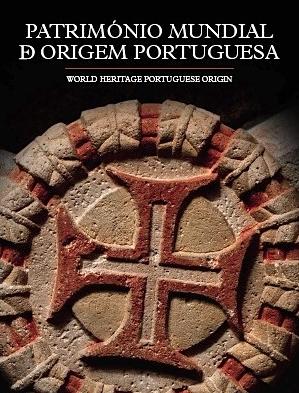
The magnificent bilingual book entitled PATRIMÓNIO MUNDIAL DE ORIGEM PORTUGUESA – WORLD HERITAGE OF PORTUGUESE ORIGIN exemplifies the scope of Portuguese influence all over the planet, and PortuGOAL is offering its site visitors the chance to win it.
Embellished with a stunning compilation of photographs, this work is a veritable treasure trove of Portuguese architecture and heritage, in each case providing a historical account of the arrival and settlement of those dauntless explorers from bygone times in all continents of the planet.
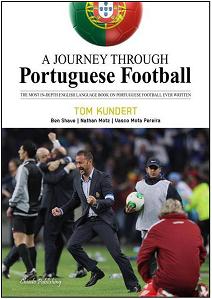
To kick off our Book Corner section of the site, we bring you A Journey Through Portuguese Football, the most in-depth English-language book ever written on Portuguese football, penned by members of the PortuGOAL.net team and some very special guest authors.
For a detailed description of the book, the introduction is reproduced below.
Answer the question at the bottom of the page to be in with a chance of winning the book. We are giving away three copies to the competition winners.
How could Portugal make amends for past mistakes and look to the first World Cup played in December as a unique opportunity to take home their first world crown?
The performance at the Euros in 2021 – the competition was postponed because of the COVID-19 pandemic – had been demoralising. Cristiano Ronaldo’s club football career was backtracking fast, first at Juventus and then by returning to Old Trafford. A lot of squad players were now part of some of Europe’s best sides, but they never seemed to find the best way to coexist within the national camp.
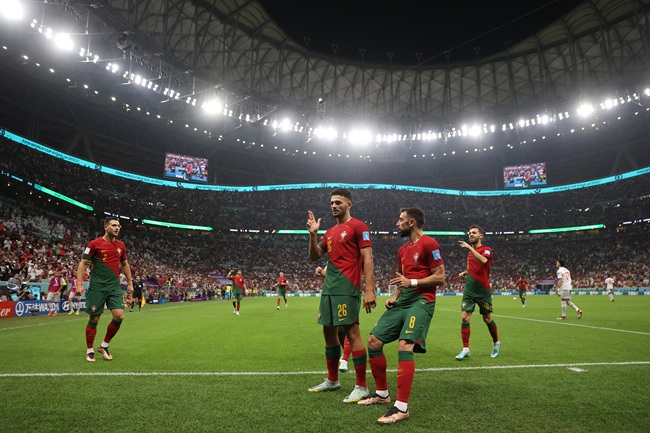
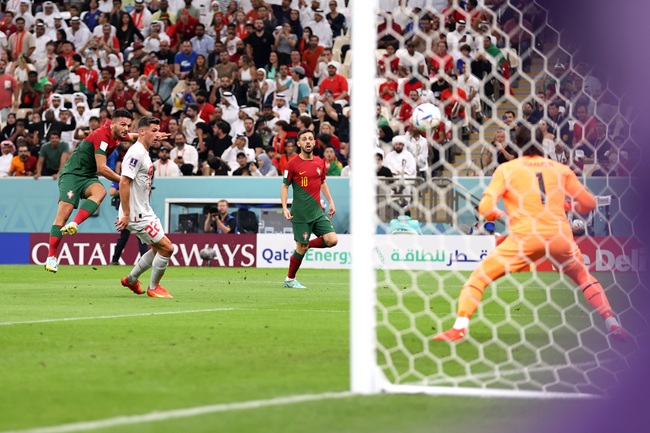
Gonçalo Ramos celebrates after scoring against Switzerland at the 2022 World Cup. (Photo: Michael Steele/Getty Images)
Come the last sixteen tie against Switzerland, for almost two hours, it seemed they had finally found their soul just in time to put a claim for the throne. Only to be a glimpse quickly lost in the following round.
***
Portugal arrived at Qatar as one of the strongest sides and at the same time one of the most indecisive squads in the competition. After the Russia debacle, the 2019 triumph in the inaugural Nations League tournament, played at home, brought back a sense of positivity. It was Portugal’s second trophy win in three years, and many started to expect more from them in the years to come. The likes of Bernardo Silva, Rúben Dias and Bruno Fernandes were approaching the peak of their club careers, while promising young players such as João Cancelo, Rúben Neves, Rafael Leão and Diogo Jota were making a name for themselves.
Ronaldo was still there, as was Pepe, the stalwarts of the previous generation, even if it became clear that they were past their peak. Still, Fernando Santos felt unsure about dropping either. Pepe, because Portugal didn’t have a decent centre-back partner for Rúben Dias, now of Manchester City. Ronaldo, because he was the greatest football icon in the world, a player bigger than his home nation, and who was still scoring for fun in Italy despite his physical limitations, forcing him to change the way he played. To fit Ronaldo into a more coherent attacking side became Santos’ biggest nightmare, but the lack of a world-class number nine, after the promising career of André Silva went sideways due to persistent injuries, helped.
Question marks after poor Euro and stumbling World Cup qualification
Still, the 2020 European Championship was a shambles, Portugal played poorly in the group stage, qualified miraculously, and then were out in the first knockout round against a poor Belgium side. Some started to doubt whether Ronaldo should keep on playing. It became clear that Bernardo Silva and Bruno Fernandes often stepped over each other on the pitch, and by playing the three of them Portugal usually lacked width. All those warning signs became clear during the qualifying stage for the 2022 World Cup. Away draws in Belgrade and Dublin hurt, but it was the home defeat against the Serbians, despite a first-minute goal by Renato Sanches, himself a player who after the 2016 Euros saw his career go downhill due to injuries and poor decisions.
Portugal finished second in their qualifying group, and had to battle past Turkey and North Macedonia to book their place in Qatar. They were no longer seen as such a formidable side as they probably should have been. They were still seeded, though, and that helped them have a seemingly favourable draw, albeit having to face teams they did not have great memories of playing against. Uruguay, who had beaten them in 2018; Ghana, whom they faced in 2014 when they got knocked out in the group stage; and South Korea, responsible for their demise in 2002. The omens weren’t particularly good.
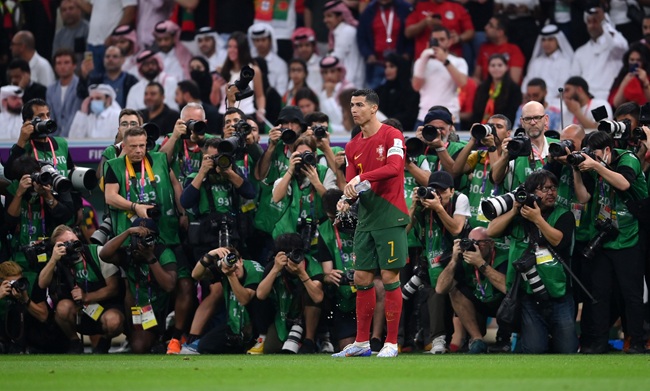
As had been the norm for years, Ronaldo’s every move at the Qatar World Cup was scrutinised by the world’s media. (Photo by Laurence Griffiths/Getty Images)
Before travelling to the Middle East, rumours started to spread about the possibility of Fernando Santos finishing his tenure after the tournament. It was widely believed that the likes of Pepe and even Cristiano Ronaldo would follow. The Portuguese superstar actually arrived at Qatar without a football club, having been released by Manchester United once his relationship with Dutch manager Teen Haag collapsed. Ronaldo went on strike, expecting the club to support him, and was surprised to see the board backing the manager. Still, he was leading the side as Santos decided to bring also Rui Patrício, Pepe, Raphael Guerreiro and William Carvalho as the sole survivors of the 2016 Euro winning squad.
Only six years had passed by, but the changing of the guard was clear. With the possibility of calling up 26 players due to COVID-19 restrictions, the names called by Santos included goalkeepers José Sá and Diogo Costa, defenders António Silva, Nuno Mendes, João Cancelo, Danilo Pereira, Diogo Dalot and Rúben Dias, as well as midfielders João Palhinha, Bruno Fernandes, Bernardo Silva, Vitinha, Rúben Neves, Matheus Nunes and Otávio. Alongside Ronaldo in the attacking line there was room for André Silva, Gonçalo Ramos, João Felix, Rafael Leão and Ricardo Horta. It was, undoubtedly, the most talented squad Portugal had ever taken to a World Cup finals, but there were doubts if talent would suffice.
Portugal open with edgy win over Ghana and Uruguay victory
As Uruguay drew against South Korea, Portugal’s win against Ghana proved decisive. Ronaldo scored from a penalty kick well into the second half, and João Felix netted a second before André Ayew got one back for the Ghanaians. Rafael Leão was brought on for Rúben Neves and scored a third, and Bukari benefited from a rare Diogo Costa mistake to make it 3-2 in the end. It was a precious win, but there were signs of defensive frailty with Danilo Pereira playing alongside Rúben Dias and Cancelo and Guerreiro operating from the wings.
Ronaldo’s goal meant he became the first player to score in five different World Cups, another record to add to his long list, but once again it became clear he was out of shape, after failing Manchester United’s pre-season due to his row with Teen Haag. Against Uruguay, Portugal played a more clinical game and won 2-0, with Bruno Fernandes scoring twice. His second goal came from the spot, as Ronaldo had already been subbed for the second time, a novelty in his career. Already qualified for the last sixteen, Santos decided to rotate most of the squad for the last match against South Korea, but while many expected Gonçalo Ramos or André Silva to play up front, Ronaldo was once again called up, and rumours started to spread that Santos had been pressured to keep the skipper on due to his World Cup goalscoring record.
Ronaldo played terribly and failed several goal-scoring opportunities. This time, he was subbed on the hour and put on an ugly face as he saw his number on the board, with André Silva coming on in his place. Portugal, who were drawing 1-1, lost after conceding a goal in the final seconds, but all the focus had been put on the fact that Ronaldo and Santos, once so close, seemed more distant than ever.
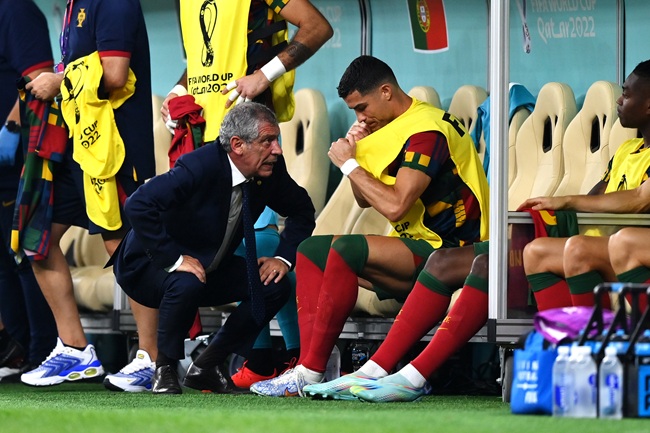
The deteriorating relationship between coach Fernando Santos and captain Cristiano Ronaldo became one of the stories of the Qatar World Cup. (Photo: Justin Setterfield/Getty Images)
Bombshell! Ronaldo is dropped
Knowing they would be playing Switzerland, who had finished second behind Brazil in a group that comprised Cameroon and Serbia, but who had only lost with a late goal by Casemiro, many expected Santos to keep trust in his usual starting eleven. That meant playing Ronaldo up front even if it seemed wiser to have a more dynamic attacking line as the Swiss were known to sit deep. An hour before the match, to be played at the Lusail Arena, news broke that Santos had benched Ronaldo. It was the first time since a match precisely against the Swiss, in the last group game of Euro 2008, that the No7 was starting a competitive match for Portugal at an international tournament on the bench.
Cancelo was also dropped for Diogo Dalot. Gonçalo Ramos, who hadn’t played one minute yet, was drafted in to be the lone striker. He was supported by Bruno Fernandes and João Felix, with Bernardo Silva, Otávio and William playing behind. Dalot played with Guerreiro, Dias and Pepe, now team captain, in front of Diogo Costa.
Swiss unprepared for Ronaldo-less Portugal
Murat Yakin, who had played against Portugal on that night in 2008, called his usual lineup of Yann Sommer, Manuel Akanji, Fabian Schar, Ricardo Rodriguez, Granit Xhaka, Fernandes, Sow, Freuler, Vargas, Embolo and Shaquiri, but he too seemed dismayed by the prospect of facing a different attacking line than expected. It seemed the Helvetic side had a plan to stop Ronaldo, but couldn’t fathom any other option, and it quickly showed.
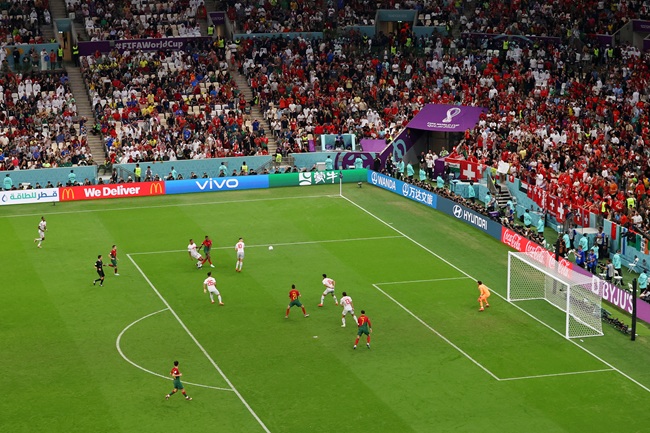
While Switzerland moved in their usual 3-5-2, despite noting Ronaldo’s absence, Portugal remained faithful to their 4-2-3-1. Santos, who was coaching his eighth World Cup match with Portugal, a new record, asked the players to exploit the space between the back three and the wings. For the first fifteen minutes, both sides seemed too respectful of the opponent, but then, in the 17th minute, Portugal scored first. Bernardo Silva had seen Ramos moving well and tried to pass, but the ball went sideways, but a few seconds later it was João Felix who managed to assist the debuting forward. Ramos began an exhibition that would vindicate Santos’s decision more and more by the minute. A thunderous shot that took everyone by surprise fizzed into Sommer’s net at his near post for one of the goals of the tournament.
Portugal kept on pressing and fifteen minutes later came the second, with Pepe taking advantage with a powerful header, from a beautifully measured cross by Bruno Fernandes from a corner kick. The centre-back became the second-oldest player to score in a World Cup, surpassing Roger Milla from Cameroon. At halftime, Portugal looked comfortable, controlling their lead, in the knowledge that the Swiss would have to push forward eventually, meaning more space would become available for the quick transitions powered by Bruno and Bernardo’s through balls.
Gonçalo Ramos smashes in a brilliant snapshot to put Portugal ahead against Switzerland at Lusail Stadium, Qatar. (Photo: Lars Baron/Getty Images)
As Ronaldo prepared to warm up, Ramos started the second half by scoring his second, taking advantage of a beautiful pass by Diogo Dalot, passing his marker and then deflecting the ball past Sommer nonchalantly. Zakaria and Seferovic came on for the Swiss as Murat Yakin desperately tried to stay in the game, only for Raphaël Guerreiro to appear out of nowhere and take advantage of a nice assist from Ramos to score Portugal’s fourth. The forward’s ability to link with the players around him was making it clearer that he offered more to the collective play than Ronaldo, who usually holds on to the ball to try to shoot at any moment.
Minutes later, Akanji scored after a well-placed corner kick by Shaquiri had been deflected by Pepe, once again showing Portugal’s defensive frailties. It wasn’t to be for the Helvetics, though. Ramos finished the night by netting a hat-trick, once again finishing beautifully from a Félix assist. Minutes later, Ronaldo finally came in, looking grim, alongside Ricardo Horta and Vitinha. Ramos, Felix and Otávio came off under thunderous applause.
Leão the smiling assassin
The Portuguese captain still had twenty minutes to add his name to the scoresheet, he who had netted 118 goals in 195 caps, but it wasn’t to be. Rafael Leão, who later came on for Bruno Fernandes, eventually scored the sixth goal for the Seleção with a trademark curled shot and smiling face. Seconds later, the match ended, confirming what was probably the most perfect match by any Portuguese side in a World Cup since the demolition of North Korea in 1966. It was the first time since 2006 that Portugal managed to qualify for the last eight. Funnily enough, they did so with Ronaldo as substitute, he who had played in the 2006 Nuremberg Battle against the Dutch, but during his football prime career was never able to guide his teammates as far as the last sixteen.
It seemed ironic if it wasn’t for the paranoia that quickly spread in the Portuguese camp. In the hours following the match, the country seemed divided. On one hand, Ronaldo’s family, journalists who were close to him, and some supporters made themselves heard and publicly attacked Santos and his decision, while others, ecstatic after the collective display of the Portuguese, fully supported the manager. At the same time, Messi was guiding Argentina to what was going to be his first win in the tournament, adding rubbing into the wound in Ronaldo’s camp.
Rafael Leão scores Portugal’s sixth goal against Switzerland with a beautiful curling effort. (Photo: Alex Pantling/Getty Images)
It was a bittersweet win. Even Ramos, who became the first player since Thomas Skuravhy in 1990 to score a hat-trick in the knock-out stages, didn’t get the credit he deserved as his place in the starting lineup for the following match against Morocco immediately came under attack. Ronaldo, it was said, would be a better option, and what happened versus Switzerland was a one-off and unlikely to happen again. Santos, however, acknowledging that by sidelining Ronaldo his time with the national side was effectively over, decided to stay true to himself and once again picked Ramos over Ronaldo for the Morocco match in the last eight.
The North Africans had proven themselves to be as competitive as any other side in the tournament, disposing of Spain in the previous round, and took advantage of Portugal’s sole mistake. They also prepared themselves to play against Ramos, not Ronaldo, and knew how to neutralise the offensive threat of the Benfica forward better than the Swiss. When Ronaldo finally came on, he too was unable to tie the match, and Portugal became the victim of the first African nation ever to reach a World Cup semifinal. It was one of the most painful defeats in the history of the Seleção because, for the first time, it seemed possible to actually win the competition as Santos had shown the courage many claimed he didn’t have.
It was the end of the line for him, but not Ronaldo, who was quickly back at the starting lineup under Roberto Martínez, the new national team manager, while Ramos was progressively sidelined once again, despite having earned a high-profile move to PSG months after. Beating the Swiss – only the third time Portugal actually managed to win three matches at a World Cup after 1966 and 2006 – showed how good Portugal could actually be if they played as a collective unit, while the display against Morocco showed they needed more than just that. And that is a doubt that remains whenever Portugal kicks off another international competition. The 2026 World Cup is around the corner, and once again, people will be waiting to see which version of the Seleção will unfold.
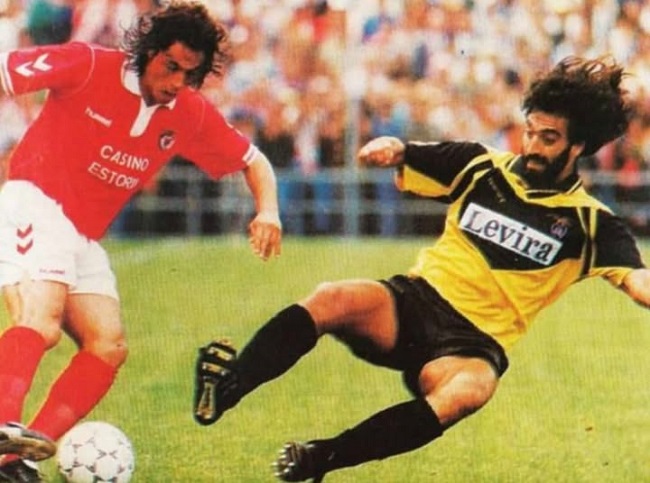
No nonsense! Beira-Mar centre-back Dinis Resende flies into a tackle against Benfica’s Paulo Sousa in the 1992/93 season. Beira Mar would win the match at their mythical Estádio Mário Duarte 1-0
1999 was a year of mixed feelings for the people of Aveiro. Yes, they celebrated the local club’s first major silverware as Beira-Mar came out on top against Campomaiorense to claim the Portuguese Cup in a surprise final at Jamor, but they had also been relegated to Division Two weeks earlier.
A decade earlier, however, football was finally starting to reconnect with one of the country’s most often forgotten districts at a moment when Aveiro itself was beginning to climb from oblivion, taking the right steps to become what it is today: one of the most vibrant and modern mid-sized cities in the country.
During those years, the yellow and black colours of Beira-Mar put the city on the map once again, not only by returning to the first division after years of absence but also by playing in their first-ever cup final. That memorable football shirt became forever intertwined with those golden years of the Alvinegros as well as part of the popular culture of the 1990s.
***
Despite having been founded in the early 1920s and having counted briefly with Eusébio in their ranks in the mid-1970s, few events had made Sport Club Beira-Mar a memorable force in Portuguese football. They weren’t the first club from their district to be promoted to the top tier, and for some time they weren’t even the best side in a region that also included the likes of Sporting Espinho, Feirense, Oliveirense, Águeda, Ovarense and Sanjoanense, to name but a few. Their first spell in the top tier was short, between 1971 and 1974, as the club plunged back into the second division for more than a decade, as football was developing fast not only in the Aveiro district but mainly north of the River Douro.
By 1988, however, things started to change. Aveiro’s university became more popular during the decade as new educational centres developed outside of the Lisbon-Coimbra-Porto axis, and the city’s economy, fuelled mainly by the canned food industry, was benefiting from Portugal’s recent inclusion in the common market of the EEC.
Establishing their top-tier status
By the 1987/88 campaign, Beira-Mar got promoted back to the first division with a side coached by the Belgian Jean Thissen, who had Victor Urbano as his assistant. They finished second in the central division, below Académico de Viseu and four points clear of Torreense and União de Leiria, after years of failure. On their first season back at the top, Beira-Mar finished a creditable 15th, a point clear of the relegation zone, in a season when five sides were relegated to restore an 18-team league.
In 1989/90, things improved drastically, particularly when Victor Urbano was promoted to first team coach, guiding the Alvinegros to a comfortable 11th place in the league table. The side added Egyptian international Abdel Al Ghany to their ranks and the former club legend António Sousa, who had just been let go by FC Porto. Alongside centre-backs Dinis and Petar Petrov, former Sporting international Mário Jorge, the veteran Paquito Saura and striker Penteado, it looked like a fine side, expected to drive through the 1990/91 season unharmed. That would also be the season when Beira-Mar decided to switch shirt sponsors.
Based near Aveiro, Levira took its name from one of the tributaries that flowed into the River Vouga, which feeds Aveiro lagoon before swimming into the Atlantic. It was a small, local company, and as with everything regarding Portuguese football at the time, stitched together the bond between the local club, the local fandom and the booming local commercial enterprises. There was still no room for globalisation in the Portuguese game.
Keeping it local
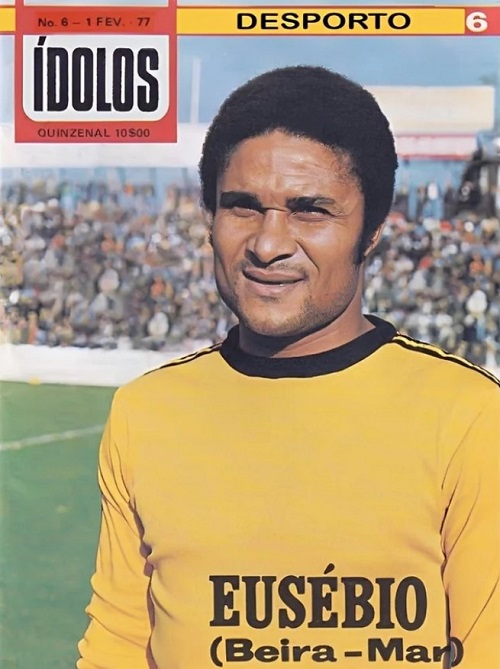
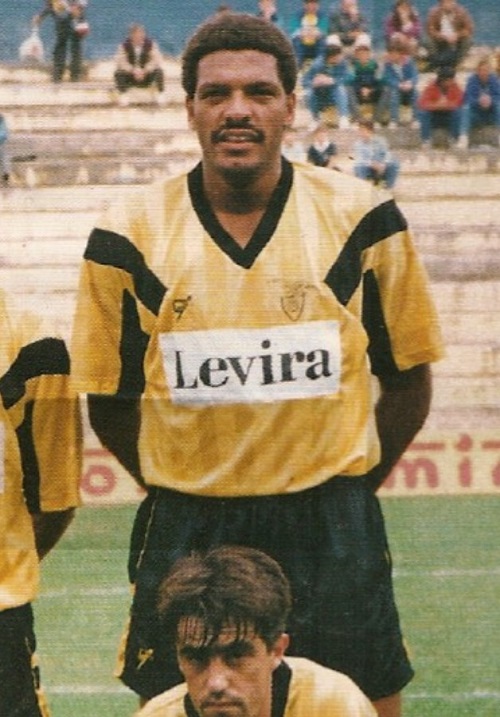
The club had been previously sponsored by a butcher’s, Talhos Campos, and now embraced a more industrial blueprint. A locally based company New Sports provided the manufactured kits and shorts, with black gaining more relevance on the shirt than it used to for the 1990/91 season. Until then, only the collar was black as Beira-Mar shirts were almost exclusively yellow (see the Eusébio picture above) but the brand made a small adjustment by adding two thick diagonal black stripes of black from the shoulders to the armpit, to bring a sense of modernity at a time when the biggest names in the market, namely Adidas, Puma, Umbro and Hummel were starting to experiment with new designs and templates. Beira-Mar couldn’t afford a deal with any of those world-class brands, but they could feel like they were part of a new wave by embracing a more modern football shirt style.
Levira, the sponsor, was placed at the centre, in all-black as the collar and trims were also painted black, as were the shorts, while socks remained yellow and black as was historically traditional. The shirt’s polyester design also meant there were two shades of yellow stripes to lend it a sense of movement, and for some occasions the sponsor’s name was printed with a white background, instead of the customary black letters. The alternative kit remained all-white, as it had been the season before, but it was used only once, when the team travelled to Funchal to meet União da Madeira.
The season soon became the most memorable one in the club’s history, with the forward Dino brought from Nacional now added to the attacking line alongside Jorge Silvério, who became the side’s top scorer. Urbano often played Hélder in goal, with Dinis, Redondo, China and Oliveira at the back, Sousa and Abdel Ghany in creative roles, with José Ribeiro providing support and Silverio, Dino and Tozé Ribeiro giving offensive prowess. Despite starting the season with four consecutive draws, Beira-Mar soon found their form and ended the campaign sixth in the standings, their best result ever.
European football missed by a whisker
Only a defeat against Benfica on the last day of the season prevented them from finishing one place higher in the league table which would have meant qualification for the UEFA Cup. They would have played Zinedine Zidane’s Cannes at the Estádio Mário Duarte but instead the French team went to the Bessa to meet Salgueiros.
However, better than the sixth-place finish was Beira-Mar managing to surprise everyone by making it to the Portuguese Cup final for the first time in their history. They did so by beating Fafe, União da Madeira, Estrela da Amadora, Ovarense and Boavista in the semis before facing FC Porto in the Jamor final. It was the highlight of a memorable campaign, even if the side finished on the losing side after taking the Dragons to extra time, thus missing the possibility of enjoying European football for the second time in a fortnight.
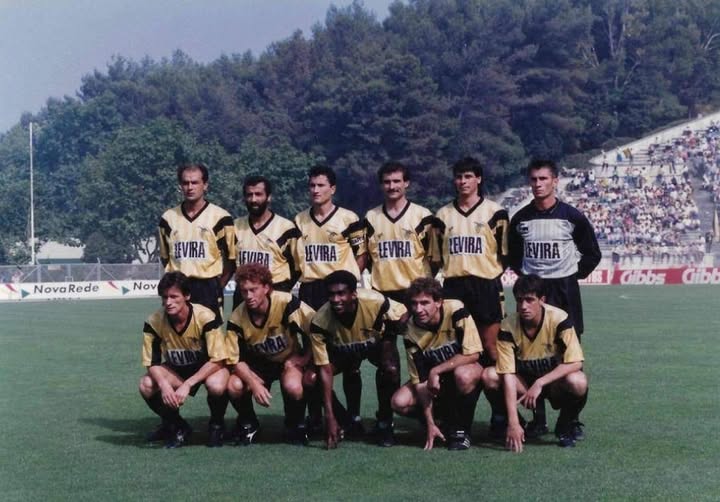
The Beira-Mar team photo at Jamor ahead of the 1991 Portuguese Cup final. Porto won 3-1 after extra time.
For the 1991/92 campaign, New Sport decided to keep the same kit template as the club renewed sponsorship with Levira. The season wasn’t as brilliant as the one before, but Beira-Mar finished 8th, sustaining the good sensations from the previous campaign. For the 1991/92 season the sponsorship of Levira was enhanced with the company name appearing mainly with a white background to become more visible.
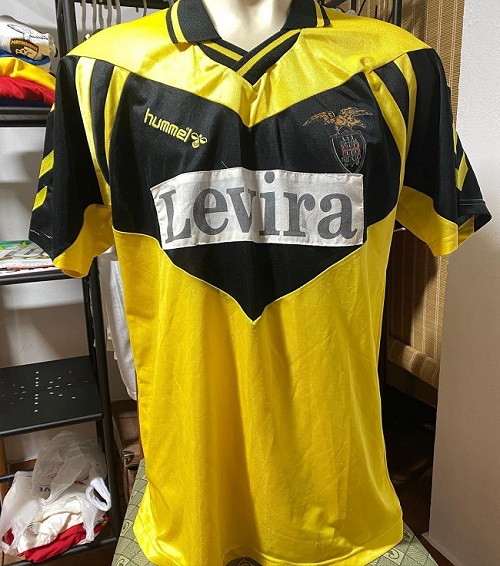
By 1992, the sustained success of the previous campaigns led the club to finally sign with a high-profile sports manufacturer. New Sport was gone and Hummel came into the picture and they would provide the club’s kits for the following three campaigns, before moving briefly to Olympic and then Umbro for the end of the decade until they moved to the smaller MPH who manufactured the famous 1998/99 kit that supporters still revere due to the Portuguese Cup win at the end of that season.
Beira-Mar’s sustained success on the pitch led to a deal with major kit manufacturer Hummel in 1992 (Image:footballkitarchive.com)
New Sport disappeared from the football market in the mid-1990s, and the club also replaced the popular Levira sponsorship with Vulcano. Beira-Mar were a regular top-tier side in the 1990s, making both the Mário Duarte ground and the Black and Yellow club shirts part of the popular culture. The city itself started to attract more attention up to the point that the “Portuguese Venice” tag began to be used more often, helping transform Aveiro into one of the most popular tourism destinations in the land over the following decade.
Beira-Mar’s future was darker than anyone could have imagined back then. The club has spent the past decade in the lower leagues after being relegated due to financial issues. They haven’t been able to step up since, performing nowadays in the local district league, a grim situation for a side that played two Cup finals, winning one of them. The Aveiro district is today represented at the highest level by the small town of Arouca, and in the second tier by the likes of Feirense and Oliveirense.
With their iconic stadium long gone, memories of those glorious afternoons still live in the memory of locals. Many expect that someday that iconic yellow and black shirt will once again find its way among the elite of Portuguese football as it did during those halcyon days in the early nineties.
Portimonense host Farense tomorrow in a red-hot Algarve derby with both teams fighting to stay in Division Two. The two sides have seen happier days...
The Carnation Revolution was felt in every single aspect of Portuguese society. Not at the same time, not at the same pace, but quietly, Portugal started to feel like a different, more modern country.
Part of that change came hand in hand with a slow, incomplete, but essential decentralisation process that football represented perhaps better than any other popular activity. For decades, the main bulk of the football league clubs had come from the greater Lisbon area, including the Setúbal district, the economic pillar of the fascist regime. A scarce nationwide presence of other sides explained why the country was not comfortable with itself once it lost sight of the walls of the capital.
April 1974 changed all that. The economy in other regions boomed, released from the shackles of the corporativist economic model preferred by António Salazar and his successor Marcelo Caetano, and in turn helped regional football clubs make a name for themselves. It was a slow-paced change that spread across the land over the following decade. By the mid-1980s, the regions of Madeira, Trás-os-Montes, Minho and the inland districts of the Beiras had found their voice in the football league. One of the greatest symbols of this new era was the fact the Algarve derby was finally played among the big fish in Portuguese football’s top division.
A big crowd attended the Algarve derby played a couple of days before Christmas Day, 1984
***
Algarve’s impoverished past
Portimonense and Farense have become the two big names of a region that always felt at odds with the rest of Portuguese society. For centuries, the Algarve was so isolated that it was easier for locals to reach Seville, far across the Spanish Andalusian border, than Lisbon. Dependent on fishing, the relationship with those who lived there – and they were not many – was closer to the northern Moroccan villages or the Spanish pueblos on the other side of the border. It was a social dynamic that changed the way they talked, the way they behaved and the way they managed to stay alive, fighting for crumbs.
Football clubs suffered as much as anyone else. Despite the early popularity of the game – in Spain, it had been established just across the border in Huelva, so from an early period football was played in the Algarve as well – no football club was ever able to thrive. Olhanense, the region’s third big club, even managed to claim the Campeonato de Portugal in the late 1920s, making them winners of a cup format competition that is viewed as the predecessor of the Primeira Liga or the Portuguese Cup, depending on who you are talking to. It was Algarve’s football finest hour, but not only was it forgotten by everyone else in the land, but also in the region itself, and soon enough Olhanense fell into almost oblivion.
Same colours, intense rivalry
Only Sporting Clube Farense, a club founded by a group of teenagers who so admired Sporting CP that they decided to go with their name and colours, only to mistake the green and white half of the shirt for black and white, as the published photos were not yet in colour in the 1920s. Portimonense Sport Club, who also decided to go with the black and white as their primary colours, presented some sense of the football potential of the region.
Their rivalry was deeply felt by the 1930s, and they were regular contestants of the Portuguese second and third divisions from the 1940s onwards. Backed by the canned fish industry developed in the area, Portimonense were almost promoted in 1949 to the first tier but the political influence of a cabinet minister of Salazar’s, Fernando Andrade Pires de Lima, who had a fancy for Académica, forced a tie at a neutral ground after the team from the Algarve came on top in the promotion play-off. The Coimbra club won out. It was the closest Portimonense ever came to playing in the first division during the fascist years.
A motorway and tourism transform Algarve
Farense only got there in 1971, despite having tried for several seasons, also fuelled by the local economy focused on the canning industry. It was a short-lived experience, but it proved that the Algarve was starting to be heard, and it wasn’t only in footballing terms. The motorway connecting Lisbon to Portugal’s southern coast to provide access to the summer pleasures of the region was a reality by then, and soon enough, a tourism boom completely changed the lives of the Algarvians. It became the primary holiday destination for Lisbon’s upper classes, and after the April Revolution, it was also adopted by the emergent middle classes who were ready to make an almost fifteen-hour drive from north to south to enjoy its paradisiacal beaches.
By the 1980s, visitors from abroad, particularly from the United Kingdom, Germany and the Netherlands, who had already travelled the length and breadth of the Spanish coastline, also found in the Algarve the perfect holiday destination. A poor region still, but one that had now found a new fountain of riches and eventually that money followed the sporting path. By the early 1980s, for the first time, the Algarve had two sides competing in the first division. It was during the 1983/84 campaign, and both duels ended in a draw. Neither team was relegated, so the Algarve readied itself for another season in the top flight and another derby that sparked the attention of the region’s football community. What few expected is that the game would mean so much come the end of the season.
Exceeding expectations
On 23 December 1984, two days before Christmas, there was still some sun peeking out of the clouds that swept across Portimão, as buses from Faro started to arrive in town, bringing the Farense supporters for a heated duel. The two regional giants were preparing to face off once again, but few had expected, at the beginning of the campaign, that things would be going so well for both, particularly for Portimonense.
Halfway through the season, to the surprise of many, Portimonense were flying high in the standings and Farense were also in the top half of the table
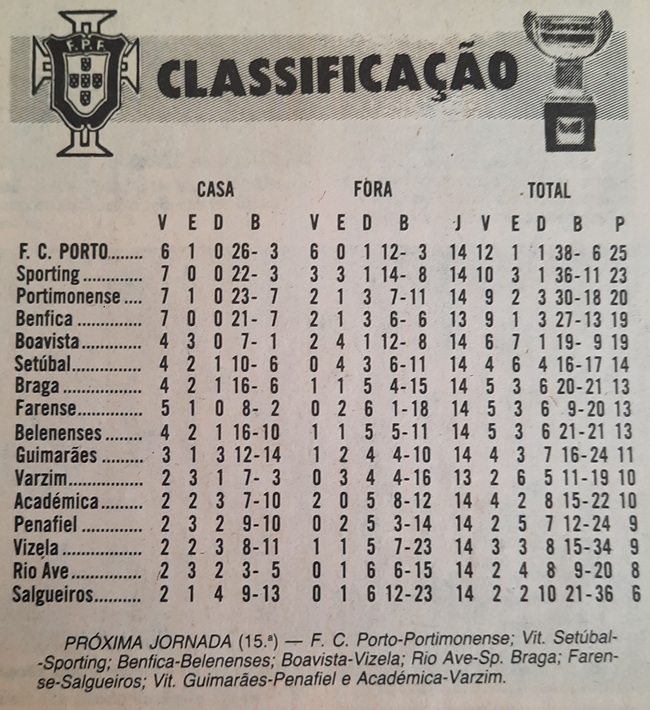
While Farense sat comfortably in mid-table, having accumulated 13 points in 13 matches played – five above the drop-zone where Rio Ave sat – Portimonense had found themselves as close to a title run as they ever had been. The side was fourth in the league table, with 18 points, just three fewer than reigning champions Benfica and five below Artur Jorge’s FC Porto, who sat at the top of the table. Moreover, the five-point gap to Braga, in sixth, meant Portimonense were at least well placed for a UEFA Cup slot in the following season, something few had ever expected to happen for a club from the Algarve.
Manuel José bursts onto the scene
Everything had to do with the coaching genius of Manuel José, one of Portugal’s most influential football managers and the greatest icon of football in the Algarve. Born in Vila Real de Santo António, right alongside the River Guadiana border with Spain, Manuel José enjoyed a playing career that took him to Benfica as a youth graduate and then across the full geography of Portuguese football in the seventies, playing for the likes of Farense, União de Tomar, Beira-Mar and Sporting Espinho. It was there, by the Atlantic, that his career as player-manager kick-started in 1978, and after a brief spell in Guimarães, where he succeeded José Maria Pedroto, José moved back to his favoured Algarve to take charge of Portimonense.
There, he assembled a memorable side that included mostly local players. Despite all the commodities and new highways, most players still preferred to be paid less and remain near Lisbon or Porto instead of travelling south to an almost isolated piece of land. José had in the likes of Alinho, Bernardino Pedroto, Teixeirinha, the former Porto veteran Simões, Abreu, Carvalho, Vítor Oliveira (future manager of many first division sides) the brothers João and Luis Reina and the young Rui Águas, son of the former Benfica legend José Águas, players who were talented enough to punch above their weight.
Belgian and Catalan stars
The star of the side was a Belgian, though, Serge Cadorin, a former Liege man who moved to Portugal in 1983, where he spent the rest of the decade, scoring almost fifty goals in a hundred matches played for Portimonense and Académica. Portimonense had only lost two matches, against Boavista and Benfica, and had held Sporting to a draw at home.
They were heavy favourites to win, but Farense also had some decent arguments to their name. Their season didn’t look as fantastic as their neighbours, but under Fernando Mendes, a veteran Sporting icon, with Manuel Cajuda serving has deputy, the Faro Lions could claim in their ranks players such as Teixeira, Hernani, Carraça, Amaral, Rui Lopes, Bukovac, and above all the Catalan Paco Fortes, a former Barcelona player who ended up in the Algarve in the later stages of his career and would become the club’s greatest football icon. It was expected to be a tight affair and ended up turning into a football classic of the era.
Portimonense entered the pitch sporting their best eleven in their usual kit, with Cardorin partnering his fellow Belgian Alain Thiriart, playing in front of a midfield four of Reina, Pedroto, Skoda and Carvalho. Mendes was in goal, and Teixeirinha, Simões, Balacó and Dinis completed the defensive line. Fernando Mendes didn’t have Fortes available due to injury, so he called up the veteran goalkeeper Amaral, alongside Miguel Quaresma, Quim, Leonardo, the Bulgarian international Bukovac, accompanied by Hernani, Carraça, Martins, Borges, Gil and Rui Lopes up front. They dressed in all white.
Packed house
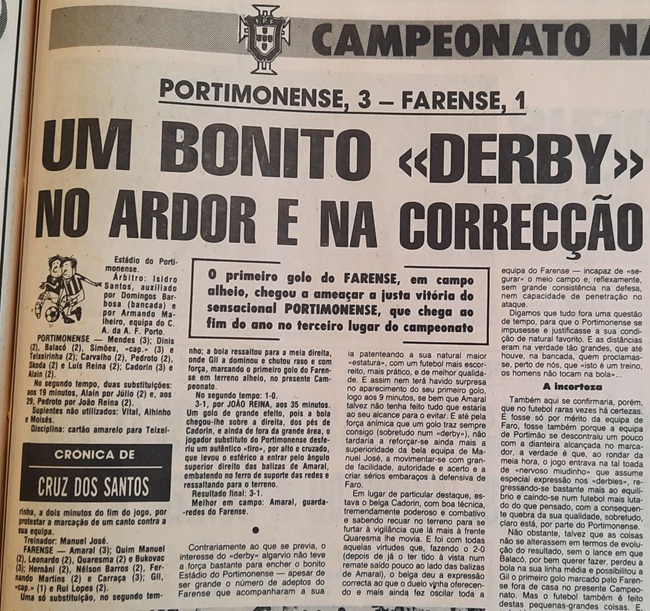
The match report in A Bola was full of praise for both sides and the spectacle they put on
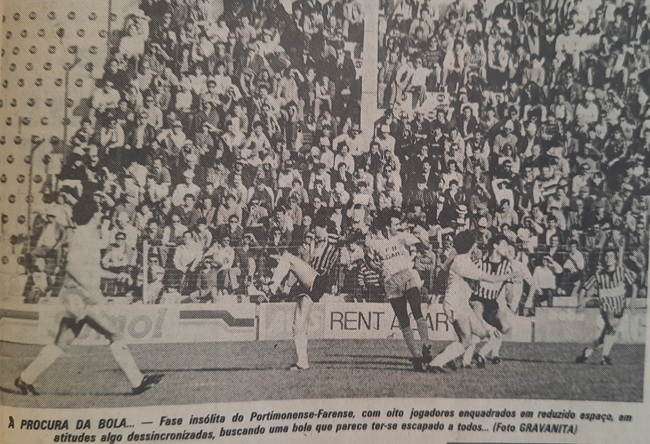
The stadium was packed as it always had been during the heated derbies played while both sides were in the second tier, and the home crowd began to celebrate early as Luis Reina, a local fan favourite, opened the score on the 9th minute with a beautiful strike. Portimonense were clearly motivated by the home support and their positive run of results, and they quickly pressed for a second. It came at the 26th minute. A neat combination between Reina and Cadorin played in the Belgian with the whole goal to aim at in front of a hapless Amaral.
While it looked like a one-sided affair, it was far from it. Farense began fighting back, showing pace and grit where they lacked talent, and they began to create chance after chance until Gil, their slim Brazilian forward, put the ball past Mendes to get one back just before the break. Game on!
In the second half, Farense had the better opportunities as they battled to grab a precious away draw. Manuel José’s boys, on the other hand, felt comfortable on the ball and controlling the rhythm of play, while occasionally causing some scares in the visitors’ defensive line. On the hour, both managers decided to make changes. Fernando Mendes switched Bukovac for Rogério to put an extra man in attack, while José answered by bringing on Julio for Thiriat to gain more presence in the middle of the park.
Tidings of Christmas joy
The match was tight, and when João Reina, the centre-back and Luis’ brother came on, it seemed that Portimonense were preparing to hold on for a final assault, but it was he who headed in a third and decisive goal from a set piece with ten minutes to play. By then, the home crowd had already started to believe the win was theirs, and their Christmas supper would have some extra cheer to it. Chants of Merry Christmas started to erupt from the stands as the players prepared for the final moments.
Farense still had a couple of chances to their name but were unable to make good on them and ended up accepting the defeat as a natural consequence of Portimonense’s brilliant first half of the season.
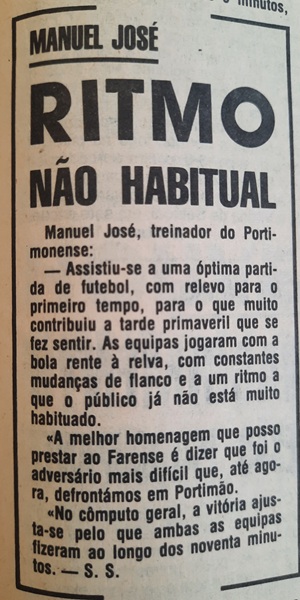
Manuel José was a happy coach at full time, saying: “We witnessed a great game of football, especially in the first half, which was helped by the springlike afternoon. The teams played with the ball on the ground, with constant switching of flanks and at a pace that the public are not very used too.
“The best tribute I pay to Farense is to say they were the opponents who gave us our toughest game, so far, here in Portimão.”
“I general, the victory is fair given what both teams did over the ninety minutes.”
Home fortress
A 4-1 away thrashing in Porto at Estádio das Antas brought Manuel José’s players back down to earth, but at the halfway point of the campaign, Portimonense still sat fifth, with the same number of points as Boavista. While many expected them to drop more points in the second half of the season, particularly after a surprising defeat against relegation battling Salgueiros, they remained highly competitive, losing against Sporting and Belenenses away but drawing at Estádio da Luz.
Come the final round, they were still fighting for fourth position in the league table, but an already championship-winning Porto side came to Portimão and won, guaranteeing Boavista would finish the season a step above the side from the Algarve. It was Portimonense’s only home defeat of the entire season, but as they celebrated, further down the coastline, tears were being shed at Faro.
Last day heartbreak for Farense
Farense, who had seemed so comfortable for most of the campaign, got themselves into trouble after a poor series of results. A home draw against Portimonense in the penultimate match of the season meant they had to win on the last day away at Salgueiros’ mythical Vidal Pinheiro ground in what effectively was a final to avoid relegation. The Porto side had 21 points, one fewer than Farense, but a draw may not be enough if Rio Ave managed to win their game as well. It was a tense last day. António Carraça’s goal seemed to have guaranteed Farense another season at the top. Alas, a late comeback powered by the famed Alma Salgueirista resulted in a 3-1 defeat and meant Farense dropped below both Rio Ave and Salgueiros.
The result of that afternoon game just before Christmas in Portimão hurt them in the end more than they could have fathomed. A draw that day would have been enough to guarantee a place in the top flight, but a loss in an Algarve derby played in the first division for the first time also sealed their fate.
Moving in different directions
Portimonense managed to qualify for the following campaign’s UEFA Cup, but with Manuel José moving to coach Sporting, their destiny was soon marred, and they would become a second-tier side by the end of the decade, taking more than twenty years to rise up again.
Paco Fortes is a club legend at Farense, the Catalan spending 15 years as a player and manager at the Algarve club
Farense, on the other hand, ended the decade playing the Portuguese Cup final – the first and only time a club from the Algarve managed such a feat – and then turned into one of the most popular first division sides in the following decade. They would eventually follow in Portimonense’s footsteps by qualifying for European football under Paco Fortes, appointed club manager after his playing career ended.
The democratisation of football
Although two sides from the Algarve would meet at the top of the football pyramid in future years, the 1980s was the decade in which the region was finally fully accepted into the dynamics of Portuguese football.
As with Madeira, who by the end of the 1980s had three sides playing in the first division, the heartfelt story of GD Chaves from Trás-os-Montes, the tenure of Sporting Covilhã in the top flight and the popularity of sides from the centre region of Leiria, Santarém, Coimbra and Aveiro, that was the decade that Portuguese football truly became a national sport, paving the way for a new era away from the centralised constraints and shackles of the past.